A metamaterial gets its properties from its structure rather than its chemistry. By arranging elements smaller than the wavelength of the wave passing through, it is possible to build materials that behave in ways no natural substance does, including bending light the wrong way.
A wave passing through a material does not resolve individual atoms; it responds to their average effect. The same is true of a wave passing through an engineered array whose features are much smaller than its wavelength. Build such an array, and the effective properties can be chosen rather than inherited.
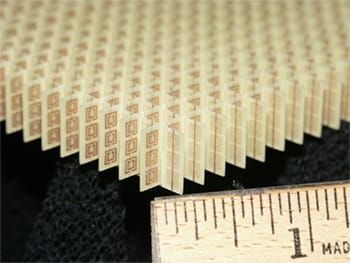
The most striking result is negative refraction. Every natural material bends light toward one side of the normal; a negative-index material bends it the other way. Victor Veselago worked out the consequences theoretically in 1968, and nothing was built until John Pendry proposed practical structures around 2000 and David Smith's group demonstrated one for microwaves in 2001.
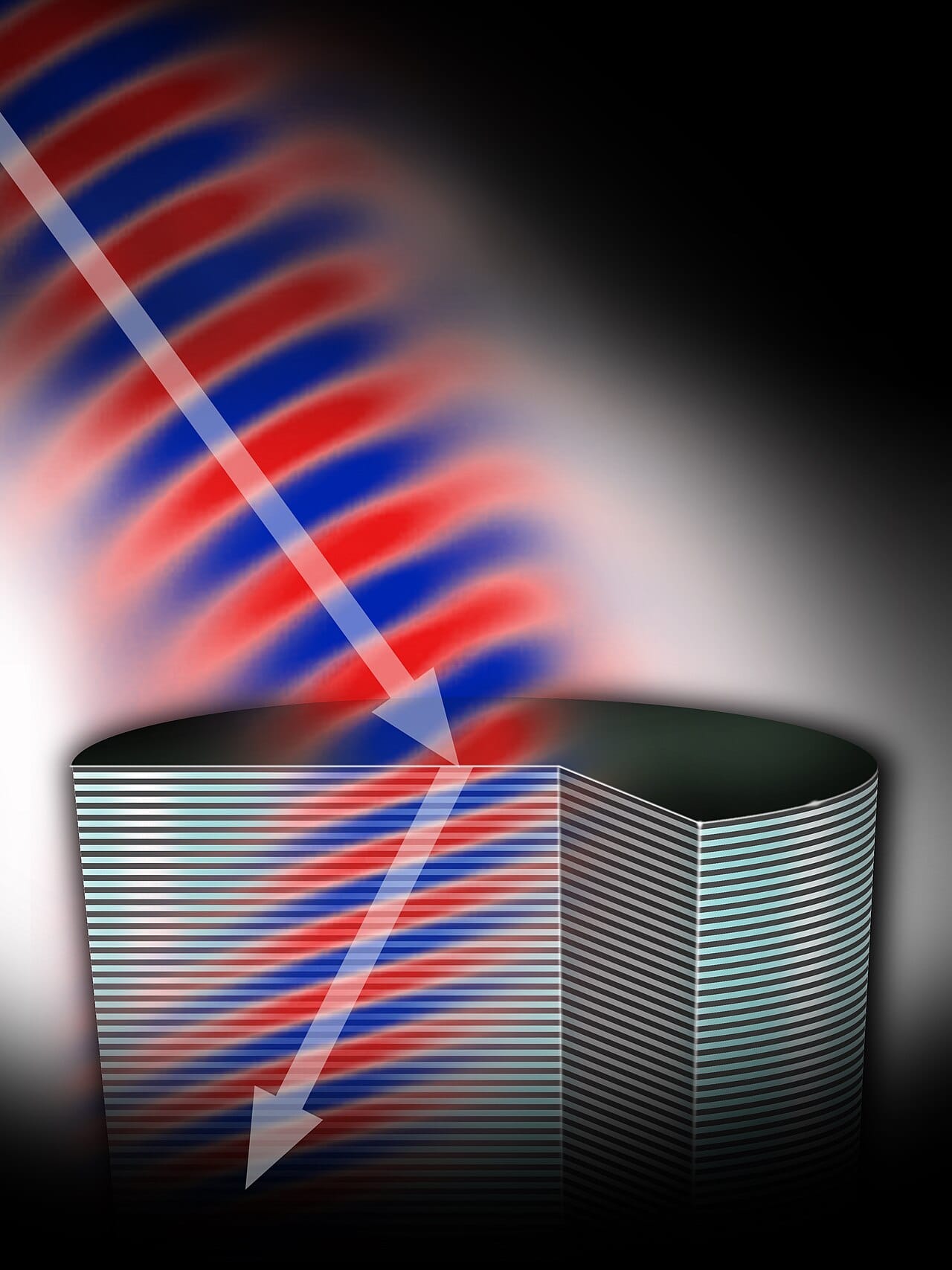
Superlenses: conventional lenses cannot resolve detail finer than roughly half the wavelength, because the information is carried by waves that decay before reaching the image. A negative-index material can amplify those waves, and sub-wavelength imaging has been demonstrated, though over very short distances.
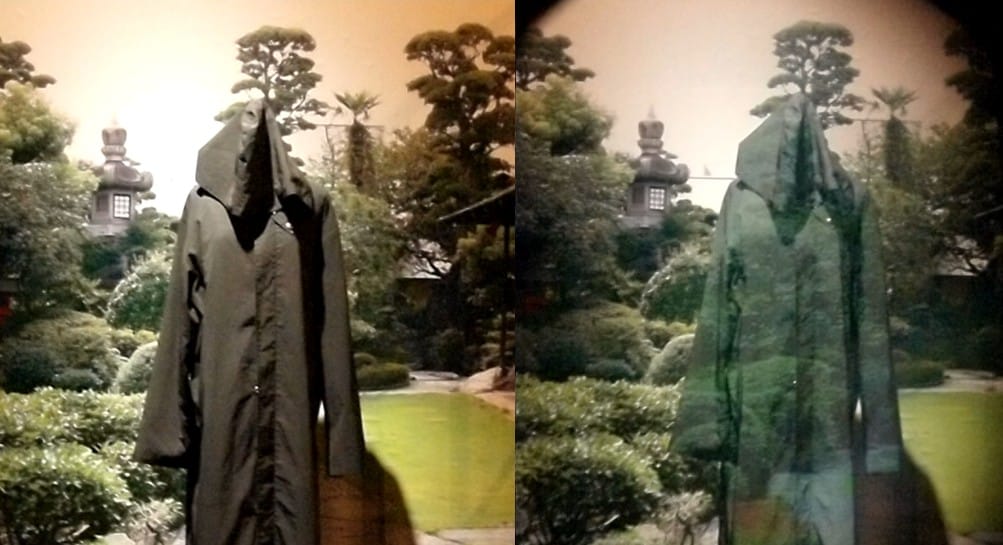
Transformation optics and cloaking: Pendry showed that guiding light around a region rather than through it would make it invisible. Working cloaks have been built for microwaves and for other wave types, and acoustic and seismic metamaterials that steer sound or ground vibration around a protected area have been demonstrated at useful scales.
Acoustic and mechanical metamaterials are arguably further along than optical ones, including panels that block sound while remaining open to airflow, and structures with a negative Poisson ratio, which thicken rather than thin when stretched.
Popular coverage of metamaterials is dominated by invisibility cloaks, and the gap between that coverage and what has been achieved is wide.
The demonstrated cloaks are narrowband, working over a small range of frequencies rather than the whole visible spectrum, and usually work for one polarisation and one direction. Optical wavelengths require features of tens of nanometres, which is manufacturable only over small areas. Losses are substantial, since the resonant structures absorb energy, and a cloak that darkens what it hides is not much of a cloak. And there is a theoretical constraint rather than merely an engineering one: broadband cloaking of a large object runs into limits imposed by causality, because the light going around must arrive no later than light going straight through, which would require it to travel faster than light in vacuum.
The genuine near-term value is less cinematic and more useful: compact flat lenses for phone cameras and imaging systems, antennas smaller than conventional physics would allow, radar-absorbing surfaces, acoustic panels, seismic protection, and improved wireless components. Several of these are already commercial. As with graphene, the field's substance is being delivered on an ordinary engineering timeline while public attention remains attached to the most spectacular possible application.