An attempt to make gravity quantum by quantising spacetime itself, producing a picture in which space is granular and area and volume come in discrete units. It is the main alternative to string theory, it makes a genuinely radical claim, and after forty years it has no experimental support.
General relativity describes gravity as the curvature of spacetime and works superbly at large scales. Quantum mechanics describes everything else and works superbly at small scales. They are incompatible.
The incompatibility is not stylistic. Applying standard quantum field theory methods to gravity produces infinities that cannot be removed by the usual renormalisation, because gravity's coupling has dimensions that make the theory non-renormalisable. The theory breaks down at the Planck scale, around ten to the minus thirty five metres.
Two regimes require an answer: the interior of black holes, and the first instant of the universe. Both are places where matter is dense enough for quantum effects and gravity to matter simultaneously, and where general relativity predicts singularities, which is a theory announcing its own failure.
Loop quantum gravity, developed from the 1980s by Abhay Ashtekar, Lee Smolin and Carlo Rovelli among others, differs from string theory in a specific way that is worth stating.
String theory places new objects, strings, on a background spacetime. Loop quantum gravity has no background: it quantises spacetime itself, taking general relativity's insight that geometry is dynamical and applying quantum rules directly to the geometry.
The result is that geometry becomes discrete. Area and volume are operators with discrete spectra, so there is a smallest possible non-zero area, of order the Planck length squared, and a smallest volume. Space is not a continuum but a network of finite quanta.
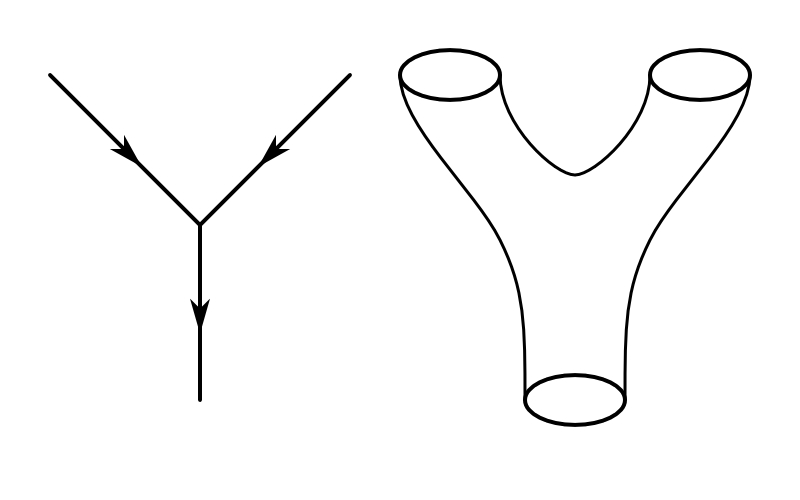
The mathematical objects are spin networks: graphs whose edges carry labels giving areas and whose nodes give volumes. A spin network is a state of the gravitational field, which is to say a state of space. Evolution in time is described by spin foams, which are spin networks swept through a further dimension.
There is no spacetime in which this happens. Spacetime is what the network is.
Black hole entropy is the main internal success. Counting the spin network states crossing a horizon reproduces the Bekenstein-Hawking entropy proportional to area, though the calculation requires fixing a free parameter, the Immirzi parameter, by hand to match the known answer, which critics regard as fitting rather than predicting.
Loop quantum cosmology, applying the framework to the early universe, replaces the Big Bang singularity with a bounce: quantum geometry effects create an effective repulsion at extreme density, so a contracting universe rebounds rather than reaching infinite density. This is a genuine prediction of the framework and it is not testable with current observations.
Singularity resolution inside black holes appears in the same way, with proposals that the interior transitions to an expanding region rather than terminating.
Recovering ordinary spacetime is the hardest one. A theory of discrete quantum geometry must reproduce smooth four-dimensional spacetime and general relativity in the appropriate limit, and demonstrating this rigorously has not been achieved. This is the objection string theorists press hardest and it is fair.
Matter is not naturally included. General relativity plus the standard model must both emerge, and loop quantum gravity quantises geometry without a compelling account of how the particles get there. String theory's claim to unify all forces is a real advantage here.
The dynamics are incompletely defined. The spin foam formulation aims to specify how spin networks evolve, and different proposals exist without agreement on which is correct.
And its relationship to holography is unclear or hostile. Analyses have found that loop quantum gravity's quantisation can violate the holographic entropy bound, which if correct puts it at odds with a principle most of the field takes seriously.
There is no evidence for it, and this is not a criticism specific to loop quantum gravity: there is no evidence for any theory of quantum gravity. The Planck scale is about fifteen orders of magnitude beyond what accelerators reach.
Proposed tests exist and none has produced a result. Discrete spacetime might make light of different energies travel at slightly different speeds, and observations of gamma-ray bursts across cosmological distances have looked for the accumulated delay and found none, which constrains some models. Constraints have been derived from Event Horizon Telescope images of the galactic centre black hole, from gravitational wave observations, and from the cosmic microwave background. All are consistency checks rather than detections.
The bounce would leave signatures in the cosmic microwave background if the effects were large enough. They are not, on current models.
Loop quantum gravity is a serious, mathematically developed research programme pursuing a specific and defensible strategy: take general relativity's lesson about background independence seriously and quantise geometry directly.
It is classified as a hypothesis because it makes a definite physical claim, that space is discrete at the Planck scale, which is in principle falsifiable and which no experiment can currently address. The same is true of its main competitor. That two well-developed frameworks have coexisted for decades without an experiment able to distinguish them is the actual state of quantum gravity, and it is worth stating plainly rather than presenting either as established.