The description of the atomic nucleus in which protons and neutrons occupy quantised energy levels, filling shells in the way electrons do in an atom. It explains why certain nuclei are unusually stable and why the elements have the abundances they do.
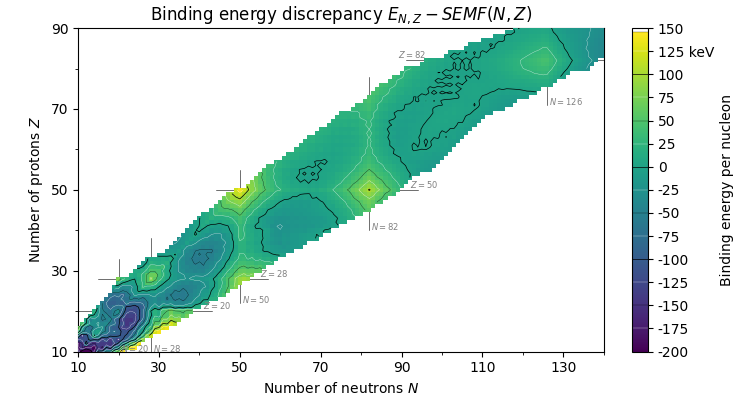
Nuclei containing 2, 8, 20, 28, 50 or 82 protons, or those numbers of neutrons, or 126 neutrons, are systematically more tightly bound than their neighbours. These are the magic numbers.
The evidence is varied and consistent. Binding energies exceed the smooth prediction of the liquid drop model at exactly these values. Such nuclei have more stable isotopes. They are more abundant in nature. Their first excited states lie at unusually high energy, meaning they are hard to disturb. And they capture neutrons poorly, because there is no available level for the neutron to enter.
Nuclei magic in both protons and neutrons, such as helium-4, oxygen-16, calcium-40, calcium-48 and lead-208, are the most tightly bound of all.
An atom has a natural centre: the nucleus provides a fixed potential in which electrons move nearly independently.
A nucleus has no such centre. It is a dense collection of particles interacting strongly with one another at short range, more like a liquid drop than a planetary system, and the liquid drop model built on that picture successfully explained fission and the general trend of binding energy.
That a nucleon could have a well-defined orbit in such a medium appeared physically implausible, since it should scatter constantly off its neighbours.
The resolution is the Pauli exclusion principle. Nearly all the low-lying states are occupied, so a scattering event that would move a nucleon into an occupied state cannot happen. With nowhere to scatter into, nucleons travel long distances without collision, and independent-particle motion becomes a reasonable approximation.
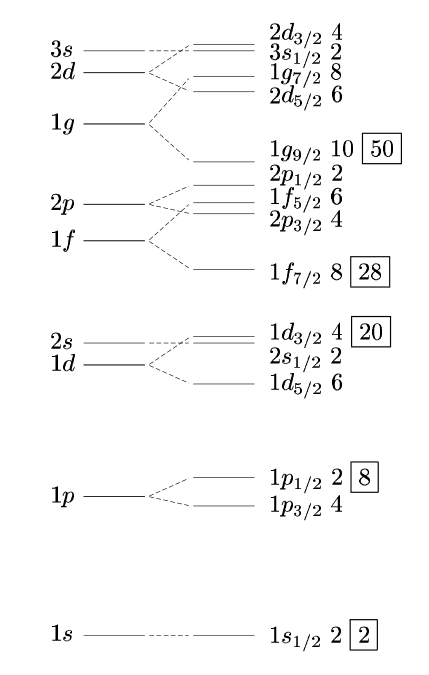
A simple potential well gives shell closures at 2, 8 and 20, and then fails, predicting the wrong numbers thereafter. For over a decade this was the obstacle.
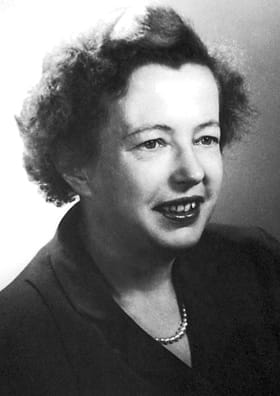
In 1949 Maria Goeppert Mayer, and independently Otto Haxel, J. Hans D. Jensen and Hans Suess, introduced a strong spin-orbit interaction: the energy of a nucleon depends on whether its intrinsic spin is aligned with or against its orbital motion.
The effect is large in nuclei, unlike the small spin-orbit correction in atoms, and it splits the higher levels substantially, pushing some down into the shell below. With that term included, the magic numbers come out correctly, all of them, with no further adjustment.
Goeppert Mayer and Jensen shared the 1963 Nobel Prize in Physics with Eugene Wigner.
The model predicts nuclear spins and parities from the configuration of the last unpaired nucleon, and these predictions are correct for a large majority of nuclei near closed shells.
It accounts for the abundance peaks in the elements at magic neutron numbers, which is essential to explaining how heavy elements were built in stars and in neutron star mergers.
It predicts an island of stability: superheavy nuclei near the next closed shells, expected around 114 or 126 protons and 184 neutrons, should be far longer lived than their neighbours. Elements synthesised so far have shown lifetimes trending in the predicted direction, and the island itself has not been reached.
The model is at its best near closed shells and degrades away from them.
Nuclei with many nucleons outside a closed shell are deformed rather than spherical and show rotational and vibrational spectra that an independent-particle picture cannot produce. These required the collective model developed by Aage Bohr, Ben Mottelson and James Rainwater, which unified the two descriptions and earned its own Nobel Prize in 1975.
The magic numbers themselves are not fixed. In nuclei far from stability, with large neutron excesses, shell structure changes: the classic magic number 20 weakens in the region known as the island of inversion, 28 erodes, and new closures appear at 14, 16, 32 and 34. Rare isotope facilities are mapping this, and it is among the most active areas in nuclear structure.
Deriving the shell structure from the underlying nucleon interaction, rather than assuming a potential and fitting it, remains difficult and is the goal of ab initio nuclear theory.
The shell model made the nucleus intelligible as a quantum system with structure, rather than a featureless drop, and its magic numbers organise nuclear physics in the way the periodic table organises chemistry.
It also carries a general lesson about approximation. An independent-particle description of a strongly interacting dense system looks indefensible and works, because the exclusion principle suppresses precisely the interactions that would break it.