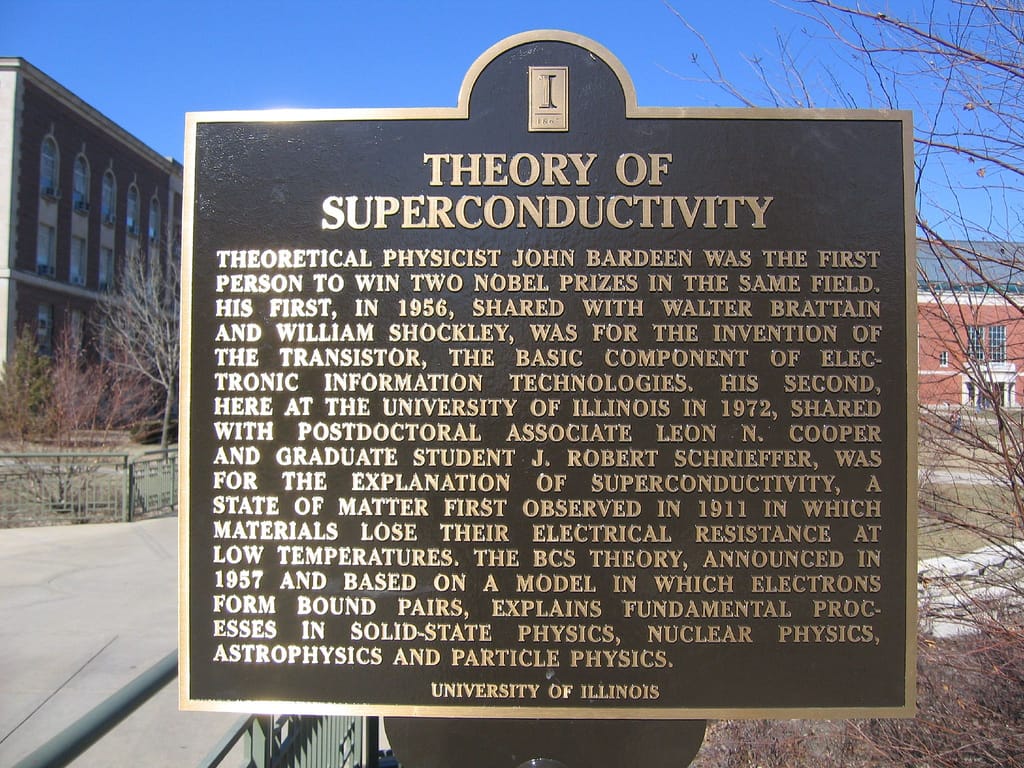
The microscopic explanation of superconductivity in conventional superconductors, published by John Bardeen, Leon Cooper and John Robert Schrieffer in 1957. It accounts for zero resistance and the expulsion of magnetic fields by pairing electrons through their interaction with lattice vibrations. It does not explain every superconductor that has since been found.
Superconductivity was discovered by Heike Kamerlingh Onnes in 1911, when mercury cooled below about 4 kelvin lost all measurable resistance. It then resisted explanation for forty six years, defeating attempts by Einstein, Bohr, Heisenberg and Feynman among others.
Two facts had to be accounted for and one of them was often forgotten. Resistance vanishes entirely, not merely becoming small. And a superconductor expels magnetic field from its interior, the Meissner effect discovered in 1933, which is not a consequence of perfect conductivity but a separate property showing that superconductivity is a distinct thermodynamic state rather than an extreme of ordinary conduction.
The decisive clue arrived in 1950, when the isotope effect was found: the transition temperature of a superconductor depends on the mass of its ions. Ion mass matters only to lattice vibrations, so the lattice had to be involved in a phenomenon that appeared purely electronic.
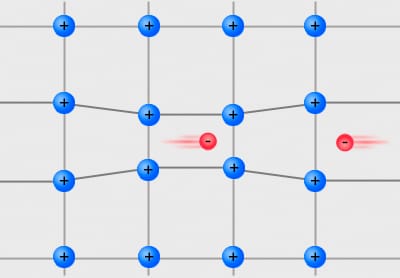
Leon Cooper showed in 1956 that in the presence of a filled Fermi sea, any attraction between two electrons, however weak, binds them into a pair. There is no minimum strength required, which is why an interaction far weaker than the electrostatic repulsion can still be decisive.
The attraction comes from the lattice. A passing electron pulls the positive ions slightly toward it. Because the ions are thousands of times heavier, the distortion persists after the electron has gone, leaving a region of excess positive charge that attracts a second electron. The two electrons never need to be near each other, and in fact a Cooper pair is typically hundreds of nanometres across, overlapping enormously many other pairs.
Pairs form between electrons of opposite momentum and opposite spin, which gives each pair zero net spin and zero net momentum, so the pairs behave as bosons and can occupy a single quantum state together.
The full theory constructs the ground state as a coherent superposition in which pair occupancy is correlated across the whole Fermi surface, and it predicts an energy gap: exciting a single electron requires breaking a pair, which costs a minimum energy. Currents cannot decay by small scattering events because there is no low-energy state to scatter into, which is what makes the resistance exactly zero rather than merely small.
The theory was not merely consistent with what was known; it made quantitative predictions that were then confirmed.
It predicted the ratio between the energy gap at zero temperature and the transition temperature, a universal number close to 3.5 for weakly coupled superconductors, which matches measurement in the classic elemental cases.
It predicted the exponential temperature dependence of heat capacity and thermal conductivity below the transition, which follows from the gap and had been observed but not explained.
It gave the isotope effect the correct dependence on ion mass.
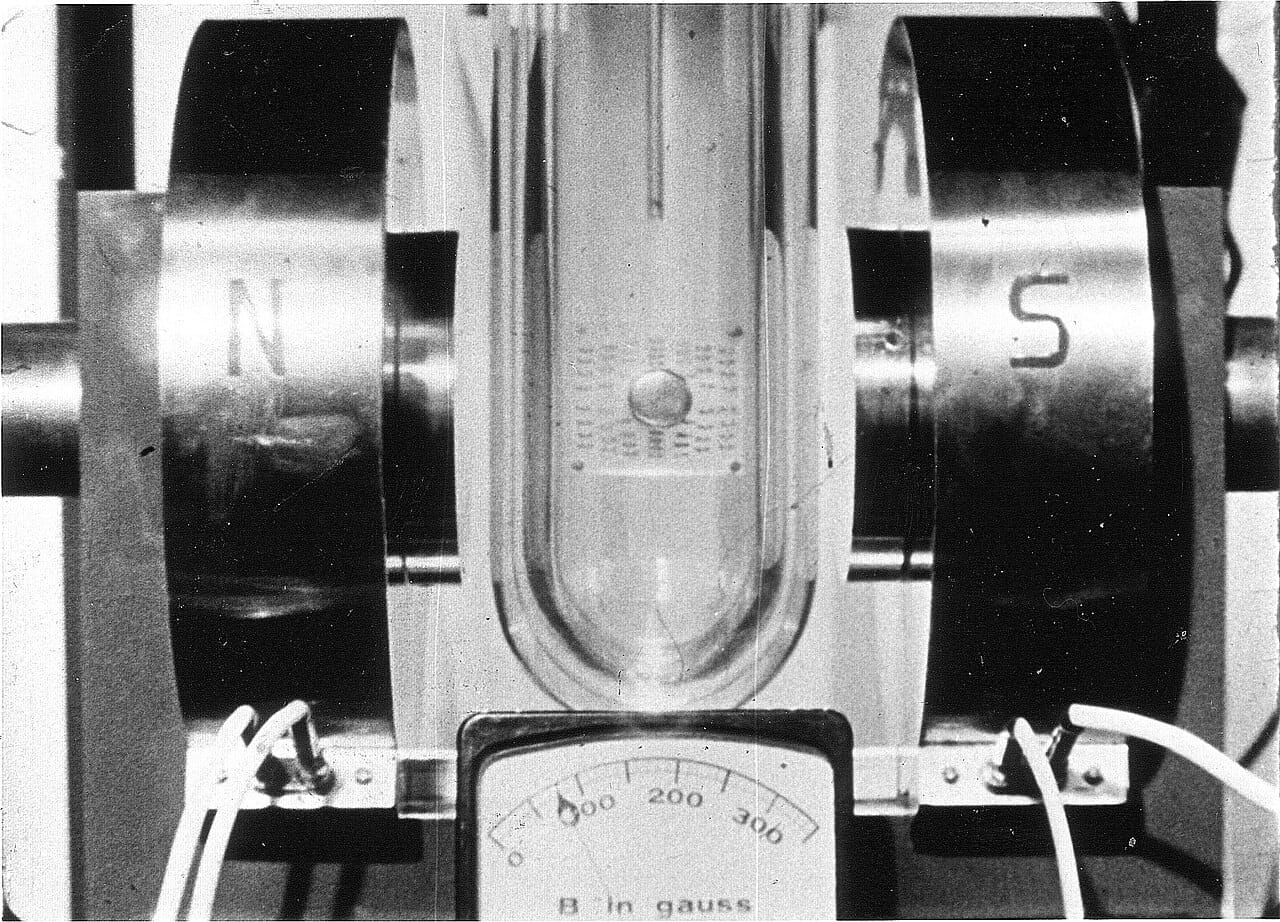
It produced the Meissner effect, which had been the sharpest test of any candidate explanation.
Brian Josephson's 1962 prediction that paired electrons would tunnel between two superconductors separated by a thin barrier, producing a current with no applied voltage, followed from the theory and was confirmed. It underlies SQUID magnetometers, the modern voltage standard, and the superconducting qubits used in most quantum computing hardware.
BCS theory sets an expected ceiling on transition temperature, since the pairing is mediated by phonons and the relevant energy scale is limited. Estimates put the limit around 30 to 40 kelvin, often called the McMillan limit.
Three families have exceeded it, and the theory does not account for them.
The copper oxides, found by Georg Bednorz and Alex Müller in 1986, reach above 130 kelvin at ambient pressure. Their parent compounds are Mott insulators, their pairing has a different symmetry, and no consensus mechanism exists after nearly forty years of work.
The iron-based superconductors, found in 2008, form a second unconventional family with a different but also unresolved mechanism.
The bilayer nickelates are the newest. Superconductivity near 80 kelvin was reported in La3Ni2O7 under high pressure in 2023, bulk superconductivity up to 96 kelvin in pressurised single crystals was reported in 2025, and ambient-pressure thin films were pushed above the McMillan limit in 2025, with onset temperatures in the forties and, in strained films, higher onsets with lower zero-resistance temperatures. This family is under active investigation and its mechanism is unsettled.
The hydrides sit on the other side of the line and are worth stating for contrast. Compounds such as hydrogen sulphide and lanthanum hydride superconduct at up to around 200 kelvin and above, but only under pressures of millions of atmospheres, and these are generally thought to be conventional phonon-mediated superconductors. Light hydrogen atoms vibrate at very high frequencies, which raises the energy scale of the pairing interaction. That is BCS working as intended, at a temperature nobody expected, and it is a reminder that the McMillan limit was an estimate rather than a theorem. Claims of superconductivity at ambient pressure and temperature are treated in a separate capsule.
BCS is correct and essentially complete for the superconductors it was built to describe, and it is one of the most quantitatively successful theories in condensed matter physics. Its framework, in which a Fermi surface is unstable to pairing whenever an attraction exists, is thought to apply to the unconventional families too. What is missing for those is the source of the attraction, since phonons alone cannot supply it at those temperatures.
BCS explained a phenomenon that had defeated the century's best physicists, and it introduced the idea of a macroscopic quantum state formed by pairing, which was carried directly into nuclear physics, into the theory of superfluid helium-3, and into particle physics as the mechanism by which symmetries break.