The set of processes by which experience is encoded, retained and retrieved. It is not one system but several, distinguishable by what they store, how long they hold it and which brain structures they depend on.
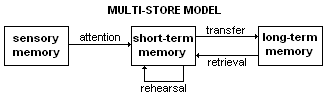
Sensory memory holds raw input very briefly, under a second for vision, long enough for the perceptual system to work on it.
Short-term or working memory holds a small amount of information for seconds while it is being used. Its capacity is famously limited, often quoted as about seven items and more recently estimated closer to four when rehearsal is prevented. Working memory is better described as an active workspace than as a store, and it includes components for verbal and visual material plus a control system that directs attention between them.
Long-term memory has no known capacity limit and can retain information for a lifetime. It divides further.
Declarative memory holds facts and events that can be stated. It splits into episodic memory, for personally experienced events located in time and place, and semantic memory, for general knowledge detached from any occasion of learning.
Procedural memory holds skills, such as riding a bicycle or touch typing. It is expressed in performance rather than description, and it is remarkably durable.
The evidence that these are separate systems comes largely from cases where one fails and others do not.
The patient known as H.M. had both medial temporal lobes, including the hippocampus, removed in 1953 to treat severe epilepsy. He was afterwards unable to form new declarative memories, while his intelligence, language and personality were unaffected.
Two features of his case were decisive. His memory for events well before the surgery was largely intact, showing that the hippocampus is not where old memories are stored. And he could learn new motor skills, improving with practice across days, while denying ever having attempted the task. Procedural memory was intact and inaccessible to conscious report.
This established that memory is not a single faculty of variable strength, and it shaped the field for decades.
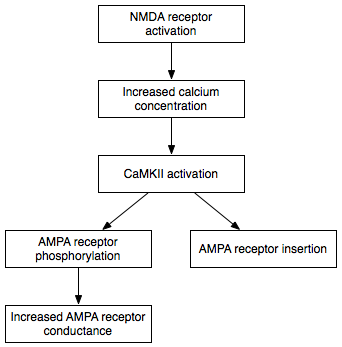
Memory is stored in patterns of connection strength between neurons rather than in any single location.
Long-term potentiation, the persistent strengthening of a synapse after repeated stimulation, was identified in the hippocampus and is treated in its own capsule. It supplies a mechanism by which coincident activity alters a circuit durably, which is what a memory requires.
Consolidation is the process by which a new memory becomes stable. It occurs over hours at the synaptic level and over much longer periods at the systems level, with the hippocampus initially required for retrieval and the cortex gradually taking over. Sleep appears to contribute, as discussed in the sleep capsule.
Memory is not a recording. Retrieval is reconstructive: a remembered event is assembled from partial traces plus general knowledge and expectation, and the result feels the same whether or not the assembly is accurate.
Several consequences follow and are well documented.
Misinformation alters memory. Elizabeth Loftus showed that details supplied after an event, including in the wording of a question, are incorporated into subsequent recall. Asking how fast cars were going when they smashed rather than hit produces higher speed estimates and more reports of broken glass that was never present.
Entire events can be implanted. Suggestive procedures have led substantial minorities of participants to report detailed memories of childhood events that did not occur.
Confidence is a poor guide to accuracy, particularly after a witness has been given feedback. Vivid, emotionally charged memories feel especially reliable and are not correspondingly more accurate, which was established by studies tracking recollections of major public events over years.
These findings have had direct legal consequences, contributing to changes in how police lineups are conducted and how eyewitness evidence is treated.
The evidence supports a small number of methods, most of which are the opposite of what people prefer.
Testing beats rereading. Attempting to retrieve information strengthens memory more than reviewing it, even when the attempt fails.
Spacing beats massing. Study distributed over days produces far better retention than the same total time in one session, though it feels less effective at the time.
Elaboration helps. Connecting new material to existing knowledge produces more durable traces than repetition.
Mnemonic techniques work by imposing structure, and the method of loci, associating items with locations along a familiar route, is the basis of most competitive memory performance.
Memory constitutes the continuity of a person, which is why its loss is experienced as a loss of self rather than of a faculty. Its reconstructive character is also of practical importance well beyond psychology, since legal systems, clinical practice and ordinary disagreement all rest on testimony that is confidently reported and demonstrably alterable.