A changing magnetic field produces an electric current. Michael Faraday demonstrated it in 1831, and essentially all the world's electricity is generated by it and delivered through devices that depend on it.
Hans Christian Orsted had shown in 1820 that an electric current deflects a compass needle, establishing that electricity produces magnetism. The obvious question was whether the reverse held.
Faraday spent a decade trying. A steady magnet near a wire produces nothing, which is why the effect resisted discovery.
In 1831 he wound two coils on opposite sides of an iron ring and connected one to a battery and the other to a galvanometer. He observed a deflection at the moment the battery was connected, and another in the opposite direction when it was disconnected, and nothing in between.
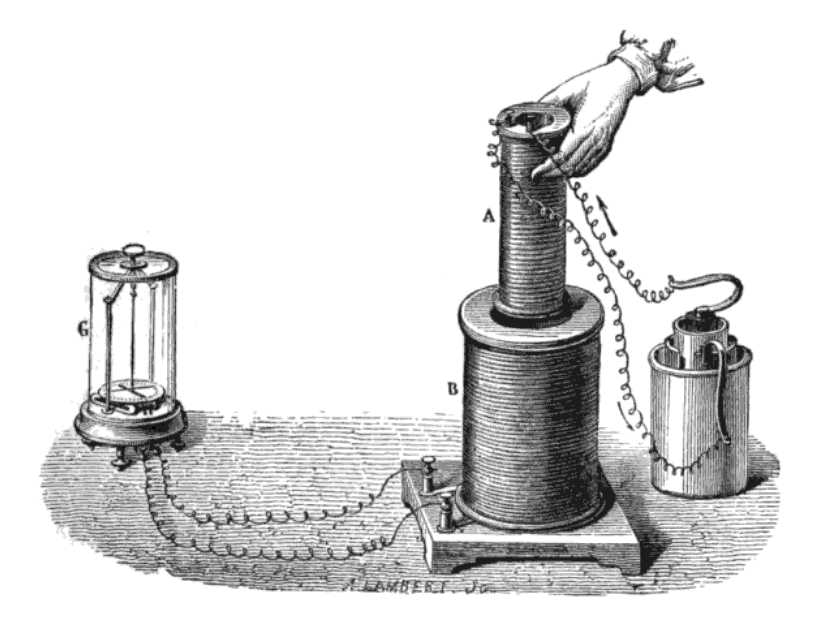
That is the crux: change is required. A magnet moved through a coil produces current while moving and stops when it rests, and the current reverses when the motion does.
Joseph Henry made the same discovery independently in America at about the same time and published later, which is why the unit of inductance carries his name.
Faraday's law states that the induced voltage is proportional to the rate of change of magnetic flux through a circuit.
Flux depends on field strength, on the area enclosed, and on the angle between them, so any of the three can be varied to induce a current: move the magnet, change the field, rotate the coil, or change the loop's area.
Lenz's law fixes the direction: the induced current flows so as to oppose the change producing it. This is not an additional rule but a consequence of energy conservation. If the induced current reinforced the change, the effect would grow without input, which is impossible.
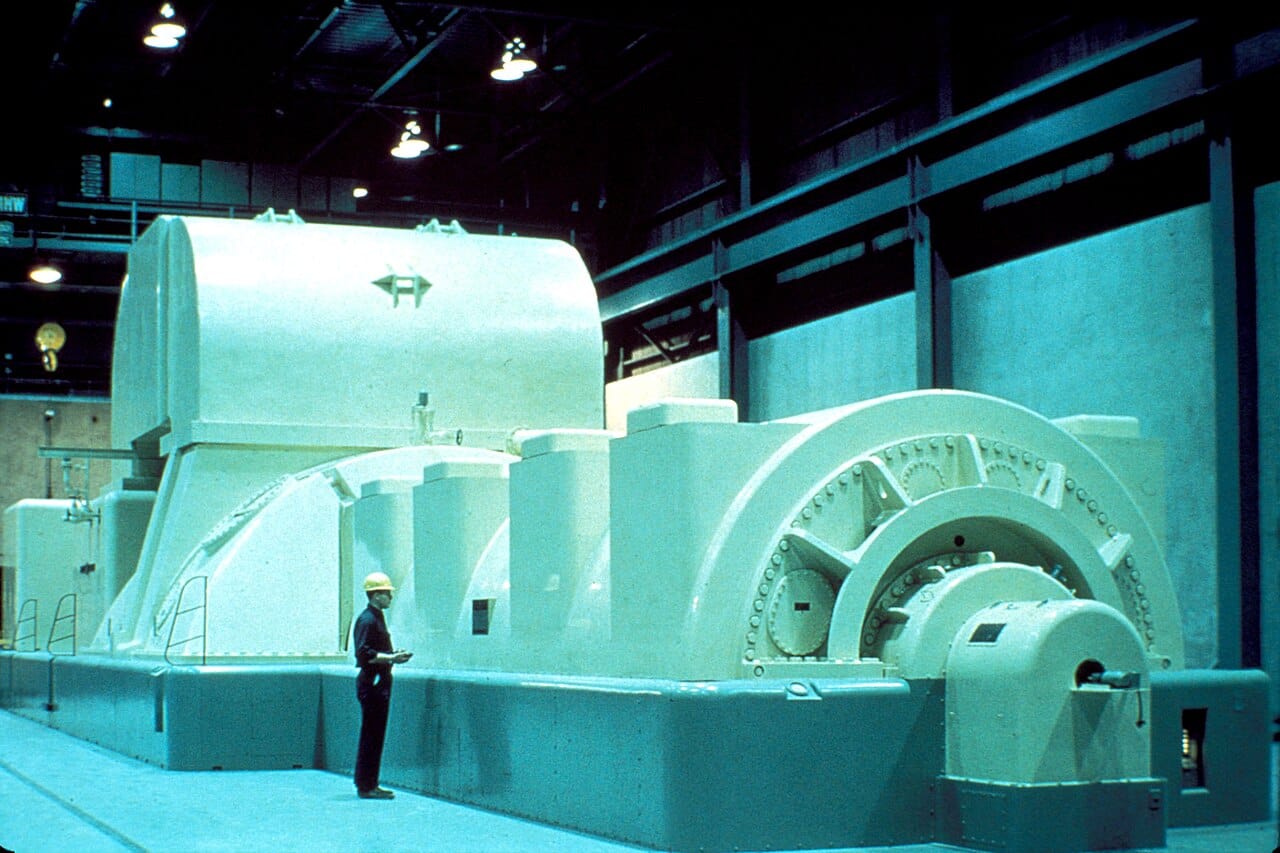
The opposition is directly felt. Turning a generator connected to a load is physically harder than turning one connected to nothing, and the extra effort is exactly the electrical energy produced. This is what a power station's turbine is working against, and why burning more fuel is required to supply more electricity.
James Clerk Maxwell later expressed Faraday's results mathematically, and induction became one of the four equations describing all classical electromagnetism.
Generation. Every conventional power station converts mechanical rotation into electricity by induction. The energy source differs, coal, gas, nuclear, hydro, wind, and the final step is identical: a conductor moving through a magnetic field.
Photovoltaic panels are the exception, converting light directly, which is why grid integration of solar differs from everything else.
Transformers. Two coils on a shared iron core, with the ratio of turns setting the ratio of voltages. This is why alternating current won the current wars of the 1880s: voltage can be raised for transmission, reducing losses in the wires, and lowered again for use. Direct current could not be transformed at the time, which limited it to short distances.
Motors are induction in reverse, and induction motors specifically use the effect twice, inducing current in a rotor with no electrical connection to it.
Wireless charging, induction cooking, metal detectors, electric guitar pickups, transformerless current sensors and regenerative braking are all the same effect.
Eddy currents are induced in any conducting mass in a changing field, and they dissipate energy as heat. Transformer cores are built from thin insulated laminations rather than solid metal to interrupt them, which is why a transformer core looks like a stack of plates.
Induced currents in long conductors during geomagnetic storms can damage grid transformers. The Quebec blackout of 1989 was caused this way, and the Carrington event of 1859 induced currents strong enough to operate telegraph equipment with the batteries disconnected.
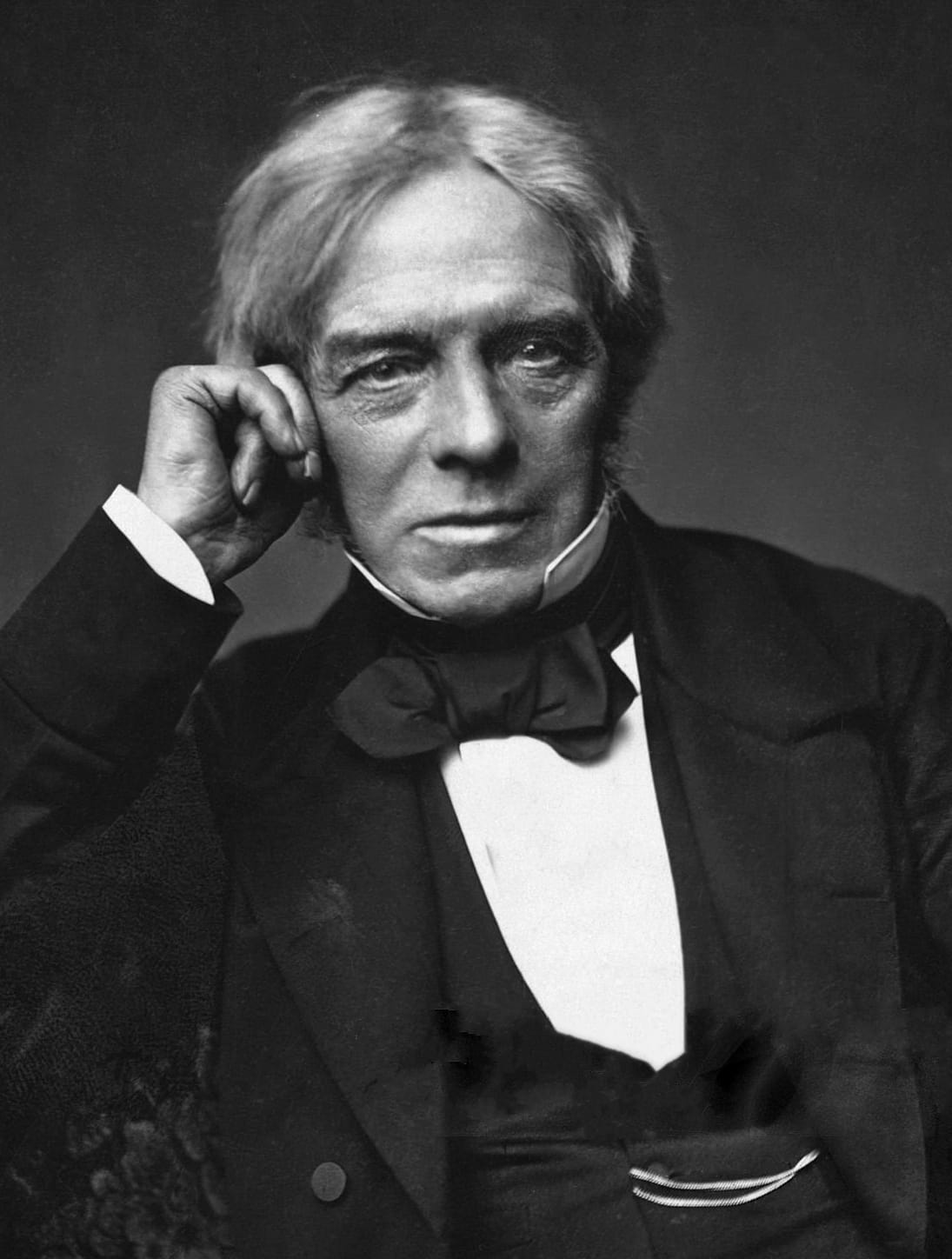
He had almost no formal education, began as a bookbinder's apprentice, and taught himself by reading the books he bound. He had little mathematics and worked by physical intuition and relentless experiment, recording everything in notebooks he numbered by paragraph across a lifetime.
Maxwell's achievement was in part translating Faraday's field concept into mathematics, and Maxwell wrote that he had found Faraday's methods to be mathematical in substance despite not being expressed in conventional form.
Asked by a politician what use the effect was, Faraday is said to have replied that one day the government would tax it. The story is probably apocryphal and has turned out to be accurate.