A body immersed in a fluid is pushed up by a force equal to the weight of the fluid it displaces. It explains why steel ships float, it is over two thousand years old, and the story attached to it is almost certainly not true.
The principle follows from pressure alone, with no experiment required.
Pressure in a fluid increases with depth, because the fluid above presses down. An immersed object therefore experiences greater pressure on its lower surface than on its upper one, and the difference produces a net upward force.
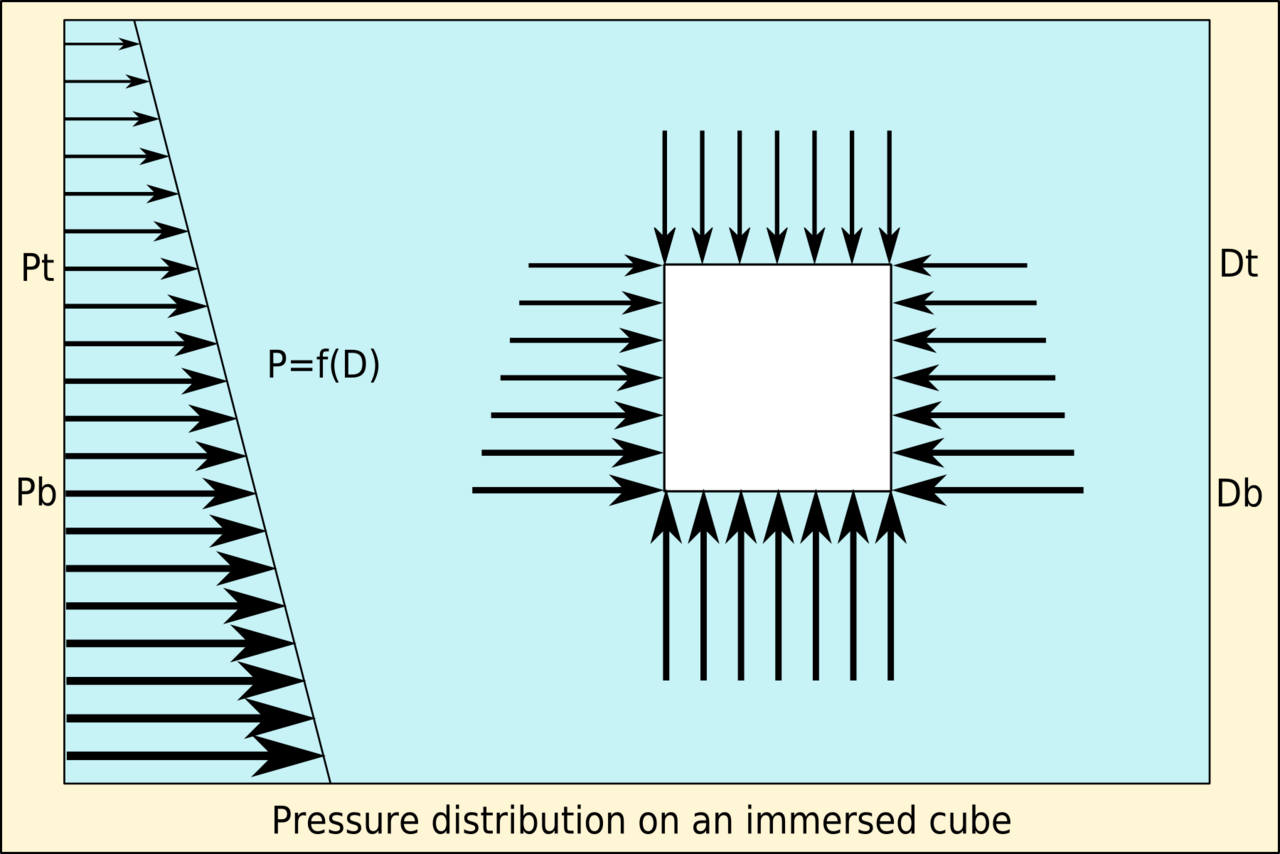
Working out the magnitude gives exactly the weight of the displaced fluid, and it does not depend on what the object is made of, only on its volume and the fluid's density.
That is the whole principle. An object floats when the weight of fluid it can displace equals its own weight, and sinks otherwise.
The apparent paradox dissolves once displacement is understood.
Steel is around eight times denser than water, so a solid steel block sinks. A ship is not solid steel. Its hull encloses a large volume of air, so the average density of the whole vessel is less than water, and the volume it displaces when floating weighs as much as the ship does.
This is why the mass of a ship is called its displacement, and why loading cargo makes it sit lower: more weight requires more displaced water.
The Plimsoll line on a hull marks the maximum safe loading, and its position varies with water density, since sea water is denser than fresh and supports more weight for the same immersion. Overloading was a serious cause of loss before the marking was made compulsory.
The story is that Hiero of Syracuse suspected a goldsmith of substituting silver in a votive crown, asked Archimedes to determine this without damaging it, and that Archimedes realised in the bath that displacement would give the volume, then ran naked through the streets shouting that he had found it.
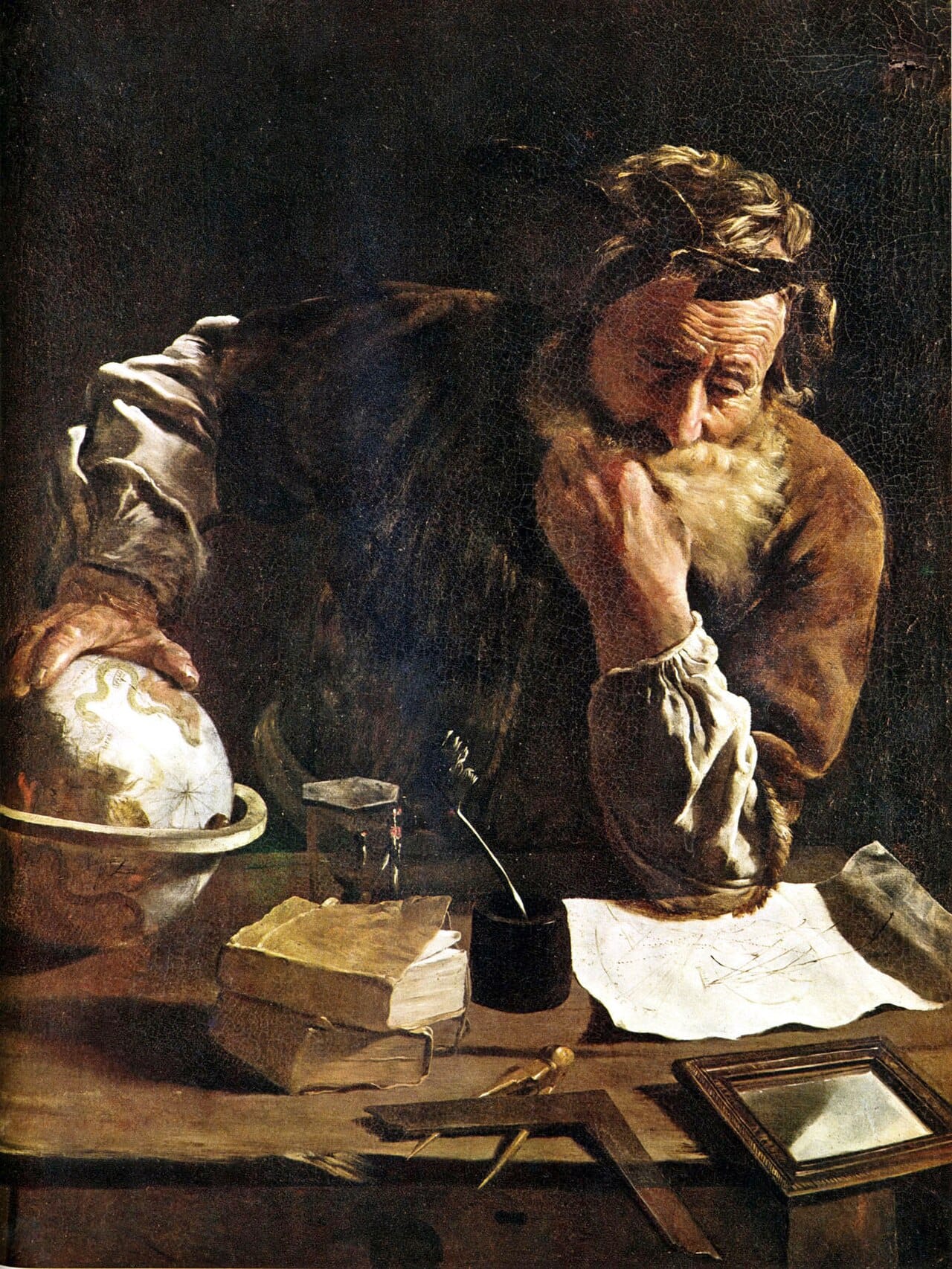
The story comes from Vitruvius, writing around two hundred years after Archimedes died. It does not appear in Archimedes' own surviving work, which discusses flotation in careful mathematical terms and mentions no crown.
The method described is also poor. Measuring the volume of a crown by water displacement requires distinguishing differences of a fraction of a cubic centimetre in a vessel of some size, which is beyond what could be done reliably.
Galileo pointed out a better method that Archimedes could actually have used and that fits his own writing: weigh the crown in air and again submerged. The apparent loss of weight gives the buoyant force directly, and comparing it with a known mass of pure gold treated the same way detects adulteration with far greater sensitivity, because the comparison is of forces rather than of small volume differences.
Ship design and stability. Load lines, draft marks and the whole discipline of naval architecture rest on it.
Submarines control depth by changing their displacement, taking on water to sink and expelling it with compressed air to rise. Fish do the same with a swim bladder.
Hot air balloons and airships use it in a gas: the principle applies to any fluid, and a balloon rises when the air it displaces weighs more than the balloon and its contents.
Hydrometers measure the density of a liquid by how deep a calibrated float sits, which is used in brewing, in testing battery acid, and in checking antifreeze.
Density determination in materials science and gemmology still uses the weigh-twice method, and it remains among the most accurate simple techniques available.
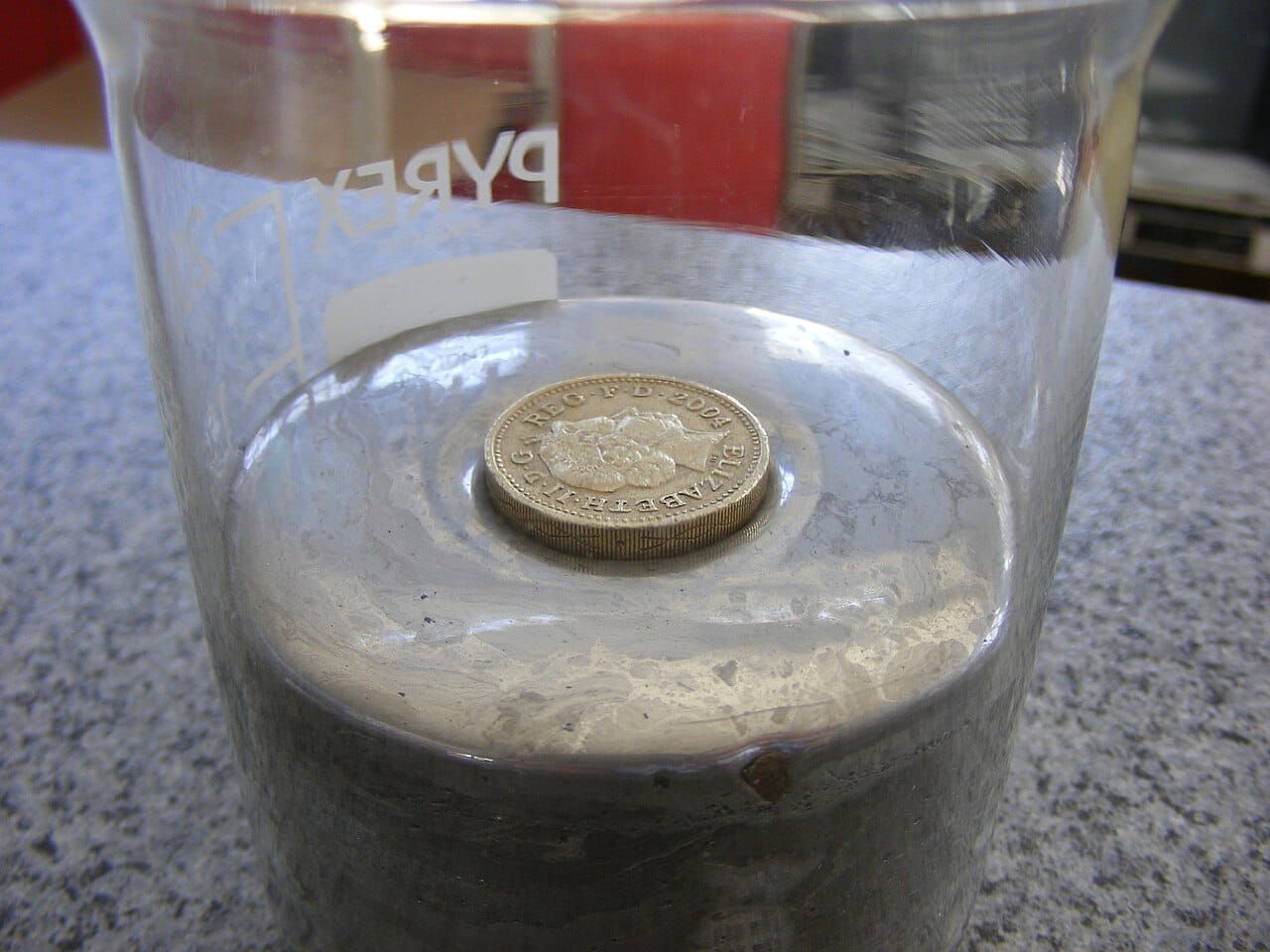
The crown story has crowded out the real achievement.
On Floating Bodies is a treatise deriving the conditions for stable flotation mathematically, including the stability of floating paraboloid segments, which is a genuinely difficult problem and is the foundation of ship stability analysis.
He also determined the ratio of the volume of a sphere to its circumscribing cylinder, calculated pi to useful precision by bounding it between inscribed and circumscribed polygons, and developed methods that anticipate integral calculus by nearly two thousand years. He asked for the sphere and cylinder to be carved on his tomb.
He was killed by a Roman soldier at the fall of Syracuse in 212 BC, reportedly while working on a diagram.