An idealised sequence of four reversible steps that a heat engine could in principle follow, and which no real engine can beat. Its efficiency depends only on the two temperatures between which it operates, a result that founded the second law of thermodynamics and the absolute temperature scale.
Sadi Carnot published Reflections on the Motive Power of Fire in 1824, at a time when steam engines were transforming industry and nobody could say what limited them.
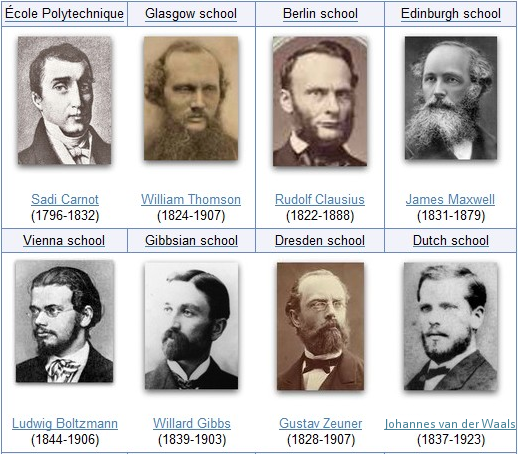
Carnot asked whether there was a ceiling on the work obtainable from a given quantity of heat, and whether a better working substance than steam might exist. He answered both, and did so while still using the caloric theory, which held that heat was a conserved fluid. The theory was wrong and his conclusion was right, which is unusual enough to be worth stating plainly. His work was largely ignored until Émile Clapeyron restated it and William Thomson and Rudolf Clausius built the second law on it.
The cycle takes a working substance around a closed loop in contact with two reservoirs, a hot one and a cold one.
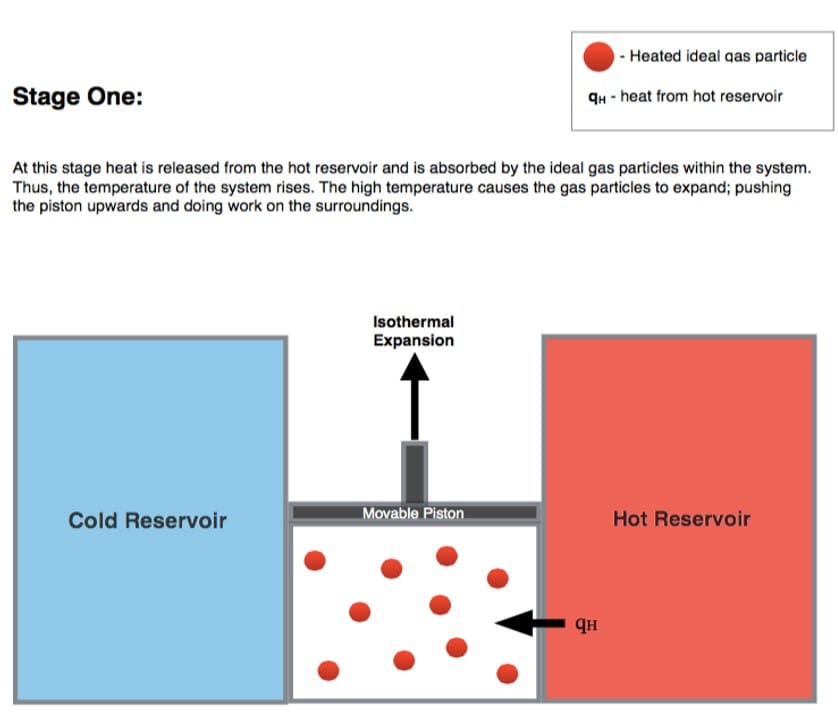
The first step is isothermal expansion. The working substance is held at the hot reservoir's temperature, absorbs heat, and expands, doing work on its surroundings.
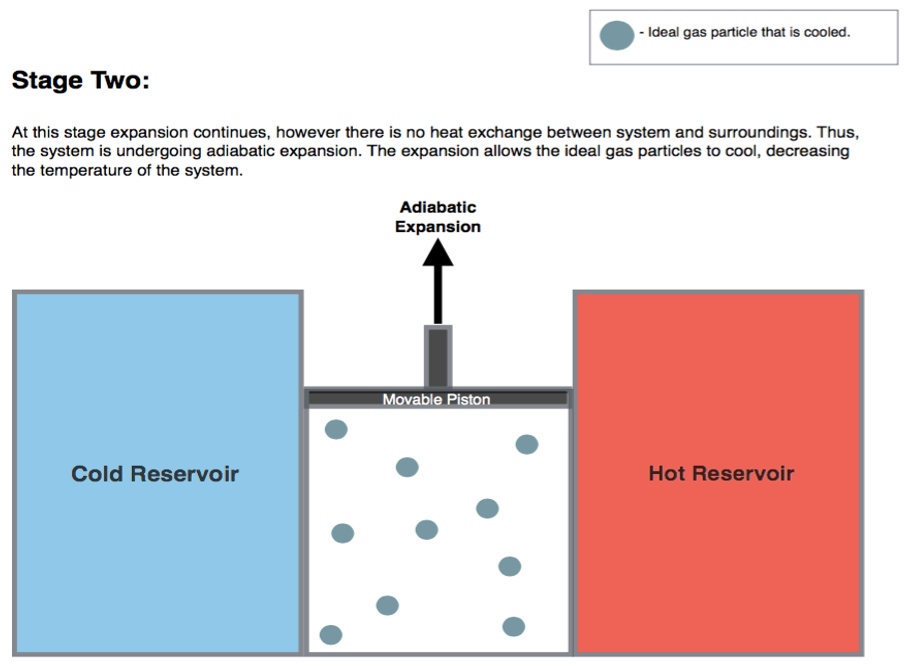
The second step is adiabatic expansion. The substance is thermally isolated and expands further, doing more work, and its temperature falls to that of the cold reservoir because the energy for that work comes from its own internal energy.
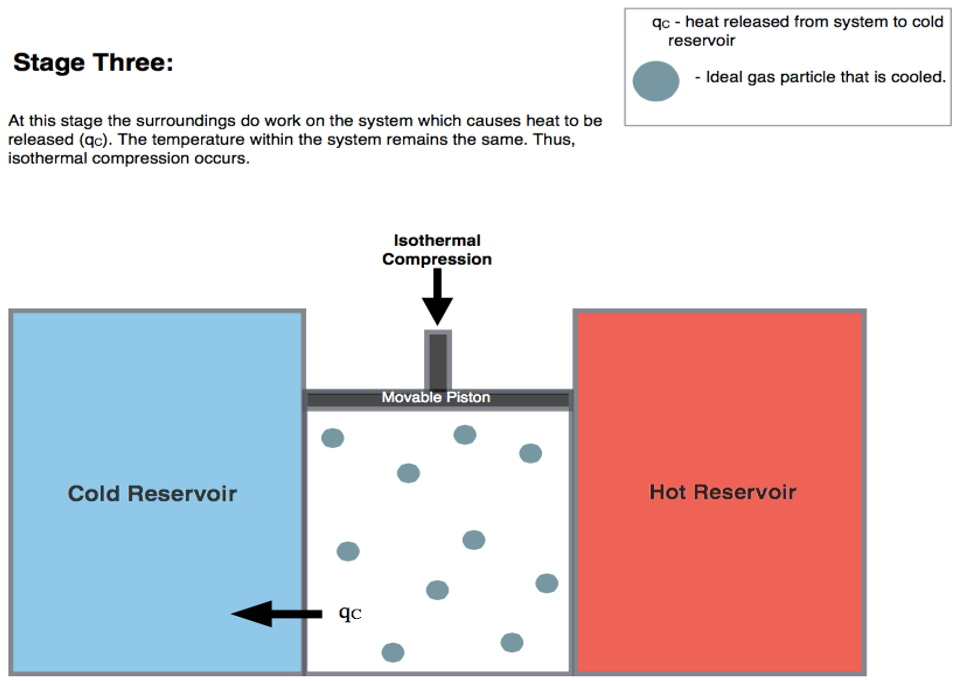
The third step is isothermal compression. In contact with the cold reservoir, the substance is compressed and rejects heat, at constant temperature.
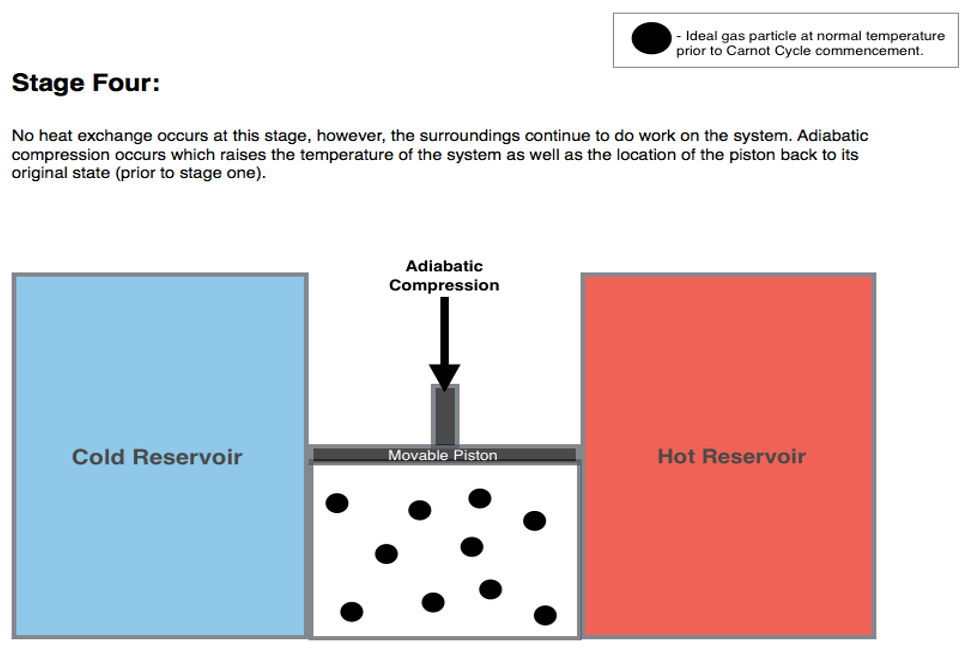
The fourth step is adiabatic compression, returning the substance to its initial state and its initial temperature, closing the loop.
Every step is reversible, which means the substance is never more than infinitesimally out of equilibrium with its surroundings. This is why the cycle is unattainable in practice: a truly reversible process takes infinite time, since any finite temperature difference or finite speed introduces irreversibility.
The work obtained is the difference between the heat absorbed and the heat rejected, and for the Carnot cycle the efficiency reduces to a strikingly simple form: one minus the ratio of the cold reservoir's absolute temperature to the hot reservoir's.
Three things follow, and each is a substantial claim.
The working substance does not appear. Steam, air, helium or anything else gives the same efficiency between the same two temperatures, which answered Carnot's second question and ended a search for better substances.
No engine operating between two reservoirs can exceed it. This is Carnot's theorem, and it can be proved by showing that a hypothetical better engine could be run together with a reversed Carnot engine to move heat from cold to hot with no other effect, which is exactly what the second law forbids.
Efficiency is limited by temperature ratio, not by engineering quality. A power station with steam at about 850 kelvin rejecting to about 300 kelvin has a ceiling near 65 per cent no matter how well it is built, and real plants reach the mid-forties. The only way to raise the ceiling is to raise the input temperature or lower the exhaust temperature, which is why materials that tolerate higher turbine temperatures matter so much.
Because the ratio of heat exchanged to temperature is the same at both reservoirs for a reversible cycle, the cycle can be used to define a temperature scale that does not depend on any particular substance. William Thomson did precisely that, and the result is the kelvin scale.
The same relation, applied to arbitrary reversible cycles, gives a quantity whose change around any closed reversible path is zero. Clausius named it entropy. The Carnot cycle is therefore the route by which the second law acquired a state function rather than remaining a statement about engines.
Reversed, the cycle takes work in and moves heat from cold to hot, which is a refrigerator or a heat pump. The same temperature limit applies, expressed as a coefficient of performance.
This is why heat pumps deliver more heat energy than the electrical energy they consume, typically three to four times more in mild conditions, and why their advantage shrinks as the outside temperature falls and the temperature ratio worsens. It is not a violation of energy conservation, because most of the delivered heat is moved rather than generated.
The Carnot cycle is the reference against which all thermal machinery is measured, and the origin of the idea that some of the energy in a hot reservoir is simply unavailable for work. It also stands as a case where a correct and permanent result was derived from a physical theory that turned out to be false.