Games played on a marked surface with pieces. They are among the oldest recorded recreational objects, they appear independently across unconnected societies, and several have been played with essentially unchanged rules for a thousand years.
The Royal Game of Ur, from Mesopotamia around 2600 BCE, survives as boards, pieces and, remarkably, a cuneiform tablet recording its rules, which allowed the game to be reconstructed and played.
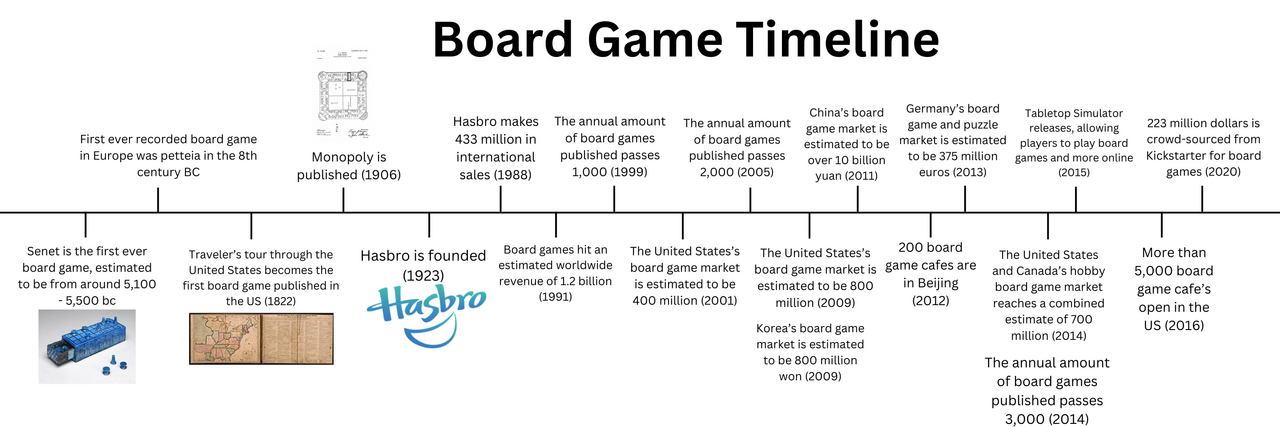
Senet was played in Egypt from around 3100 BCE, and boards were buried with the dead, indicating significance beyond recreation.
Go originated in China at least two and a half thousand years ago and is played today with rules that have changed very little.
Backgammon descends from games of the same family as Ur, and its modern form is recognisably ancient.
Mancala games, played by moving seeds between pits, are found across Africa and Asia in many variants and are of uncertain but considerable antiquity.
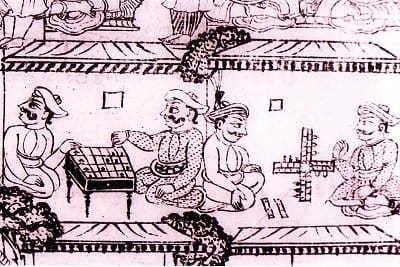
Chess developed from the Indian game chaturanga, reaching Persia and then Europe and changing substantially en route, and is treated in its own capsule.
Race games move pieces along a track toward a goal, with movement determined by dice or other randomisers. Backgammon and Ur are examples, and the category is probably the oldest.
Territory games contest control of space rather than capture of pieces, of which Go is the outstanding example.
Capture games aim to remove or immobilise opposing pieces, including chess, draughts and their many relatives.
Alignment games require pieces to be arranged in a pattern, including nine men's morris, which appears carved into stone surfaces across Europe and the Near East, sometimes in places suggesting people played while waiting.
Modern designer games, developed principally since the 1990s, combine mechanisms deliberately and are treated as designed products with named authors, which is a change from games transmitted anonymously.
Games differ in how much outcome depends on chance, and this is a design decision with social consequences.
Pure skill games, including chess and Go, have no random element. The stronger player wins nearly always, which makes them suitable for competitive ranking and unsuitable for play between people of very different ability.
Chance games allow a weaker player to win sometimes, which sustains interest across mixed groups. Race games with dice are the traditional form.
Mixed games combine both, and much modern design is concerned with tuning that balance.
Handicap systems address the same problem differently, and Go has an unusually elegant one: the weaker player places extra stones before play begins, which allows players of substantially different strength to have a genuinely close game.
Hidden information is a third dimension, distinct from chance. A game where players hold private knowledge produces bluffing and inference, which neither pure chance nor perfect information provides.
Divination and ritual, in several early cases. Senet acquired religious meaning, with the board representing passage through the afterlife.
Military and political instruction. Chess was used to teach strategic thinking, and modern wargames descend from Prussian military training exercises of the nineteenth century.
Moral instruction. Several nineteenth century games were designed to teach virtue, with the ancestor of snakes and ladders using the squares to represent vices and virtues.
Research. Board games have been used extensively in artificial intelligence as tractable domains with clear rules and objectives, and the defeat of the strongest human players at chess in 1997 and at Go in 2016 were both treated as milestones, with the second requiring approaches that could not be brute-forced.
Board games have grown substantially as a commercial category since the 1990s, driven by designed games with published authors and by crowdfunding, which lowered the barrier to publishing a game.
The growth is frequently attributed to a preference for in-person social activity alongside screen-based leisure rather than instead of it, and the evidence for that explanation is largely commercial rather than academic.
Digital implementations have made games available without physical components and without an opponent present, and have not displaced physical play, which suggests the object and the gathering are part of what is wanted.
Board games are among the oldest surviving evidence of activity undertaken purely for its own sake, and their presence in burials indicates that this was not regarded as trivial.
Their independent appearance across unconnected societies also places structured competitive play with language, music and dance among the practices that human groups arrive at without contact, which is a fact about people rather than about any particular game.