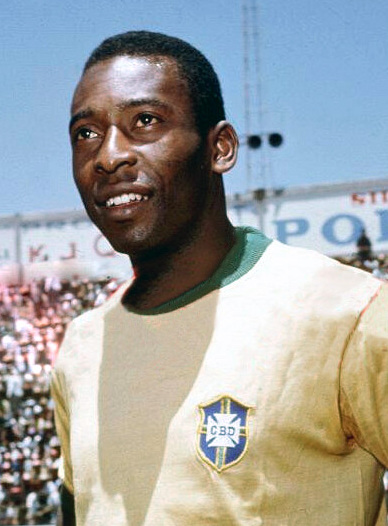
The most widely played and watched sport in the world, contested by two teams of eleven who may not use their hands. Its modern form was codified in England in 1863, and the codification is what separated it from the other football games it once shared a name with.
Two teams of eleven play on a rectangular pitch, and a goal is scored when the whole ball crosses the goal line between the posts. Only the goalkeeper may handle the ball, and only within the penalty area.
A match is ninety minutes in two halves, with time added for stoppages. Play is continuous, without the frequent set restarts of most codified sports, which is why possession and territory are contested in flowing patterns rather than in discrete plays.
The offside law is the rule that most shapes tactics. An attacker in the opponents' half must not be nearer the goal line than both the ball and the second-last defender at the moment the ball is played forward. Without it, players could wait beside the opposing goal, and the game would become long passes to a stationed forward. Successive revisions of it have repeatedly changed how the game is played.
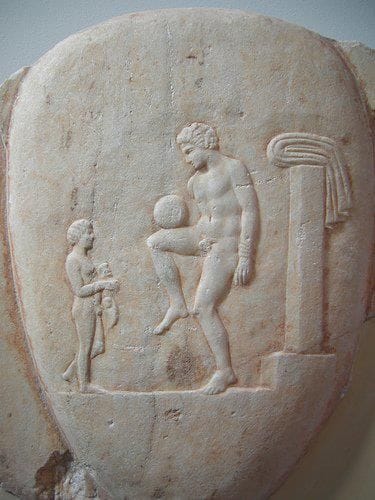
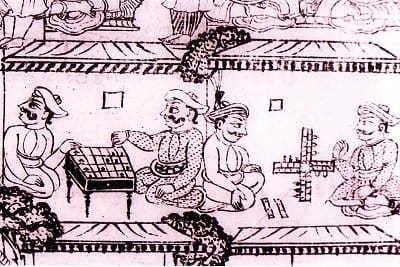
Ball games involving kicking are ancient and appear independently across many cultures.
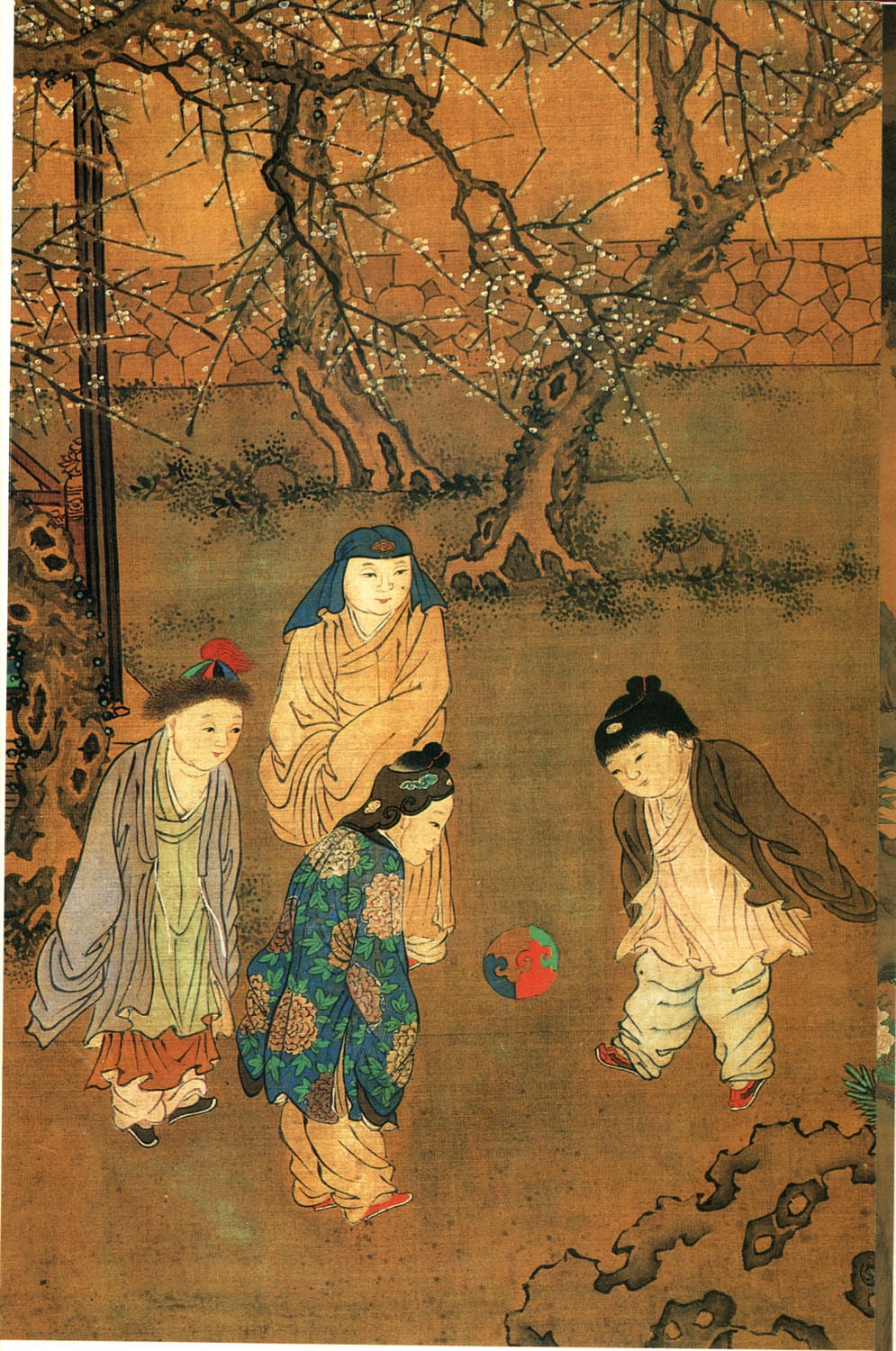
Cuju, played in China from at least the Han dynasty, involved kicking a ball through a raised opening. Episkyros in Greece and harpastum in Rome were team ball games. Mesoamerican ball games had ritual significance.
None of these is a direct ancestor. The modern game descends from folk football played in medieval and early modern Britain, which was violent, played between villages with unlimited numbers, and repeatedly banned by monarchs who considered it a distraction from archery practice.

The decisive step was codification. English public schools each played their own version with different rules, which made matches between them impossible. Representatives met in London in 1863 and formed the Football Association, agreeing a common code. The critical decision was to forbid carrying the ball and hacking, which caused those preferring them to separate; rugby football developed from that split.
The name association football, and the abbreviation soccer derived from it, distinguished the code from the others.
British workers, sailors, engineers and teachers carried the game abroad through the later nineteenth century, and it took root fastest where British commercial presence was strongest, in South America, continental Europe and later Africa and Asia.
FIFA was founded in 1904 and the first World Cup was held in Uruguay in 1930. The tournament is now among the most watched events on Earth, with audiences for the final measured in the billions.
Domestic league competition, professionalism and the modern club structure developed first in Britain and were adopted widely. Club competitions in Europe now attract a substantial share of global attention and revenue.
Women's football has a longer history than is often assumed, drawing large crowds in Britain during and after the First World War before the Football Association banned women from Association grounds in 1921, a prohibition not lifted until 1971. The women's game has grown rapidly since, with substantial increases in professionalisation, attendance and broadcast audience.
Several practical features account for its reach.
It requires almost nothing. A ball and an improvised space suffice, and markers can stand in for goals, which makes it playable wherever there is open ground.
Its rules are few and quickly learned, unlike codes requiring detailed knowledge of set plays.
Physical requirements are broad. Success does not depend on unusual height or mass to the degree several other major sports do, which widens participation.
And it favours no single technology or facility, so it spread without infrastructure.
Video assistant refereeing was introduced to review decisions on goals, penalties, red cards and mistaken identity. It has reduced clear errors and has proved contentious, since review interrupts the continuous play that characterises the sport and marginal offside decisions are resolved by measurement at a precision the naked eye cannot match.
Goal-line technology, which determines automatically whether the ball crossed the line, has been less contested, because it settles a binary question of fact.
The financial structure of elite competition has changed substantially, with broadcast revenue concentrating resources among a small number of clubs, and the resulting competitive imbalance is a recurring subject of regulatory attention.
Association football is the closest thing to a global cultural common ground, played and followed across almost every country, and its governing tournament reaches audiences no other single event approaches. It is also a clear case study in how codification creates a sport: the folk games that preceded it were locally variable and mutually incompatible, and a single meeting in 1863 produced something that could be played identically anywhere.