The creation of apparent motion from a sequence of still images. It predates cinema, it is a technique rather than a genre, and its production methods have changed more than those of any other visual medium.
Animation exploits the same perceptual effect as film: a rapid sequence of still images is perceived as continuous motion. The cinema capsule sets out the mechanism.
The difference is that the images are made rather than photographed from a moving subject.
Rates vary. Full animation draws a new image for every frame, at twenty four per second. Limited animation holds each drawing for two or three frames, which halves or thirds the work at a cost in smoothness, and became standard in television production where budgets were tight.
The principal difficulty is that motion must be constructed by someone who understands how things move. A drawn figure has no physics, so weight, momentum, anticipation and follow-through must be supplied deliberately, and their absence is what makes poor animation look wrong even to viewers who cannot say why.
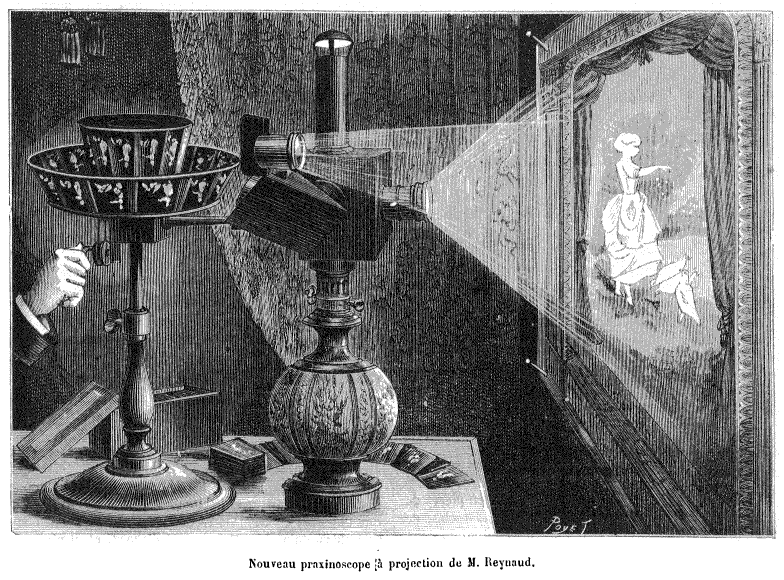
Devices producing motion from sequential images preceded photographic cinema.
The phenakistiscope and zoetrope, from the 1830s, presented drawings through slits in a spinning disc or drum.
The praxinoscope, developed by Charles-Émile Reynaud in 1877, used mirrors instead of slits and produced a brighter image. Reynaud went on to project hand-painted sequences to paying audiences from 1892, several years before the Lumière brothers' first film screening.
Animation is therefore older than photographic cinema as a projected public entertainment, which reverses the usual assumption that it is an offshoot.
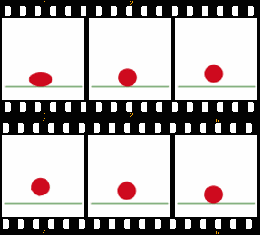
Traditional or cel animation draws each frame. From the 1910s, the practice of drawing moving elements on transparent celluloid over a static painted background removed the need to redraw the background for every frame, which made feature-length production feasible.
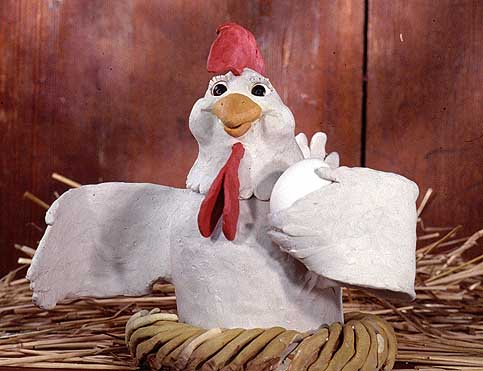
Stop motion photographs physical objects, moving them slightly between exposures. It covers puppet animation, clay animation and object animation, and it retains a physical quality that is difficult to simulate.
Cutout animation moves flat pieces, and Quirino Cristiani in Argentina used it to make what are generally regarded as the first animated features, from 1917, none of which survive intact.
Computer animation covers both two-dimensional work and three-dimensional work in which models are built, given skeletons, posed at key positions and interpolated between them.
Motion capture records the movement of a performer and applies it to a model, which shifts the work from constructing motion to recording and adapting it.
Animation is labour-intensive, which has determined its industrial organisation more than its aesthetics.
Studio production divided the work minutely, with separate roles for layout, key drawings, the intermediate drawings between them, backgrounds, ink and paint. A feature required hundreds of people and hundreds of thousands of drawings.
That cost drove offshoring of intermediate work from the 1960s, and a substantial share of animation production has been carried out in Asia for decades regardless of where a production is credited.
Computer methods changed the cost structure rather than removing it. Modelling, rigging, lighting and rendering absorbed the labour that drawing had, and feature production remains among the most expensive per minute in any medium.
The persistent assumption that animation is for children is a consequence of distribution decisions in particular markets rather than of the technique.
Japanese animation covers the full range of subjects and audiences, and the assumption does not hold there.
Animation is standard in scientific and medical visualisation, where it depicts processes that cannot be filmed, including molecular mechanisms and geological time.
It is used in instruction, in litigation for reconstructing events, in interface design and in games, which are now among the largest employers of animators.
Visual effects in live-action film are animation by another name, and the boundary has effectively dissolved, since a substantial proportion of a modern effects-heavy film is animated.
Animation is the only visual medium in which everything on screen is a deliberate decision, since nothing arrives by being pointed at. That makes it unusually direct as an expressive form and unusually laborious.
It is also older as a projected entertainment than photographic cinema, which is worth stating plainly, because it is routinely described as a derivative of a medium it preceded.