The proposal that life began in alkaline hydrothermal vents on the ocean floor, where mineral chimneys provided compartments and a natural proton gradient supplied energy in the form all life still uses. It explains something no other origin account explains as well, and it has a serious chemical problem.
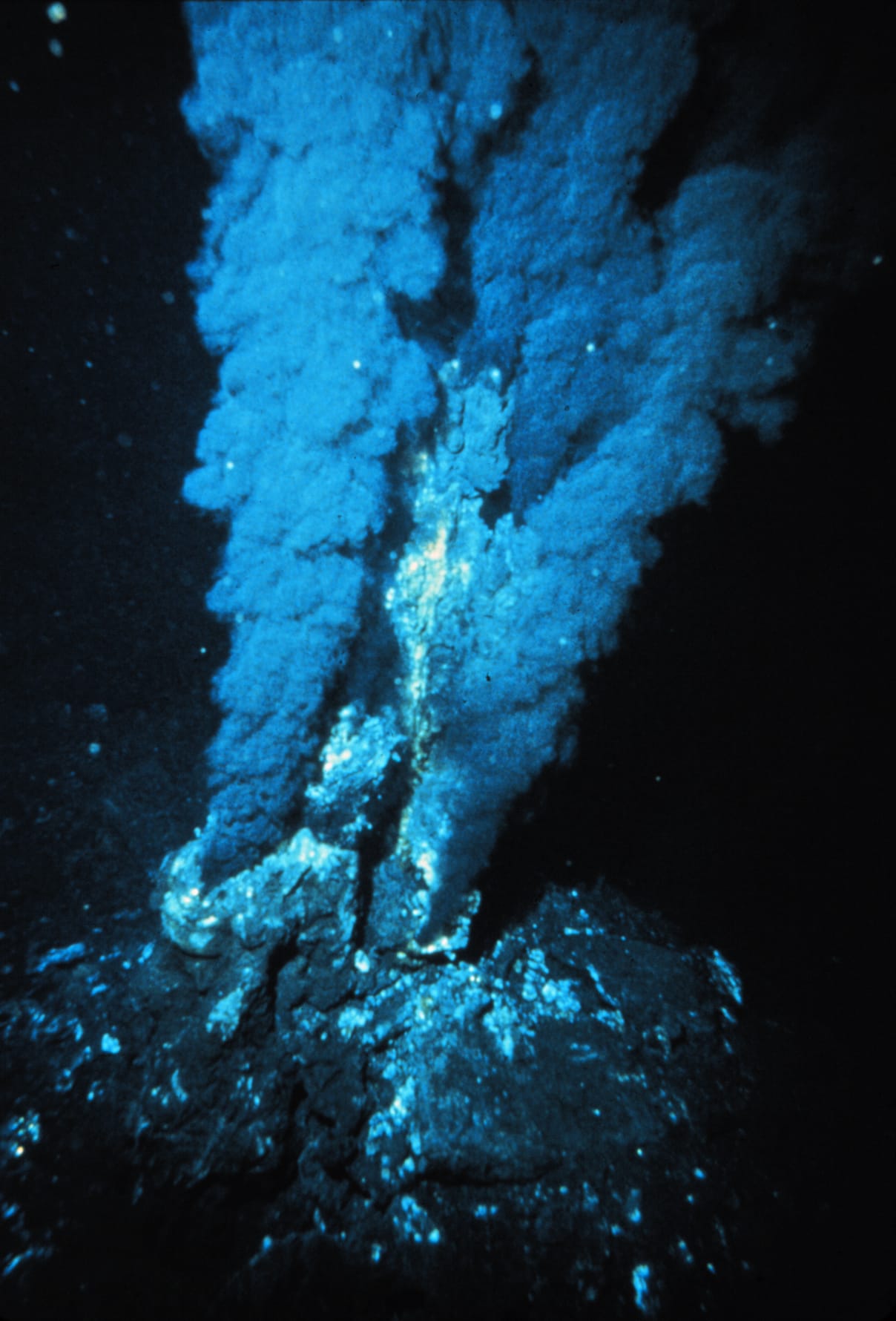
Alkaline vents are not the black smokers usually pictured. Those are volcanic, extremely hot, and acidic.
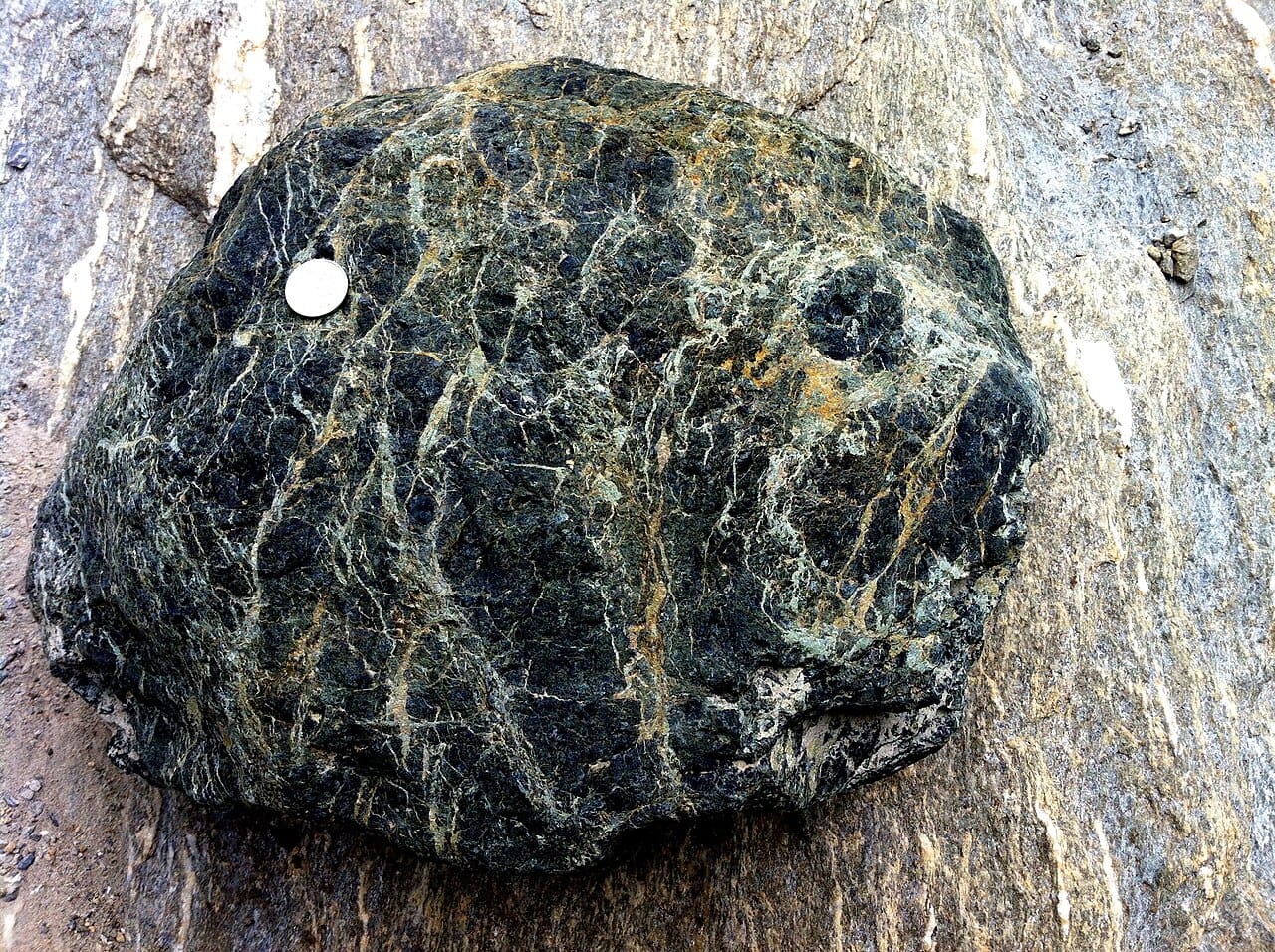
Alkaline vents form by serpentinisation: seawater reacting with olivine-rich rock from the mantle. The reaction produces hydrogen, methane and a warm alkaline fluid, at temperatures around forty to ninety degrees rather than several hundred, and it releases energy rather than requiring it.
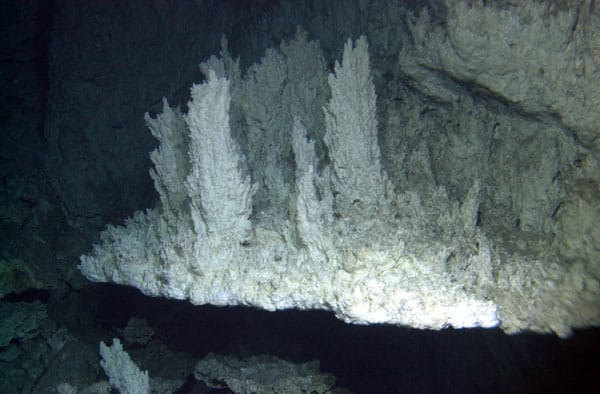
Where that fluid meets seawater it precipitates carbonate chimneys riddled with interconnected micropores. The Lost City field in the mid-Atlantic, found in 2000, is the type example: chimneys up to sixty metres tall, active for at least thirty thousand years.
Michael Russell proposed the setting in 1988 and developed it with William Martin and Nick Lane.
Their argument starts from a fact about all life that most origin accounts do not address. Every organism generates energy by pumping protons across a membrane and letting them flow back through a rotary enzyme, ATP synthase. This mechanism, chemiosmosis, is universal, present in bacteria and archaea and in the mitochondria of every eukaryote, which means it predates the split at the base of the tree of life.
A universal mechanism that complex demands explanation. The hypothesis is that it was not invented but inherited from the environment: alkaline fluid inside the chimney pores, acidic ocean outside, and a proton gradient across the thin mineral wall between them, of roughly the same magnitude cells maintain today.
On this account the first organisms did not have to evolve a way of making energy. They had to evolve a way of stopping using the free one, which is a much easier sequence and explains why the mechanism is universal.
The pores supply the other requirements. They are compartments, so products concentrate rather than dispersing into the ocean. Iron-sulphur minerals in the walls resemble the iron-sulphur clusters at the catalytic centre of many ancient enzymes. And hydrogen from serpentinisation reacting with dissolved carbon dioxide is thermodynamically favourable, so carbon fixation is downhill rather than uphill.
The chemistry has a hard problem. RNA hydrolyses rapidly in warm alkaline water, which is precisely the condition inside the vents. This has been the standard objection since the hypothesis was proposed, and it sets the alkaline vent account against the RNA world rather than alongside it.
Recent work has softened it. Experiments reported that nucleic acids can be stabilised within the iron mineral structures found in these systems, and separate chemical garden experiments found that vent-like conditions stabilise ribose, which is the sugar in RNA and is notoriously unstable. Whether this is enough to reconcile the two accounts is not settled.
Dilution is the other objection. Any product forms in an ocean, and even porous compartments exchange with seawater. Proponents answer that thermal gradients across pores concentrate molecules substantially, which has been demonstrated experimentally, and critics answer that the demonstrated concentrations are still well below what the chemistry needs.
The competing setting is surface pools undergoing wetting and drying cycles, favoured by many prebiotic chemists because concentration and polymerisation both work far better there, and because ultraviolet light is available as an energy source for reactions that need it. Its weakness is the reverse of the vent hypothesis's strength: it offers no account of why chemiosmosis is universal.
Serpentinisation happens, produces hydrogen, and would have been far more common on the early Earth when more mantle rock was exposed. Alkaline vents exist and are long-lived. The proton gradient across their walls is real and measured. Chemiosmosis is universal and ancient.
Those are facts, and they are the reason the hypothesis is taken seriously despite the chemistry problem.
The setting requires water in contact with mantle rock and no sunlight, which makes it the most transportable origin scenario available.
Enceladus vents water from a subsurface ocean and the plumes contain hydrogen and organic molecules, indicating serpentinisation on the sea floor beneath. Europa is thought to have a rocky ocean floor. If life requires only rock, water and carbon dioxide, then the number of places it could begin is considerably larger than if it requires a sunlit pond on a continent.
That is why the hypothesis is classified under astrobiology rather than chemistry. Its testability may lie less in the laboratory than in what a probe finds under the ice of a moon.