The proposal that early life used RNA for both heredity and catalysis, before DNA and proteins divided those jobs between them. It solves a genuine chicken-and-egg problem, it has real experimental support, and the step it most needs to demonstrate has not been demonstrated.
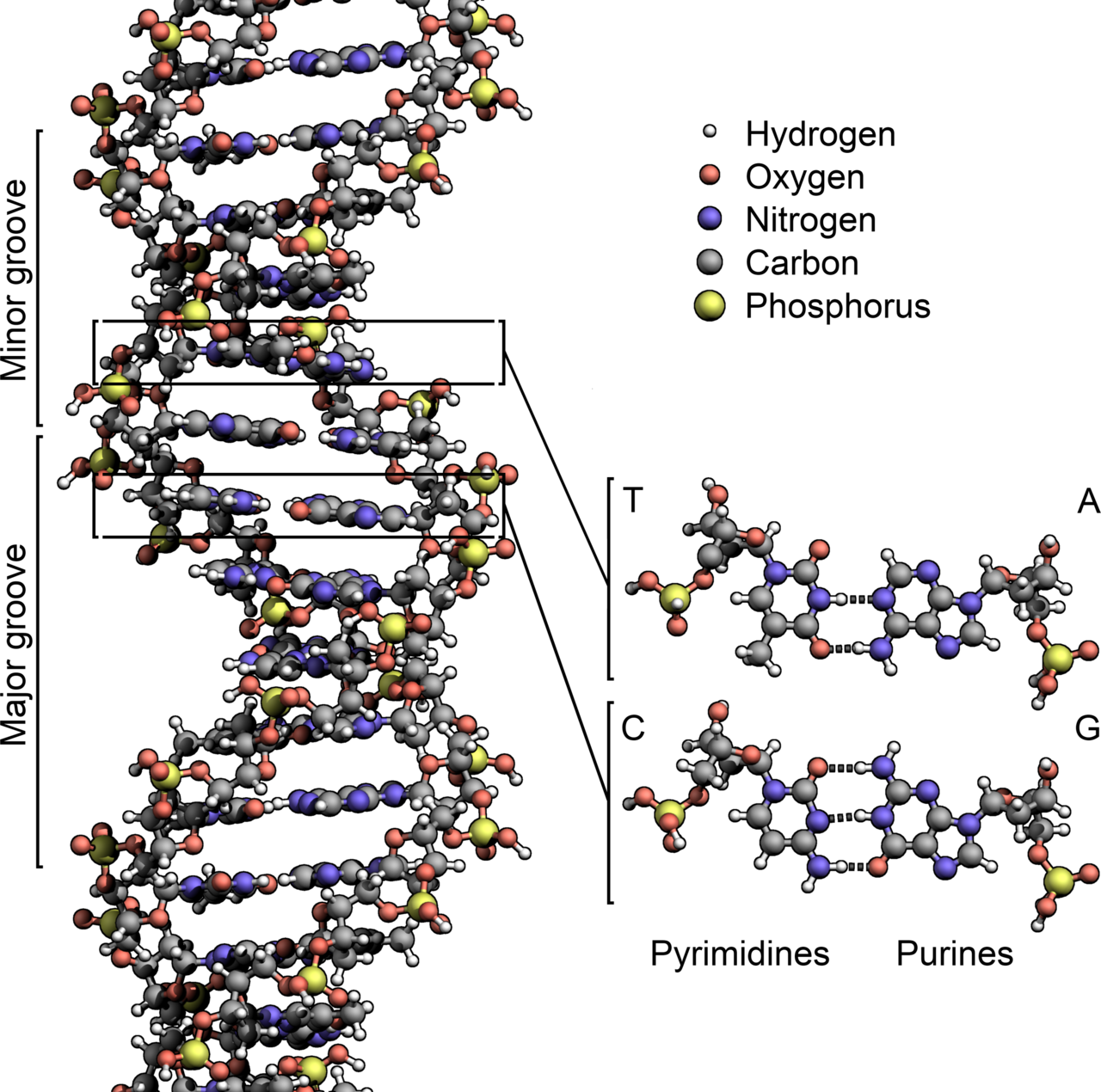
Modern life divides labour strictly. DNA stores information and does nothing else. Proteins do the chemical work and cannot be copied. The information in DNA is turned into proteins by machinery that is itself made of proteins.
This is circular. DNA cannot be replicated without protein enzymes, and proteins cannot be made without the information in DNA. Neither could plausibly have come first.
RNA does both jobs, badly.
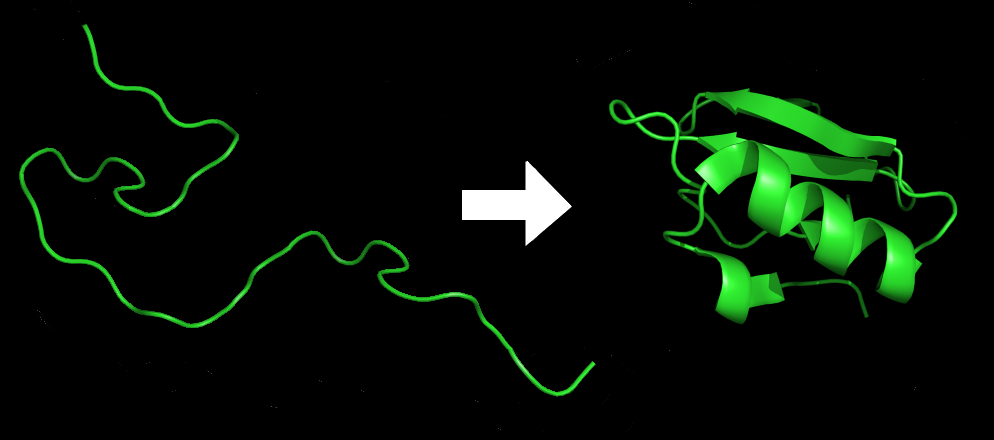
It carries sequence information, so it can be copied and can evolve. And it folds into shapes with catalytic activity, so it can act as an enzyme. A molecule that is both gene and catalyst breaks the circle: a self-replicating RNA needs nothing else to begin.
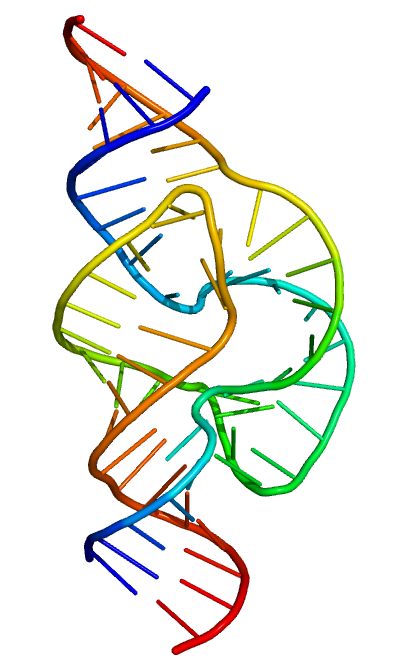
Carl Woese, Francis Crick and Leslie Orgel raised the idea independently around 1967. It became testable when Thomas Cech and Sidney Altman independently discovered catalytic RNA in the early 1980s, sharing the 1989 Nobel Prize in Chemistry. Walter Gilbert named it the RNA world in 1986.
Several features of modern cells look like fossils of an earlier RNA-based system.
The ribosome, which builds every protein in every organism, is a ribozyme. The chemical step that joins amino acids is catalysed by RNA, not by the proteins attached to it, which was established when the structure was solved and is difficult to explain unless RNA held the role first.
Many essential coenzymes contain nucleotides for no functional reason: ATP, NADH, coenzyme A, FAD. These look like handles left over from a time when the catalysts were RNA and needed to grip their cofactors.
RNA is used in ways that suggest antiquity. Telomerase carries its own RNA template. Splicing is performed by RNA-protein complexes with RNA at the catalytic centre. Some bacteria regulate genes with RNA switches responding directly to metabolites, with no protein involved.
And DNA is made from RNA. The enzyme producing DNA building blocks works by modifying ribonucleotides, which is the order of operations one would expect if RNA came first.
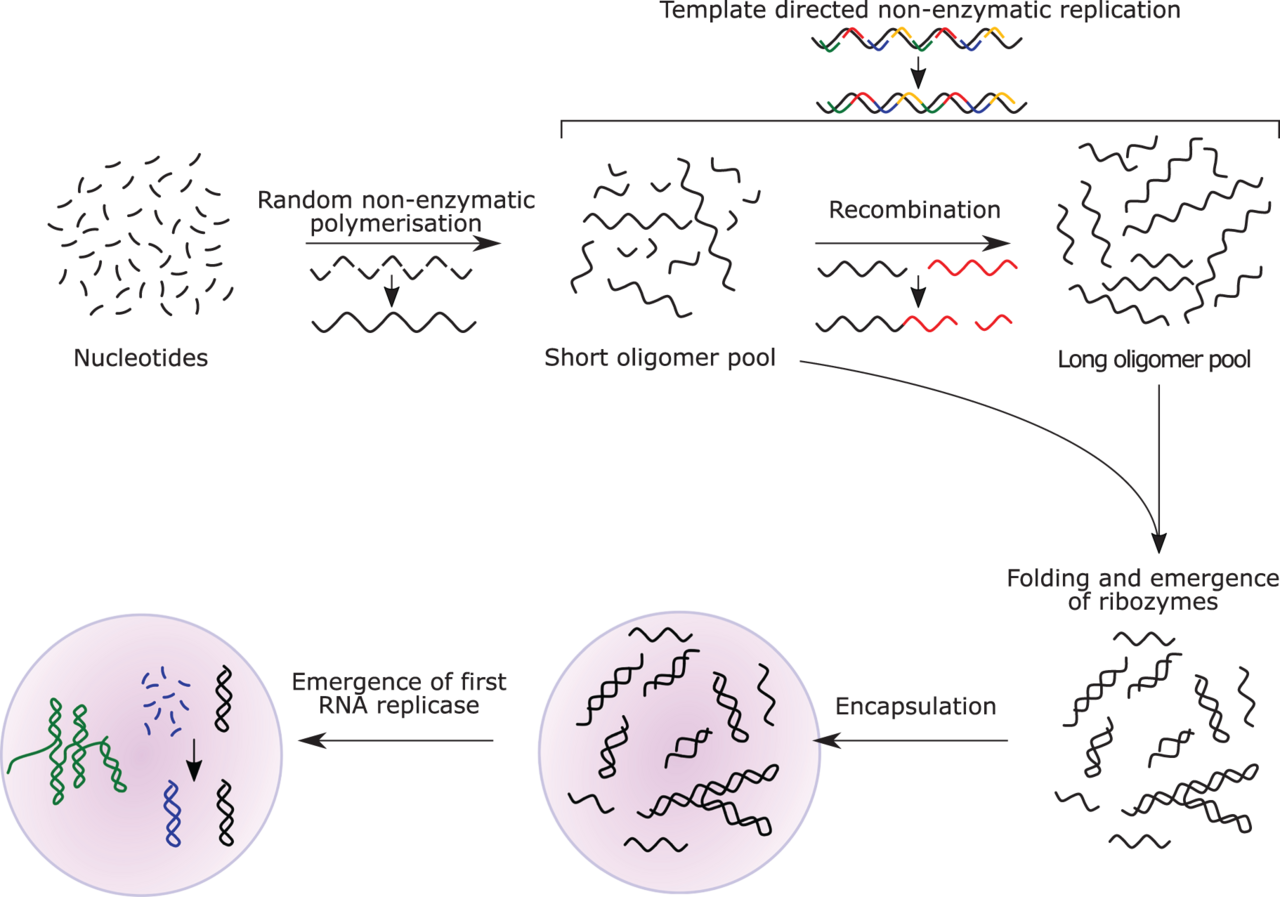
Laboratory work has produced ribozymes by directed evolution that perform a wide range of reactions, including copying other RNA strands with reasonable accuracy.
The central demonstration is missing. No ribozyme has been made that copies itself completely and accurately enough to sustain evolution. The best replicase ribozymes copy strands shorter than themselves, or copy accurately over too short a length, and closing that gap has resisted three decades of work.
The chemistry of getting there is also hard. Assembling ribonucleotides from plausible prebiotic starting materials was long considered a serious obstacle, and John Sutherland's group made major progress from 2009 by finding routes that build the components in a different order than chemists had assumed. It is progress rather than a solution, and the routes require particular sequences of conditions.
RNA is fragile. It hydrolyses readily, faster in warm water and at extremes of pH, which constrains where an RNA world could have existed.
And the origin of the genetic code remains unexplained. The mapping from codons to amino acids has to arise somewhere, and the RNA world does not obviously produce it.
Metabolism-first proposals hold that self-sustaining chemical cycles came before any replicator, with heredity arriving later. These avoid the problem of assembling a complex molecule by chance and have their own difficulty: it is unclear how such a cycle evolves without a copyable record.
Peptide-nucleic acid hybrids and simpler genetic polymers have been proposed as predecessors to RNA, on the grounds that RNA is too complex to be first. Several such molecules can carry information and are easier to form.
The field has moved toward integration rather than choosing. The current trend is away from single-mechanism accounts and toward staged models in which compartmentalisation, energy gradients, simple catalysis and replication develop together rather than in sequence.
The RNA world is the leading account and is not established.
What would settle it is a self-sustaining RNA replicator produced in the laboratory under conditions plausible for the early Earth. That would show the mechanism works; it would still not show it is what happened, since the origin of life is a historical event and no direct record of it exists or could.
That limitation is worth stating plainly. Origin of life research can establish what is chemically possible and cannot establish what occurred, and any account of it will remain a hypothesis in a stronger sense than most.