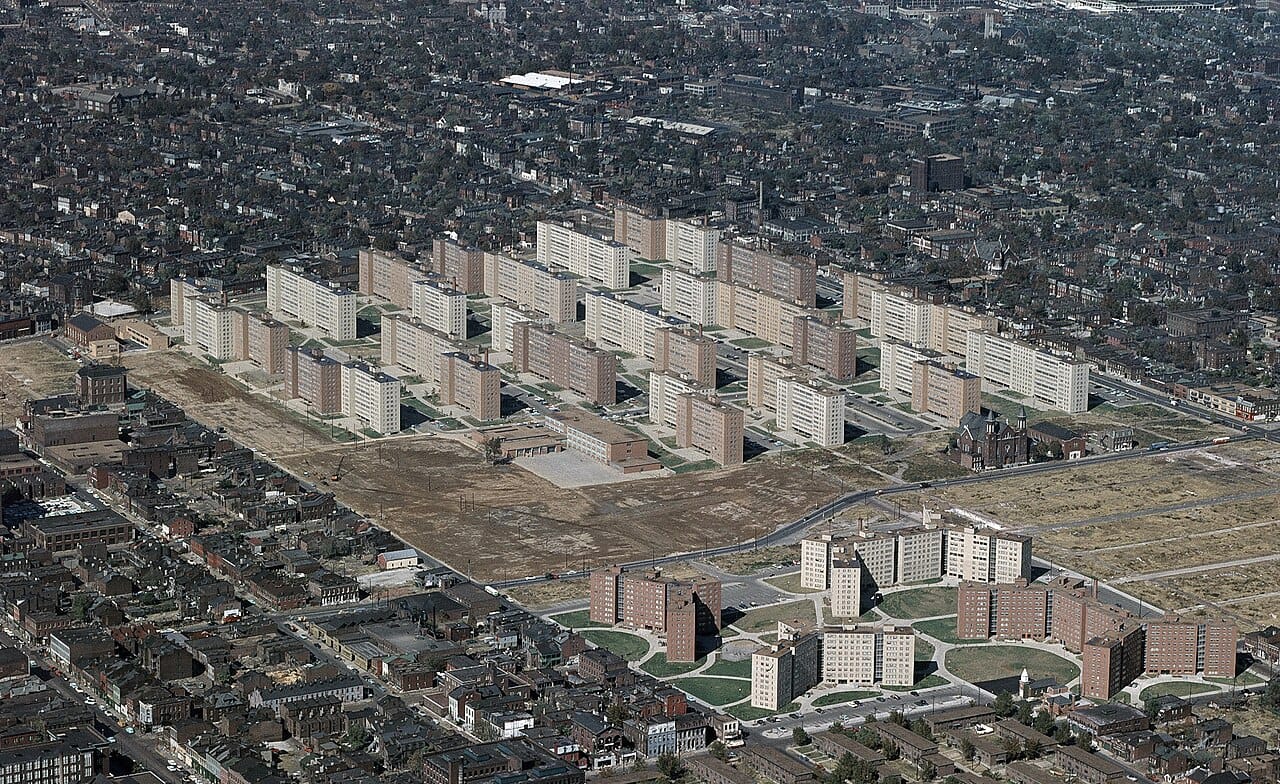
The regulation of what may be built where, by dividing a city into districts with different permitted uses and building limits. It is the primary legal instrument shaping the physical form of most cities, and its consequences have been substantial and frequently unintended.
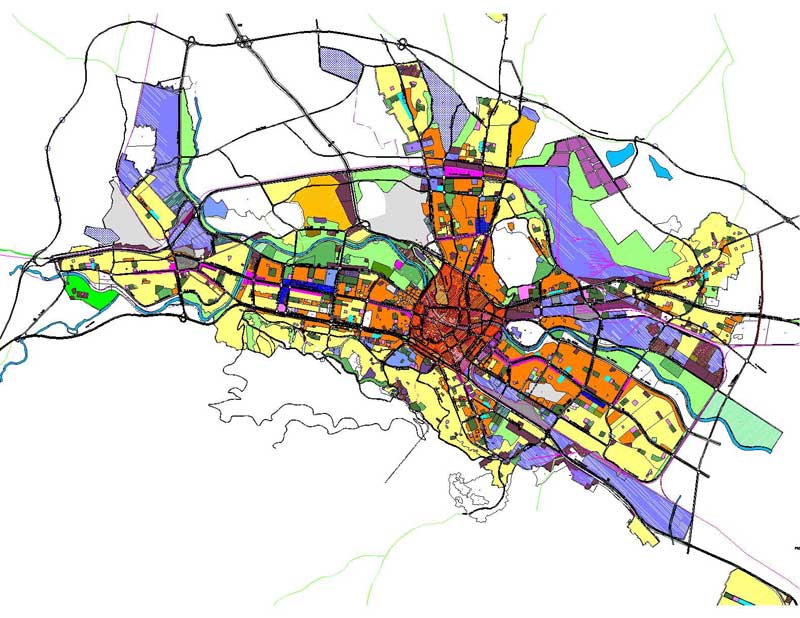
Use is the primary control: whether a parcel may hold housing, retail, offices, industry or institutions, and often which sub-type of each.
Density controls how much may be built, through limits on floor area relative to lot size, on the number of dwellings, or on height.
Form controls the building's placement: setbacks from the street and boundaries, lot coverage, and height limits.
Parking requirements specify a minimum number of spaces per dwelling or per unit of floor area, and these have proved among the most consequential provisions.
Enforcement is through permission. Construction requires approval, and departures require a variance or rezoning, which is where most of the political contest occurs.
Zoning arose from genuine problems. Nineteenth century industrial cities placed factories, slaughterhouses and tanneries adjacent to housing, with severe consequences for health and safety, and separating incompatible uses was the original purpose.
Germany developed district-based regulation in the late nineteenth century. New York adopted the first comprehensive American ordinance in 1916, prompted partly by the Equitable Building, whose bulk cast a very large shadow, and partly by pressure from Fifth Avenue retailers seeking to exclude garment manufacturing.
The United States Supreme Court upheld zoning as a legitimate exercise of public power in 1926, and adoption spread rapidly afterwards.
The original justification, separating harmful industry from homes, has weakened as heavy industry has left most cities, while the regulatory apparatus built for it has remained and expanded.

Much North American zoning is exclusionary in structure, with large areas designated for detached single-family housing only, in which apartments, terraced housing and small shops are prohibited.
The documented effects are considerable.
Housing supply is constrained where demand is highest, since land zoned for low density cannot accommodate more people regardless of price. Economic research consistently attributes a substantial part of housing cost growth in high-demand cities to supply restriction.
Separation of uses makes distances longer, which makes driving necessary. A residential district with no permitted shops requires a car trip for ordinary errands, and minimum parking requirements then dedicate large areas to vehicle storage, further spreading destinations apart. The relationship is self-reinforcing.
Environmental consequences follow from the transport pattern, including higher emissions per person and consumption of land at the urban edge.
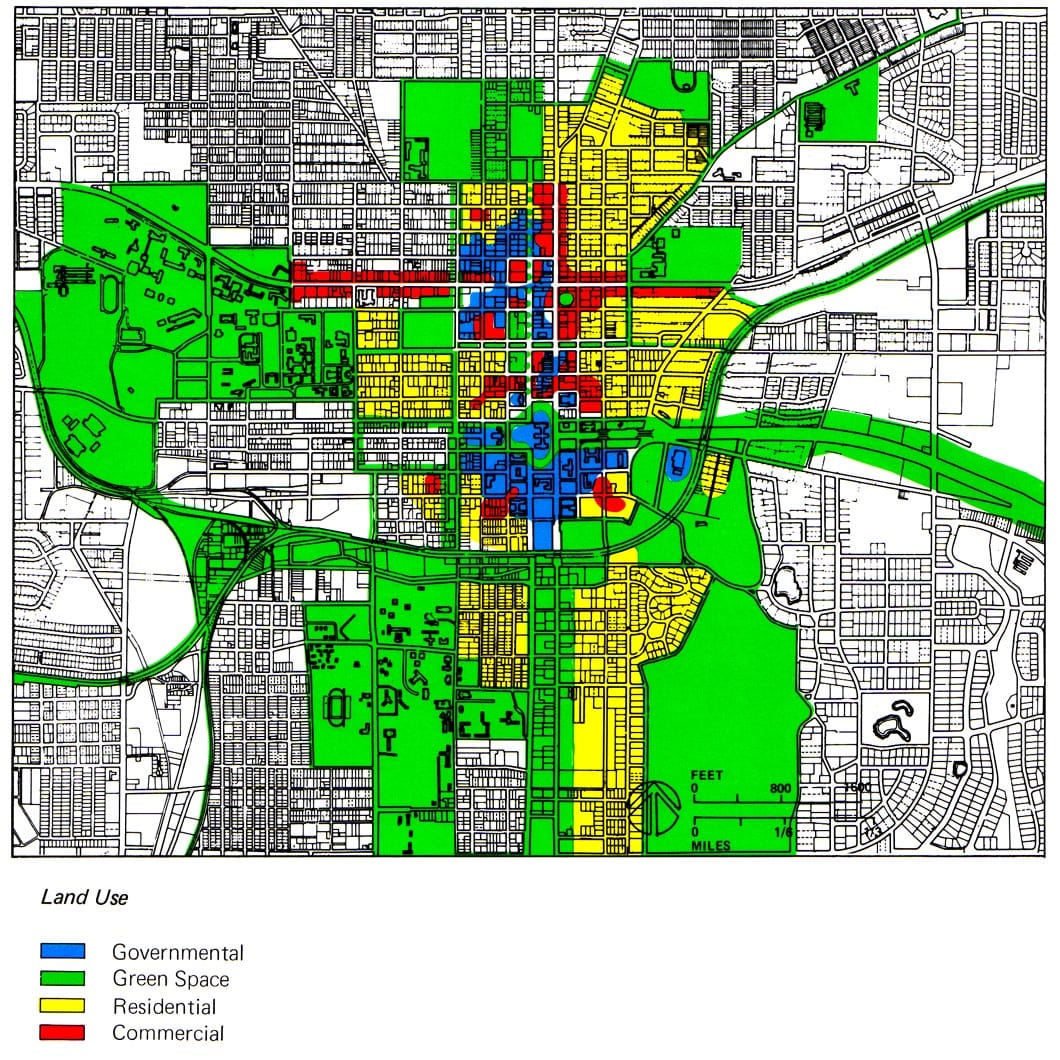
Racial and economic segregation has been an effect and, historically, an intent. After explicitly racial zoning was struck down in the United States in 1917, minimum lot sizes and prohibitions on multi-family housing achieved comparable separation by economic means, and this history is documented in the ordinances themselves.
Reform advocates argue that use separation is obsolete for most modern activity, that density restrictions cause housing shortages, and that the rules should be liberalised. Several jurisdictions have acted: New Zealand and parts of the United States and Canada have removed single-family-only zoning or legalised additional units by right, and minimum parking requirements have been abolished in a number of cities.
Defenders argue that zoning protects residents from genuine harms, preserves neighbourhood character and property values, and that removing controls transfers decisions to developers.
The evidence on reform is accumulating and not yet conclusive, since the changes are recent and construction responds slowly. Early results from places that liberalised, including Auckland and Minneapolis, have been reported as showing increased construction and slower rent growth, and these findings are debated.
Alternative approaches include form-based codes, which regulate the shape and street relationship of buildings rather than their use, on the reasoning that what matters is whether a building fits its context rather than what happens inside it.
Japan offers a frequently cited contrast, with zoning set nationally rather than locally, organised as a hierarchy in which less intensive uses are permitted in more intensive zones, and with correspondingly higher housing construction and more stable prices in large cities.
Zoning determines the physical form of cities more directly than architecture or economics, because it sets the boundaries within which both operate. What can be built, at what density and next to what, is a legal question before it is a design or market one.
It is also an unusually clear case of regulation outliving its rationale. The problem it was created to solve, factories beside housing, has largely disappeared from cities, and the instrument built to address it now governs housing supply and transport patterns for which it was never designed.