A large ensemble of instrumentalists, organised into sections and directed by a conductor. Its composition was not designed but accumulated, and it stabilised into its present form in the nineteenth century.
Strings form the core and the largest group: violins divided into two parts, violas, cellos and double basses. Multiple players read each part, which is what distinguishes the string section from every other, where each player generally has an individual line.
Woodwind comprises flutes, oboes, clarinets and bassoons, usually in pairs or threes, with related instruments including piccolo and cor anglais.
Brass comprises horns, trumpets, trombones and tuba.
Percussion covers timpani, which were the earliest to be standard, and a wide and variable group of others.
Harp, keyboard and additional instruments are added as a work requires.
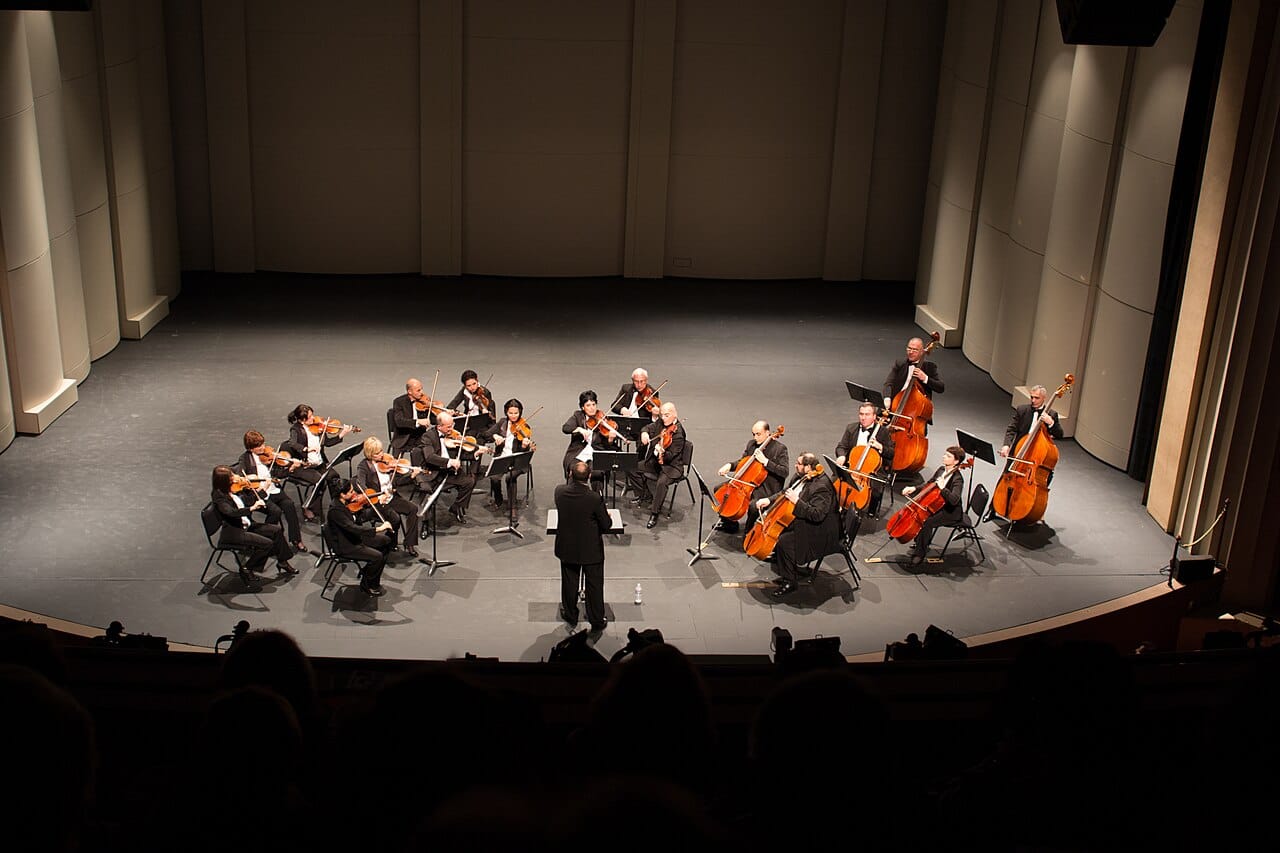
A full symphony orchestra numbers around eighty to a hundred players, and a chamber orchestra perhaps thirty to forty.
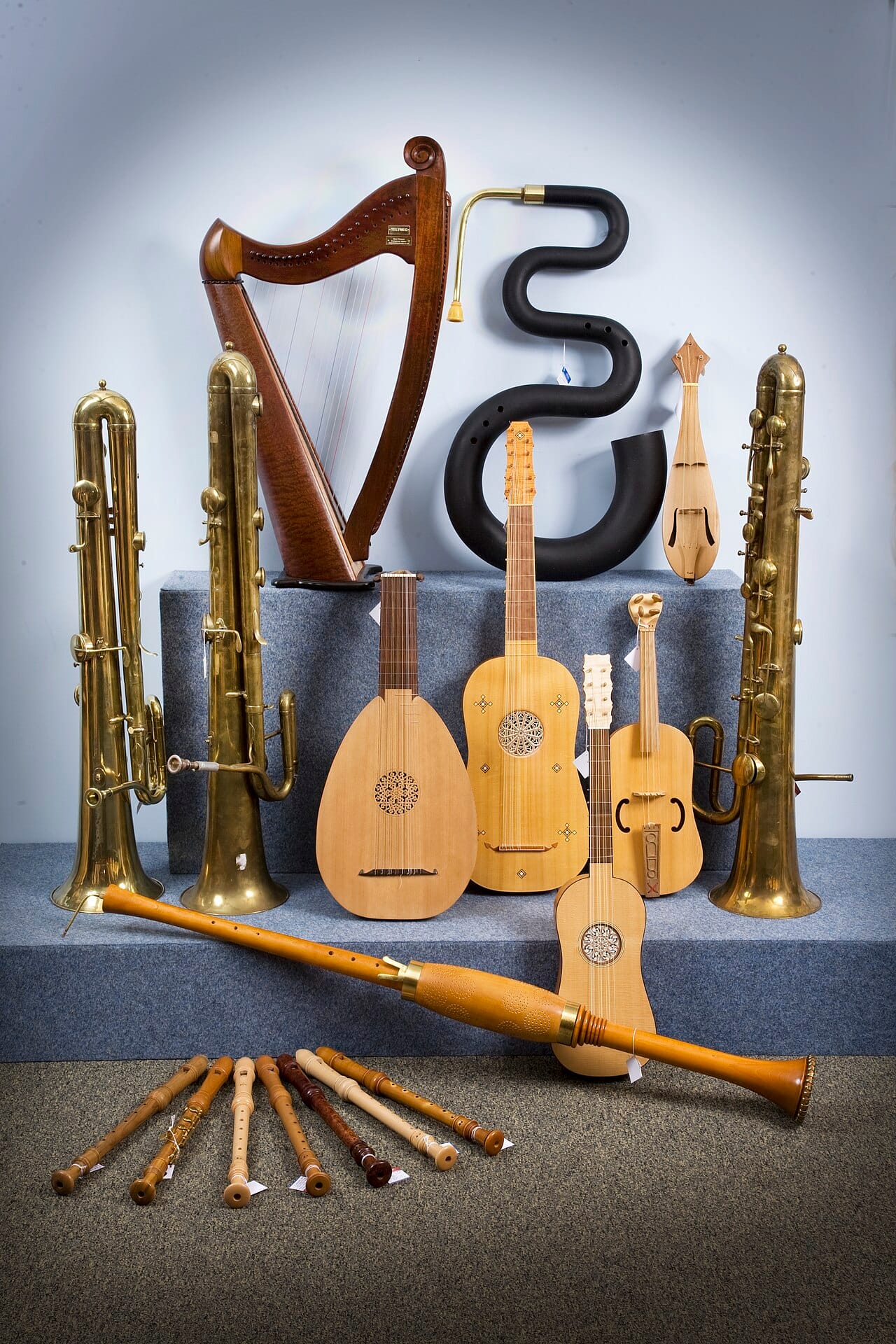
The orchestra was not designed. It accumulated through the seventeenth and eighteenth centuries around a core of strings, with wind instruments added as their construction improved enough for reliable intonation.
The Baroque orchestra was small and included a continuo, a harpsichord or organ with a bass instrument, filling in harmony from a shorthand notation.
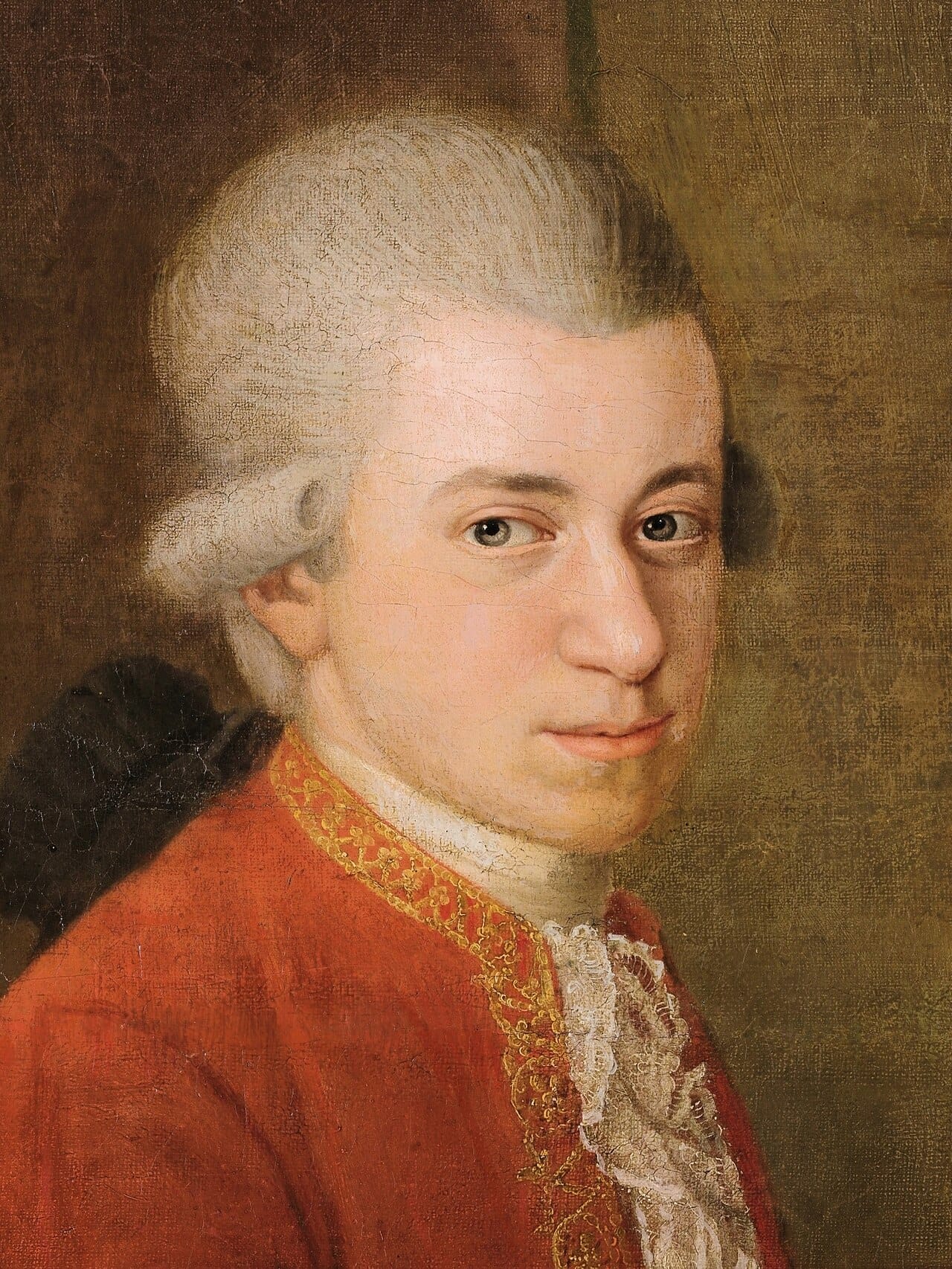
The Classical orchestra of Haydn and Mozart standardised strings with pairs of winds and horns, and the continuo disappeared as composers wrote out the harmony fully.
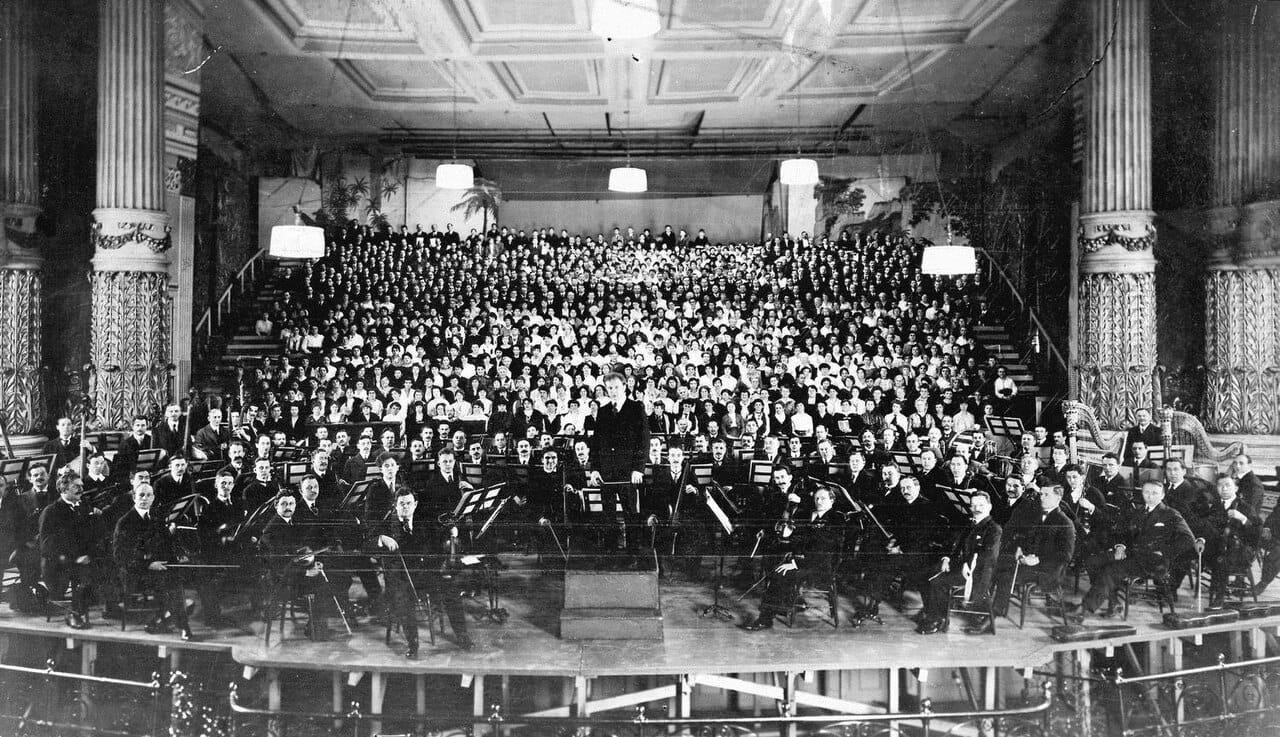
The nineteenth century expanded it substantially. Valves made brass instruments chromatic, larger concert halls demanded more volume, and composers wrote for progressively larger forces. Berlioz, Wagner and Mahler pushed the size furthest.
Twentieth century composers often wrote for smaller or unconventional groupings, and the standard orchestra remained as the ensemble the existing repertoire requires.
Conducting as a distinct role is younger than the orchestra. Ensembles were formerly led by the first violinist or from the keyboard, and beating time with a visible gesture became standard only in the nineteenth century as ensembles grew beyond what could be coordinated by listening.
The conductor's function is more than timekeeping. Decisions about balance between sections, tempo and its flexibility, phrasing and articulation are interpretative, and two conductors produce audibly different results from the same score and the same players.
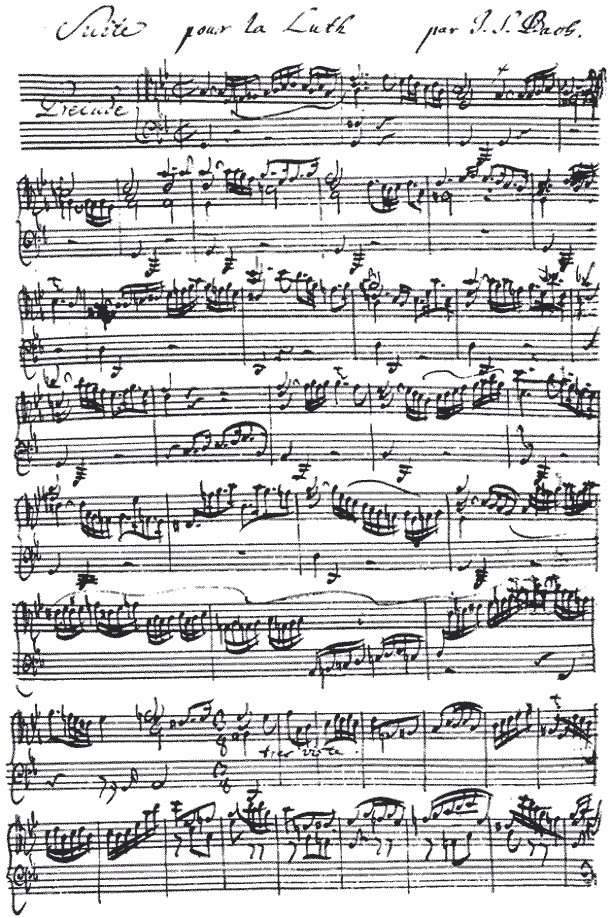
Rehearsal is where most of the work occurs. The performance is the visible part of a process in which the conductor has already settled hundreds of questions the score does not specify, as the musical notation capsule describes.
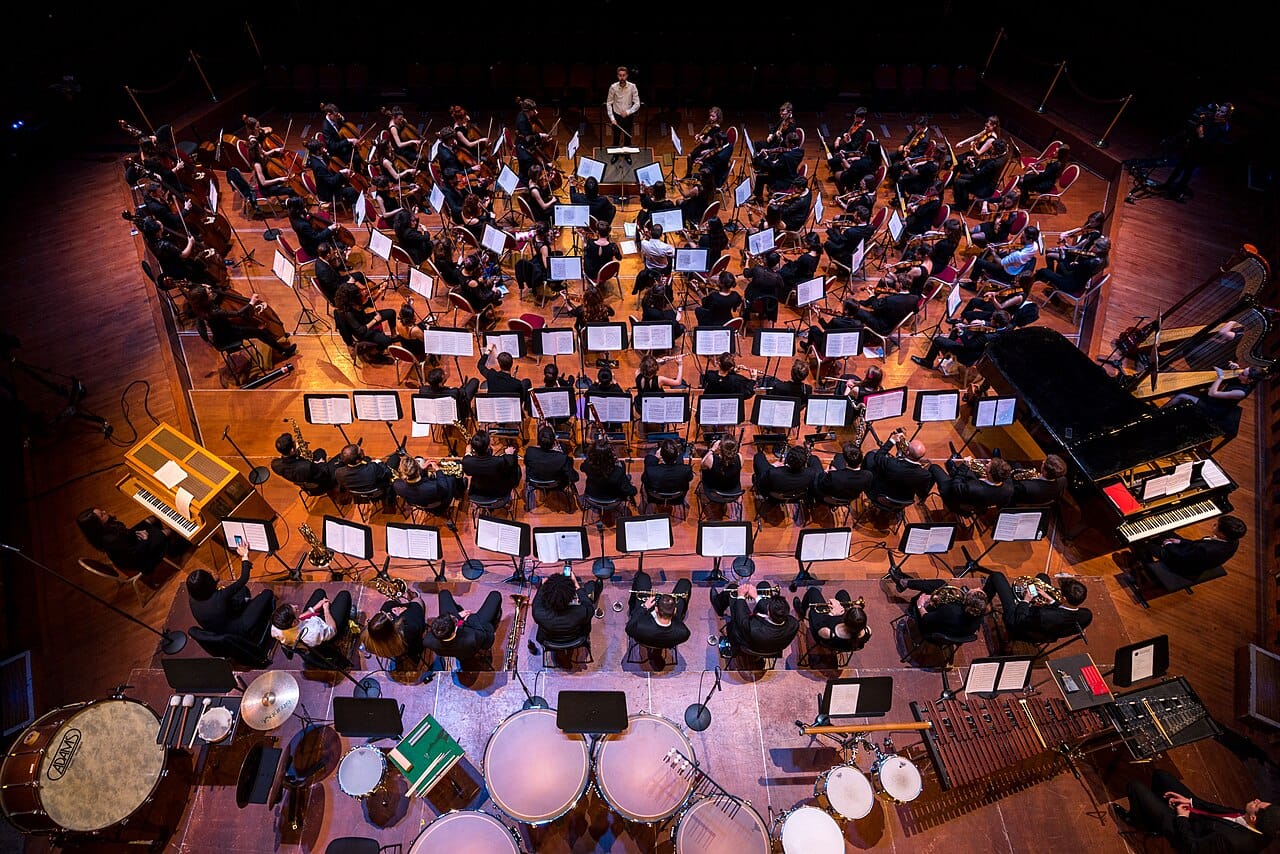
The standard layout places higher strings to the conductor's left and lower to the right, winds in the centre behind them, brass and percussion at the back.
The arrangement is acoustic and practical. Quieter instruments sit nearer the audience, louder ones further back, and players who must coordinate closely sit together.
Alternatives exist. Divided violin seating, placing second violins opposite firsts rather than beside them, was standard until the mid-twentieth century and is used by some ensembles for repertoire written with that arrangement in mind, since composers wrote passages that pass between the two.
Orchestras are expensive. A hundred salaried musicians, a hall, and administration cannot be funded by ticket revenue alone, and essentially every professional orchestra depends on public subsidy, philanthropy or both.
The economics have a structural feature described by the economists William Baumol and William Bowen: a string quartet requires the same four players and the same time as it did two centuries ago, so productivity cannot rise as it does in manufacturing, while wages must track the wider economy. Costs therefore rise relative to output indefinitely. This has been called Baumol's cost disease and it applies to live performance, education and care work alike.
The consequence is that orchestras face permanent financial pressure that is a property of the form rather than of mismanagement.
The orchestra is the ensemble for which a large part of the Western art music repertoire was written, and that repertoire cannot be performed as written without it.
It is also a striking instance of large-scale non-verbal coordination. Around a hundred people produce a coherent result from a written specification that leaves a great deal unstated, relying on shared convention, sustained rehearsal and a single interpreter's decisions.