The layer of weathered mineral material, organic matter, water, air and organisms covering most land surfaces. It supports essentially all terrestrial plant life, it forms extremely slowly, and it is being lost far faster than it is replaced.
A typical productive soil is roughly half solid material and half pore space, with the pores holding water and air in varying proportion.
The solid fraction is mostly mineral, derived from weathered rock, plus a small percentage of organic matter that is disproportionately important to its behaviour.
Mineral particles are classified by size: sand, silt and clay. The proportions determine texture, which governs drainage, water retention and workability. Sandy soils drain quickly and hold little water; clay soils hold a great deal and drain poorly.
Structure is distinct from texture and is arguably more important. Particles bind into aggregates, held together by organic matter, fungal threads and root exudates, and the spaces between aggregates form the pore network. A soil with good structure admits water and air and resists erosion; a compacted or degraded one does not, regardless of texture.
Soil is also alive. A handful contains billions of bacteria, kilometres of fungal hyphae, and populations of protists, nematodes, arthropods and earthworms. This community drives decomposition and nutrient cycling, and the fungi capsule describes the mycorrhizal partnerships involved.
Soil formation is described by five factors, set out by Hans Jenny in 1941: parent material, climate, organisms, topography and time.
The process begins with weathering, physical and chemical, breaking rock into fragments. Organisms colonise, contributing organic matter and accelerating weathering chemically.
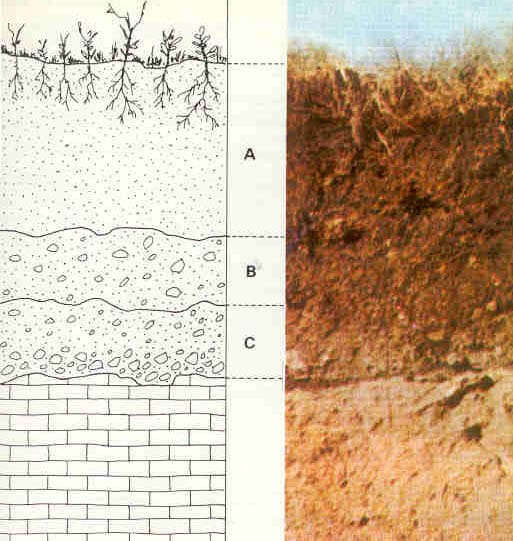
Over time distinct horizons develop, forming a profile: an organic surface layer, a topsoil enriched in organic matter, a subsoil where material leached from above accumulates, and weathered parent material below.
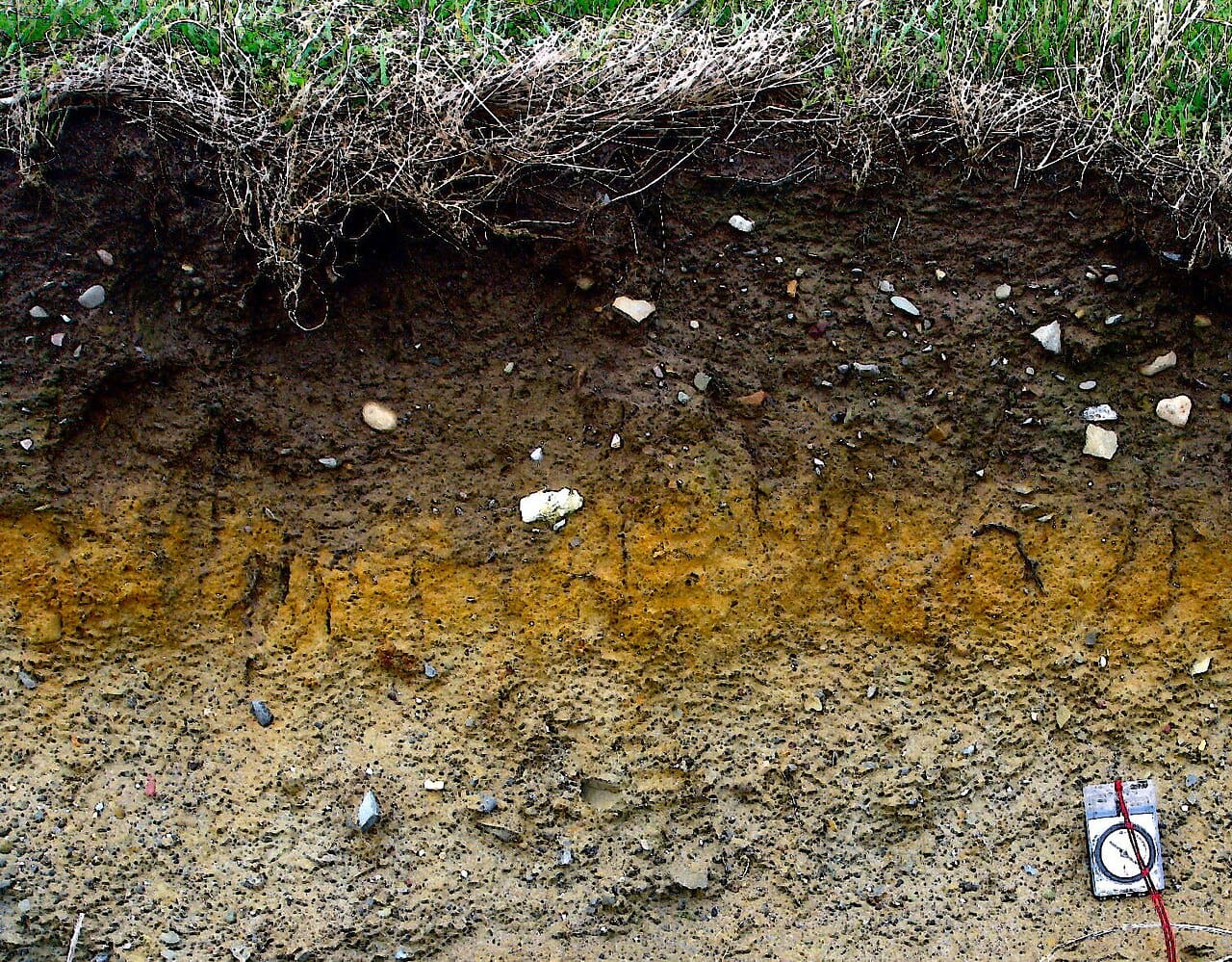
The rate is the critical number. Estimates for the formation of a centimetre of topsoil range from roughly one hundred to over a thousand years depending on conditions. On any human timescale soil is effectively non-renewable.
Food production depends on it almost entirely. The overwhelming majority of human calories originate in plants grown in soil.
Water regulation. Soil absorbs precipitation, releases it slowly, and reduces flooding. Compacted or sealed ground does neither, which is why urbanisation increases flood peaks.
Nutrient cycling. Soil organisms decompose organic matter and make nutrients available, and soil retains those nutrients against leaching.
Carbon storage. Soils hold more carbon than the atmosphere and all vegetation combined, which makes changes in soil carbon consequential in both directions.
Filtration. Water passing through soil is physically and biologically cleaned, which is why groundwater beneath undisturbed soil is generally potable.
Habitat. A large share of terrestrial biodiversity lives in soil, and much of it is undescribed.
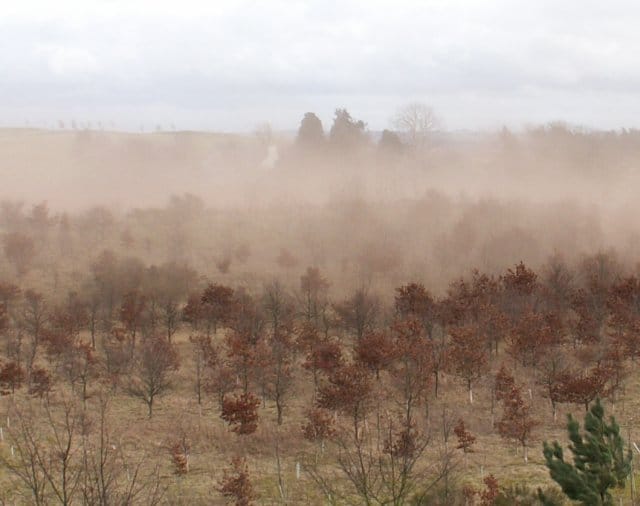
Erosion is the largest problem. Ploughing exposes bare soil, and rain and wind remove it. Measured erosion rates on conventionally tilled cropland commonly exceed formation rates by a factor of ten or more.
Compaction from heavy machinery destroys structure, reducing infiltration and root penetration.
Organic matter decline follows continuous cultivation without return of residues, and reduces both fertility and structural stability.
Salinisation affects irrigated land in dry regions. Irrigation water contains dissolved salts, and where evaporation exceeds drainage the salts accumulate until crops fail. This has ended agriculture in irrigated regions repeatedly through history, including in ancient Mesopotamia.
Sealing under buildings and roads removes soil from function entirely, and it disproportionately affects the most fertile land, since settlements were founded on it.
Estimates of the share of agricultural soil that is degraded to some degree are commonly around a third, though definitions vary and the figures are contested.
Reduced or no tillage leaves residue on the surface and avoids inverting the soil, which cuts erosion substantially.
Cover crops keep living roots in the ground between cash crops, protecting the surface and adding organic matter.
Crop rotation and diversification reduce disease pressure and improve structure.
Organic amendments, including manure and compost, rebuild organic matter.
Contour cultivation and terracing reduce erosion on slopes and are among the oldest soil conservation techniques.
Soil is the substrate on which terrestrial food production depends, and it forms over centuries while being lost over years, which makes the arithmetic straightforward and uncomfortable.
It is also routinely described as dirt, which understates what it is. Soil is a structured, living system, and the difference between soil and ground-up rock is precisely the structure and the organisms that take centuries to establish.