The social construction of reality is the thesis that much of what people treat as simply given about the world is in fact produced and sustained by social agreement. Set out by Peter Berger and Thomas Luckmann in 1966, it is one of the most influential ideas in modern sociology, and one of the most frequently misunderstood.
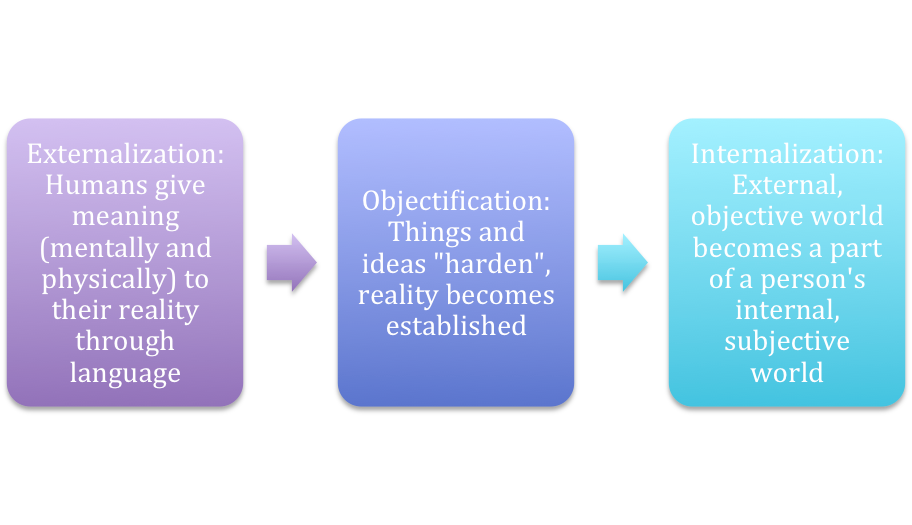
Berger and Luckmann described a three-part process. Externalisation: people act in the world and produce arrangements, institutions, and roles. Objectivation: those products come to be experienced as facts existing independently of the people who made them, so that money, universities, borders, and job titles feel like features of the world rather than agreements about it. Internalisation: the next generation is socialised into these arrangements and receives them as simply how things are.
Their central observation is that this process conceals itself. An institution that everyone treats as natural is more stable than one everyone recognises as chosen, so successful construction ends by looking like discovery.
The theory is about social facts, and this distinction is where most misreading occurs. That money has value, that a piece of paper is a passport, that a particular gesture is an insult: none of these hold independently of collective agreement, and all would cease to hold if the agreement did. John Searle later formalised this, distinguishing brute facts, which obtain regardless of what anyone thinks, from institutional facts, which exist because a community treats them as existing.
The claim is not that physical reality depends on belief. Berger and Luckmann were writing about the everyday knowledge ordinary people take for granted, not about the truth of scientific findings. Later authors extended constructionist arguments into the sociology of scientific knowledge, and that extension, not the original thesis, is what provoked the disputes of the 1990s known as the science wars.

The framework became foundational across the social sciences. It underlies work on the social construction of gender, race, illness, childhood, and deviance, in each case asking which features of a category are given and which are produced by classification itself. Ian Hacking's analysis of looping effects added an important refinement: classifying people changes how they understand and conduct themselves, which changes the group being classified, so the categories and the people co-evolve in a way categories in the natural sciences do not.

Critics argue the phrase has been stretched until it means little, applied indiscriminately to things that are clearly conventional and to things that are not. A second objection is that strong versions collapse into relativism, since if all knowledge is constructed there is no ground on which to prefer one account over another, and the claim would apply to itself. A third, from within sociology, is that the approach can underplay material constraints: a category may be constructed and still be enforced by police, employers, and law, so calling it constructed does not make it optional for the person subject to it. Berger himself was critical of what the idea became in later hands.