The ability to read and write. It is a comparatively recent condition for most of humanity, it was achieved unevenly and rapidly, and it changes the brain of the person who acquires it.
Literacy is not a single threshold. Definitions range from signing one's name, used in historical records, to the functional ability to understand and use written information in daily life.
International measurement generally distinguishes basic literacy from functional literacy, and assesses the latter across levels of complexity. By those measures, substantial proportions of adults even in wealthy countries have difficulty with tasks such as interpreting a dense official letter or comparing two sources of information.
Historical rates are therefore hard to compare with modern ones, since the older measures record something much weaker than what is now meant.

For most of writing's history, literacy was confined to a small professional class. Scribes were trained specialists, and the complexity of early scripts made the training long.
Alphabetic writing lowered the barrier considerably, since a few dozen symbols can be learned in a fraction of the time required for thousands.
Printing from the fifteenth century made text cheap. Religious movements that required individuals to read scripture themselves raised demand directly, and areas affected by the Reformation show earlier and higher literacy.
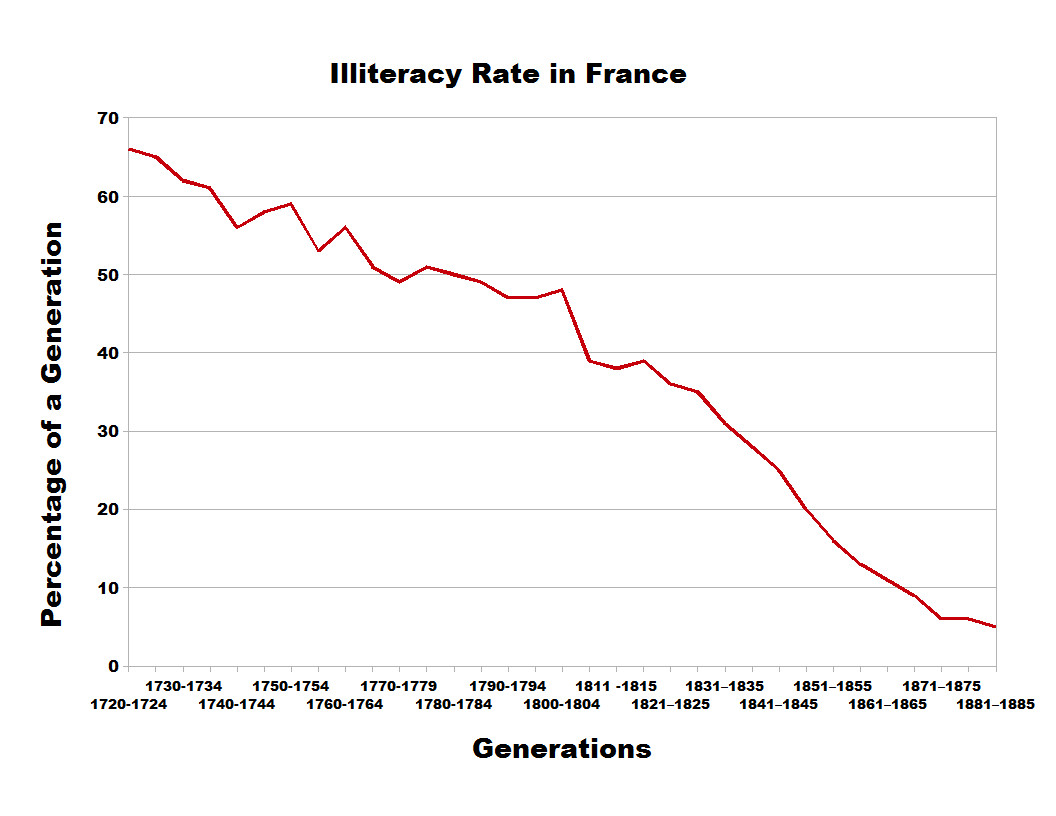
Mass literacy in Europe and North America is largely a nineteenth and twentieth century achievement, driven by compulsory schooling, and the global adult literacy rate has risen from a small minority two centuries ago to something close to nine in ten today.
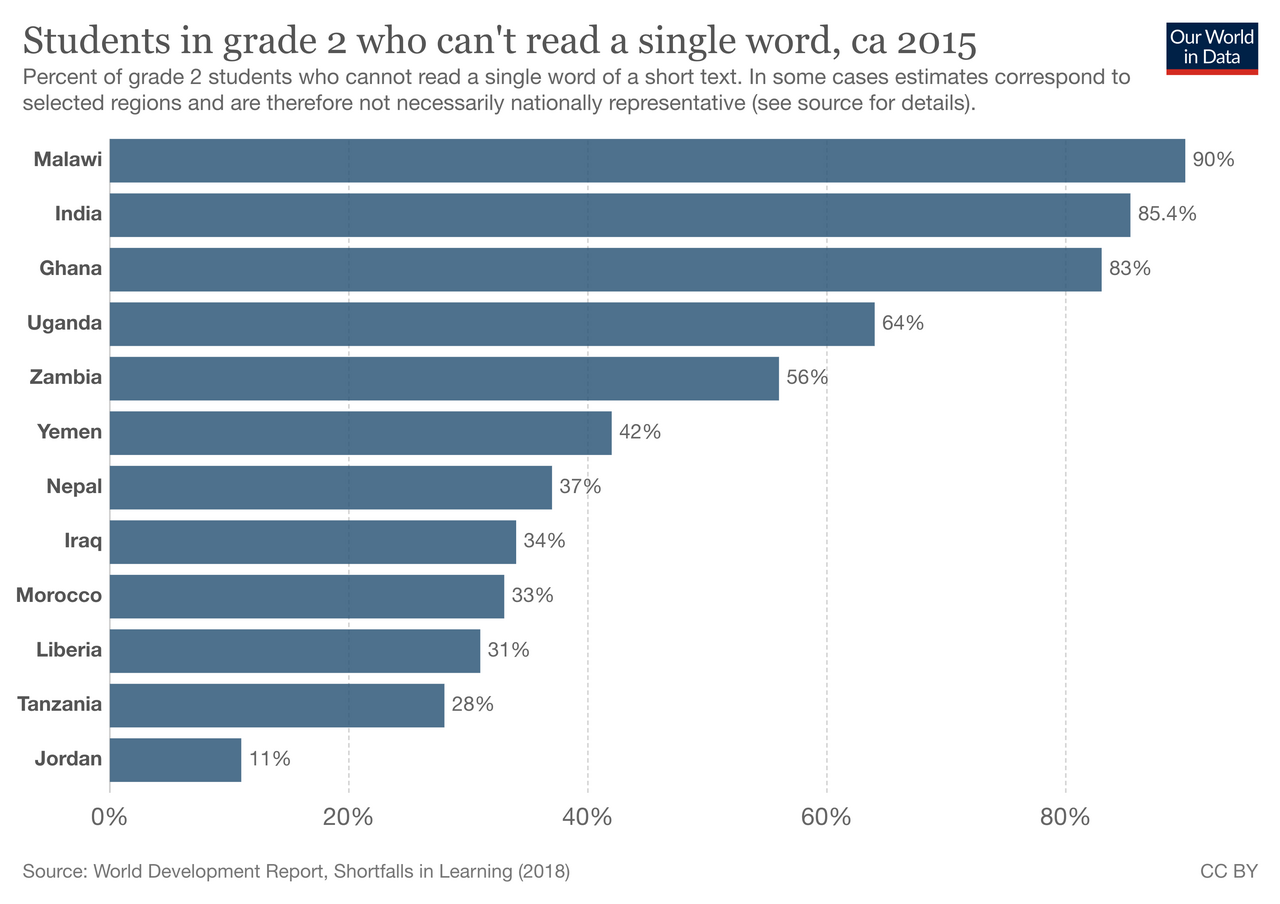
The remaining gap is uneven. Rates are lowest in parts of sub-Saharan Africa and South Asia, and women remain less likely to be literate than men in several regions, though the gap has narrowed substantially among younger cohorts.
Writing is far too recent for the brain to have evolved specialised structures for it. Learning to read therefore repurposes existing systems, a process described as neuronal recycling.
A region of the left ventral occipitotemporal cortex becomes specialised for recognising written words, and it appears in the same location across readers of very different scripts. Reading connects that visual system to the language networks that already existed for speech.
Acquiring literacy produces measurable changes. Studies comparing literate and non-literate adults of similar background find differences in the processing of speech sounds, in visual processing, and in verbal memory. One consistent finding is that literacy sharpens awareness of the individual sounds within words, because alphabetic writing requires that they be separated, and this awareness is both a consequence of learning to read and a predictor of how easily it is learned.
Reading is also acquired differently from speech. Speech develops without instruction given ordinary exposure; reading generally requires explicit teaching, which is why literacy depends on schooling in a way that language does not.
Dyslexia, a specific difficulty with reading that is not explained by general ability or instruction, affects a substantial minority and is associated with differences in the processing of speech sounds.
Individual outcomes correlate strongly with literacy, including income, health and civic participation. Maternal literacy in particular is associated with child survival and nutrition, an association robust enough to have shaped development policy.
At the level of societies, literacy allows knowledge to be stored, checked and accumulated outside living memory, and it allows administration, law and contract to operate at scale.
The direction of causation is not simple. Literacy is both a cause of development and a consequence of it, since schooling requires resources, and the relationship is reinforcing.
Text has become more central to daily life rather than less. Messaging, search and social media are text-based, and the volume of reading and writing most people do has increased.
The character of that reading has changed, toward shorter pieces, more sources, and material of uncertain reliability. This has prompted arguments that the relevant skill now includes evaluating sources, and digital literacy is increasingly assessed as a distinct competence.
Whether extended reading of long texts is declining is debated, with survey evidence pointing in different directions depending on what is counted.
Literacy is the mechanism by which a person gains access to knowledge accumulated by people they will never meet, and its spread from a specialist skill to a near-universal one is among the largest changes in human capability on record.
It is also unusual as a cultural invention that reshapes the individual who acquires it, since learning to read alters how the brain processes both vision and speech in ways that persist.