The use of friction ridge patterns on the fingers to identify individuals. It was the first widely adopted scientific identification method, it remains in routine use worldwide, and its evidentiary claims have been substantially revised in the past two decades.
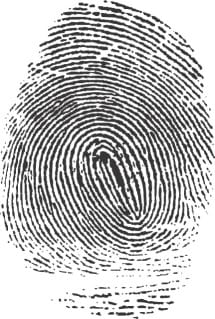
Friction ridges cover the fingers, palms and soles. They form during fetal development, under a combination of genetic influence and the physical conditions in the womb, which is why identical twins have similar overall patterns and different detail.
Patterns are classified into broad types, principally loops, whorls and arches. These are useful for sorting and are far too common to identify anyone.
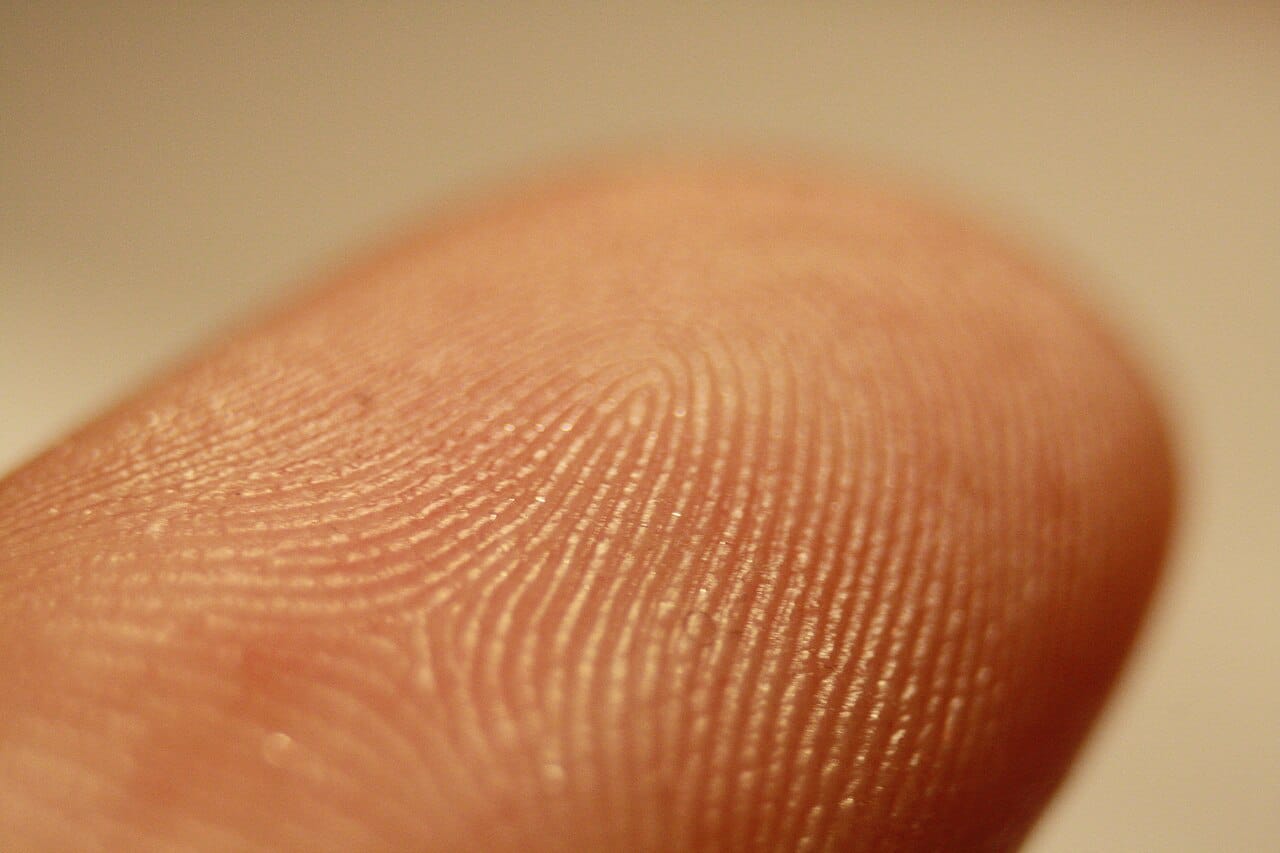
Identification rests on minutiae, the points where a ridge ends or divides. An examiner compares the type, position and relative orientation of these features between two prints.
The ridges are considered persistent through life, changing in size as a person grows but not in arrangement, and regenerating after superficial injury. Deep damage to the underlying skin layer produces permanent scarring, which is itself distinctive.
Ridge patterns were noticed and used as marks in several societies well before any systematic method existed.
The nineteenth century problem was identifying repeat offenders in growing cities where nobody knew anyone. The existing system, Bertillonage, took a series of body measurements, and it was cumbersome and produced collisions between different people.
William Herschel used fingerprints on contracts in India from the 1850s. Henry Faulds published on their forensic potential in 1880 and proposed their use in identifying criminals.
Francis Galton studied them statistically in the 1890s, arguing that they are persistent and that the probability of two individuals sharing a full pattern is extremely small. Juan Vucetich in Argentina developed a classification system and secured the first criminal conviction using fingerprint evidence in 1892. Edward Henry's system, developed in India and adopted by Scotland Yard, became the standard in the English-speaking world.
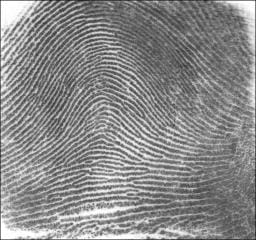
The reason for the classification systems was practical: a collection of hundreds of thousands of paper cards had to be searchable by hand, and the pattern types provided the filing structure.
Computerised systems from the 1980s replaced manual search, encoding minutiae and returning ranked candidate lists, which are then compared by a human examiner. The examiner remains the decision-maker.
Prints deposited at a scene are latent, meaning invisible, consisting of sweat and oils transferred from the ridges.
They are developed by powders that adhere to the residue, by chemical reagents such as ninhydrin which reacts with amino acids on porous surfaces, or by cyanoacrylate fuming, in which superglue vapour polymerises on the residue.
Recovery quality varies enormously. A print from a controlled ten-print record is complete and clear; a latent print from a scene is typically partial, smudged, overlapped with others, and deposited on an awkward surface, which is the central practical difficulty.
For most of the twentieth century, examiners testified that a fingerprint identification was absolute and carried a zero error rate. That claim has not survived scrutiny.
The Brandon Mayfield case in 2004 is the standard illustration. An American lawyer was arrested in connection with the Madrid train bombings after three FBI examiners and an independent court-appointed expert identified his print from the scene. Spanish authorities disagreed, and the print was eventually matched to an Algerian national. Mayfield had never been to Spain. The subsequent review found that the initial identification had influenced the later ones, a form of confirmation bias within the examination process.
A 2009 report by the United States National Research Council examined forensic disciplines broadly and found that fingerprint analysis, along with several other pattern-matching methods, lacked adequately established error rates and standardised criteria, and that claims of absolute certainty were not scientifically supportable.
Studies since have measured examiner performance directly. A large study published in 2011 found false positive rates low but not zero, and found meaningful disagreement between examiners on the same prints, and repeat testing found examiners sometimes disagreeing with their own earlier conclusions.
Contextual bias has been demonstrated experimentally: examiners given extraneous case information reached different conclusions on the same prints. This has prompted procedural changes, including blind verification and limiting what information the examiner receives.
The current professional position is more careful. Standards bodies discourage claims of absolute identification and of zero error rate, and encourage conclusions stated as strong support rather than certainty.
Fingerprint comparison remains a valuable and widely used method. The revision concerns how its conclusions should be expressed, not whether it works.
The underlying premises, that ridge detail is highly variable between individuals and persistent within one, are well supported. What was not supported was the leap from those premises to certainty in any individual comparison of a partial, degraded latent print.
Fingerprinting is the origin of forensic identification and the template for the disciplines that followed, and its history is the clearest example available of a forensic method whose scientific claims outran its evidence for a century before being examined.
The correction is also instructive in what it did not do. The method was not discarded; its claims were calibrated. That distinction matters for the other pattern-matching disciplines, including bite marks, tool marks and hair comparison, which have been subject to the same scrutiny with less favourable results.