The proposal that Earth spent roughly a billion years, from about 1.8 to 0.8 billion years ago, in near-total stasis: stable climate, stable chemistry, stable atmosphere, and almost no evolutionary change. Whether the period was genuinely uneventful or merely poorly recorded is disputed.
The interval covers the middle Proterozoic and is unusual for what it lacks.
No glaciations are recorded across the whole billion years, which is remarkable given that severe global glaciations bracket it on both sides.
Atmospheric oxygen appears to have been low and stable, well above the vanishingly small levels before the Great Oxidation Event and well below modern levels.
Carbon isotope ratios in marine carbonates, which record disturbances to the carbon cycle, are unusually flat.
Eukaryotes existed but diversified very slowly. Multicellularity did not take hold. Almost nothing in the fossil record changes for the duration.
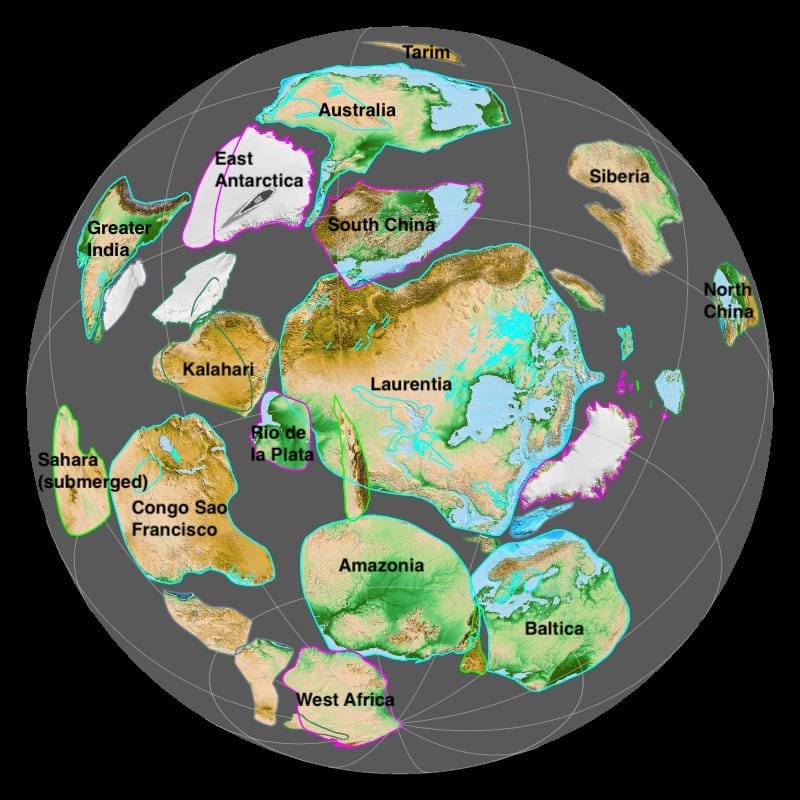
The tectonic setting was stable, with the supercontinent Rodinia assembled and remaining so for a long period.
Preston Cloud called it the dullest time in Earth's history, and the informal name has stuck.
Several accounts have been offered for why so little happened, and they are not exclusive.
Oxygen limitation is the most cited. Complex life has high oxygen requirements, and if levels sat below what large or active organisms need, the ceiling on complexity would be physical. Nick Lane and others have argued this constrained eukaryotic evolution directly.
Nutrient limitation is a variant. Some analyses find the ocean was sulphidic in its mid-depths and depleted in trace metals that enzymes require, particularly molybdenum, which nitrogen fixation depends on. A nitrogen-limited ocean would cap productivity.
Tectonic quiescence. With a stable supercontinent, less mountain building means less weathering, less nutrient delivery to the oceans, and fewer environmental changes to drive selection.
A self-stabilising system. Some argue the whole configuration was a stable state that resisted perturbation, and that escaping it required an external trigger.
The name has been increasingly criticised, and the objections have force.
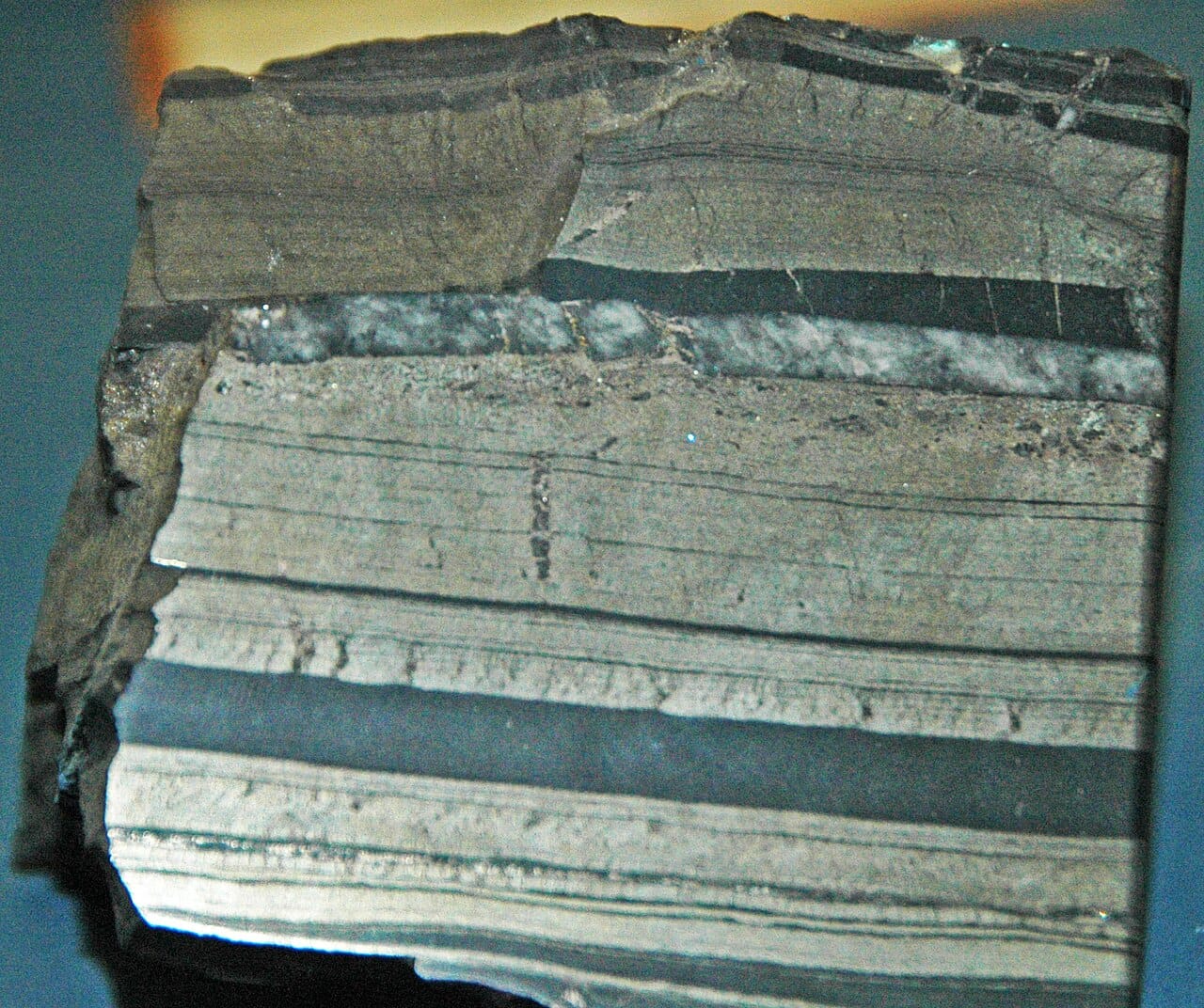
The preservation argument is the strongest. Rocks of that age are scarce, metamorphosed, and unevenly distributed. An apparent absence of events may be an absence of rock recording them. The word boring may describe the archive rather than the world.
Significant biological events have been identified within the interval. Eukaryotic sexual reproduction appears to have originated during it. The first multicellular eukaryotes are found in it. Red algae fossils from around 1.6 billion years show cellular structure indicating considerable complexity. Molecular clock estimates place several major eukaryotic lineage divergences inside it.
Some studies report oxygen fluctuations rather than a flat line, and argue that the sampling resolution has been too coarse to see them.
And a billion years of stability is itself a phenomenon requiring explanation, not an absence of one. Whatever held climate, chemistry and tectonics steady for that long was doing something.
The interval closes with the breakup of Rodinia, a rise in oxygen, and the severe glaciations of the Cryogenian, which are treated in the snowball Earth capsule.
Shortly afterward come the Ediacaran biota and then the Cambrian diversification. The proximity is suggestive and the causal chain is not established: whether rising oxygen permitted animals, or animals altered the oxygen budget, or both fed back on each other, is unresolved and actively argued.
The period bears on how likely complex life is elsewhere.
If a billion years of stasis was a necessary stage, some slow process working through to completion, then complex life is merely slow. If it was a trap that Earth escaped by chance, through a tectonic or climatic accident, then complex life may be rare even where simple life is common.
That distinction is one of the more consequential unknowns in astrobiology, and it turns on how a billion years of apparently uneventful rock is read.
The classification here is deliberate. The observations are real; the interpretation, that the period was a genuine and causally explicable stasis rather than a gap in the record, is a hypothesis with active dissent.