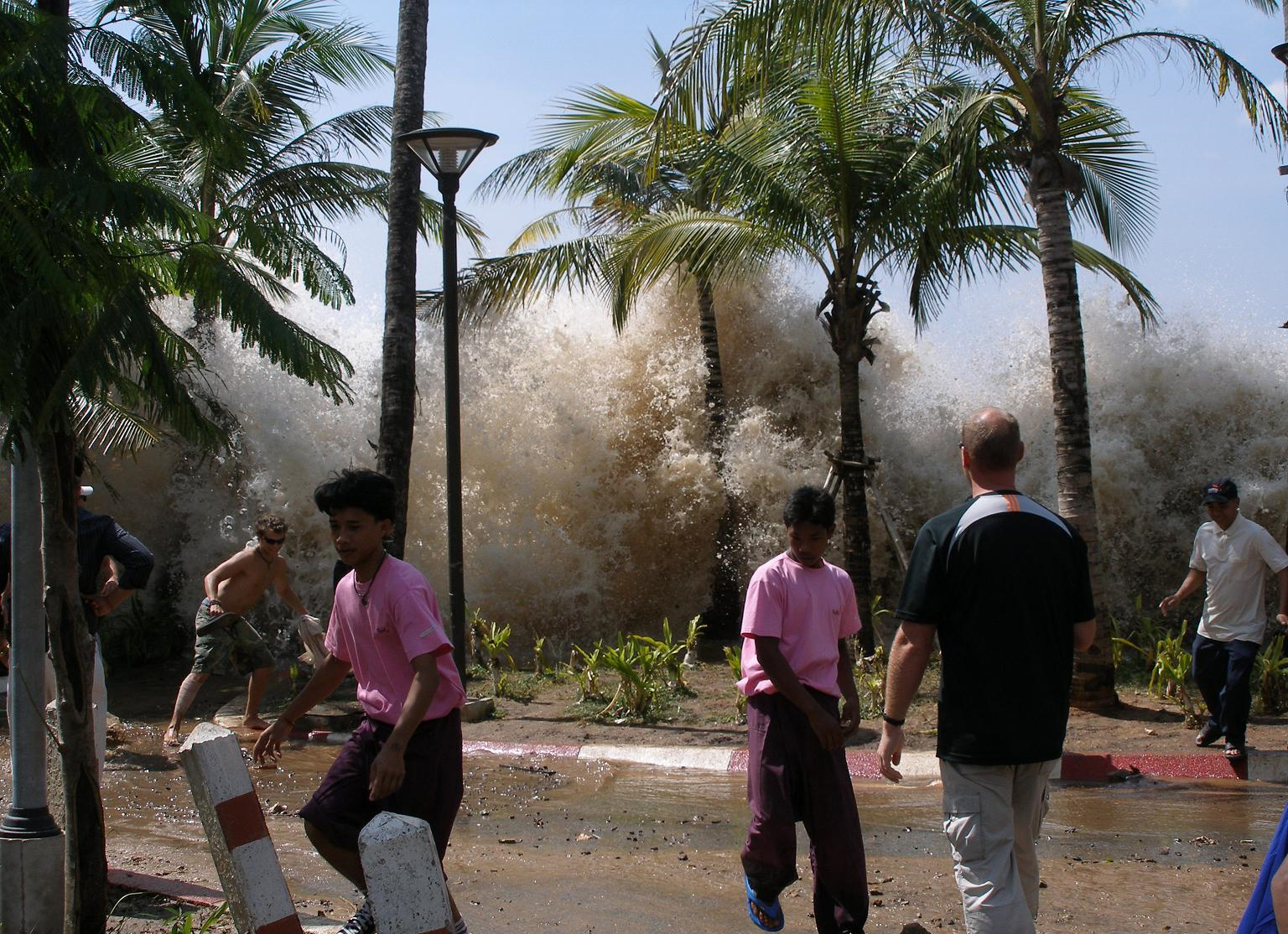
The continuous transformation of rock between igneous, sedimentary and metamorphic forms, driven by heat from the Earth's interior and by weathering at its surface. No rock is permanent, and the material of the crust has been recycled many times.
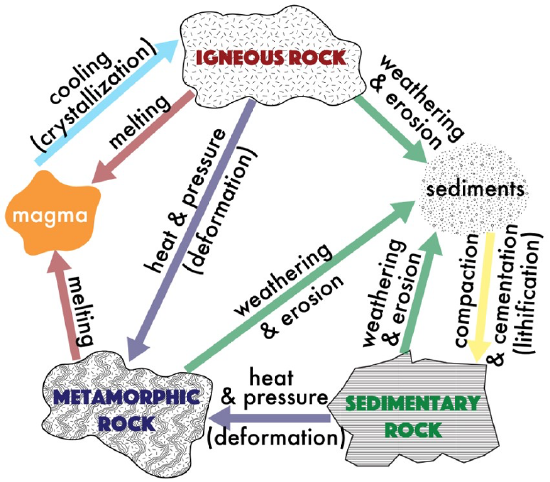
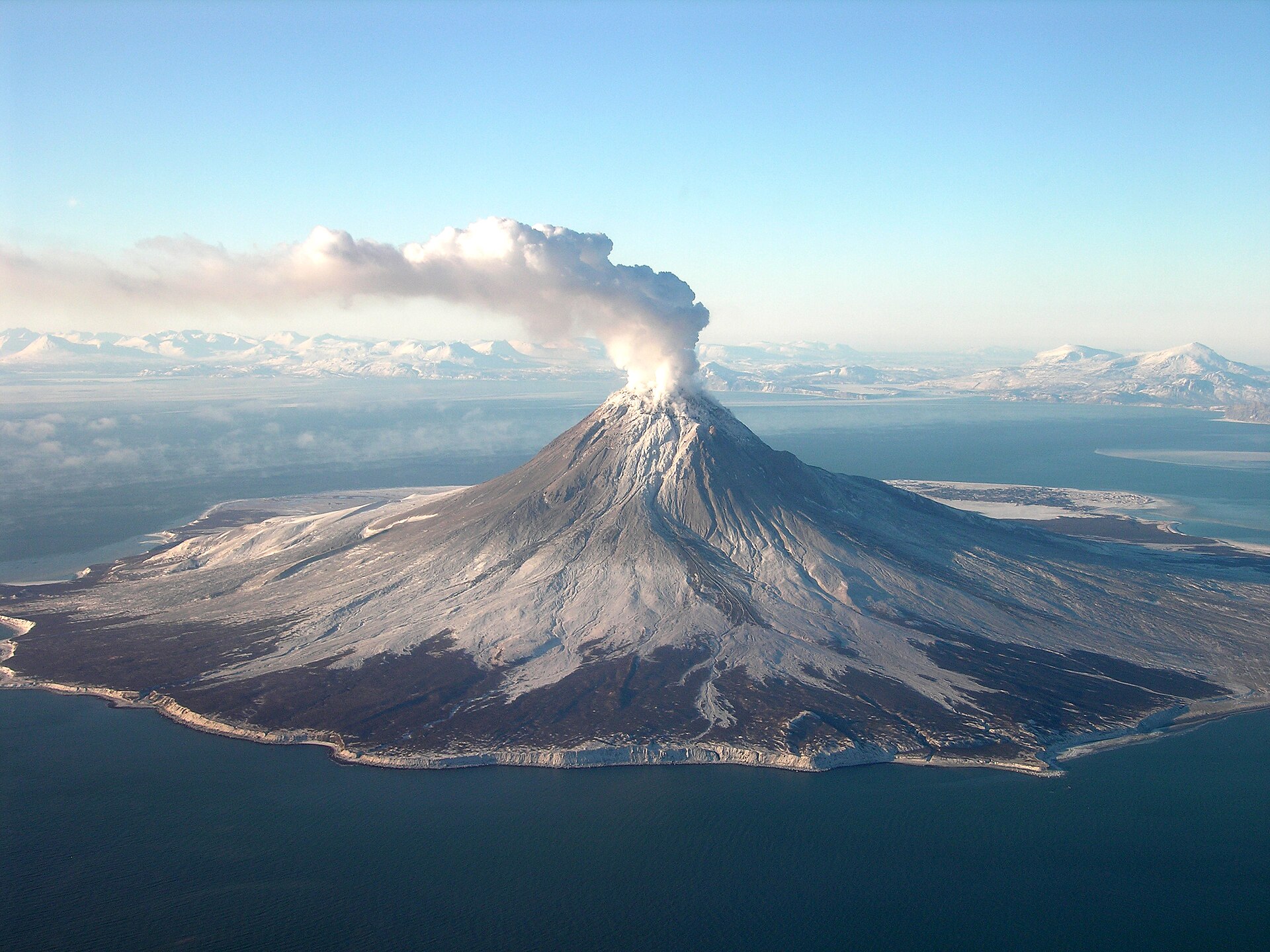
Igneous rock forms when molten material cools and solidifies. If it cools slowly at depth, crystals have time to grow large and the result is coarse-grained, as in granite. If it erupts and cools rapidly at the surface, crystals are tiny or absent, as in basalt or obsidian. Grain size therefore records cooling rate directly.
Sedimentary rock forms from accumulated fragments or precipitated material. Weathering breaks existing rock down, transport moves the pieces, deposition lays them down in layers, and burial compacts and cements them. Sandstone, shale and conglomerate form this way. Limestone forms largely from the carbonate remains of organisms.
Metamorphic rock forms when existing rock is altered by heat, pressure or chemically active fluids without melting. Minerals recrystallise and often align, producing banding or foliation. Shale becomes slate and then schist with increasing intensity; limestone becomes marble; sandstone becomes quartzite.
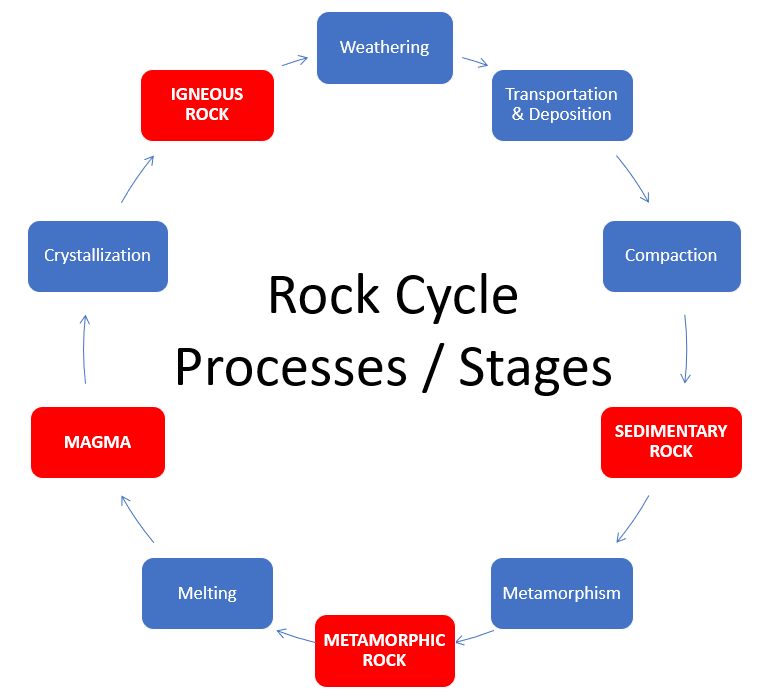
Igneous rock exposed at the surface weathers and becomes sediment. Buried deeply, it is metamorphosed.
Sedimentary rock buried under further layers becomes metamorphic, and taken deeper still it melts and becomes igneous. Exposed and weathered, it becomes new sediment.
Metamorphic rock follows the same routes, melting at depth or weathering at the surface.
There is no fixed order. The diagram is a set of possible transitions rather than a sequence, and a given piece of material may pass around parts of it repeatedly.
Two energy sources are involved and they act in opposition.
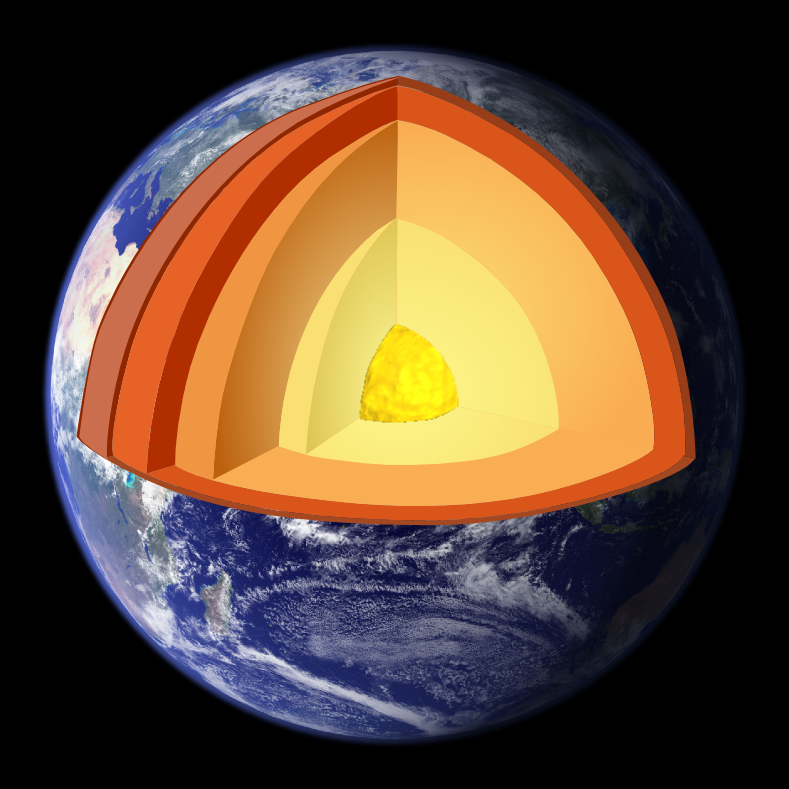
Internal heat, from radioactive decay and from the planet's formation, drives mantle convection and therefore plate tectonics. This produces melting at spreading ridges and subduction zones, uplifts mountains, and buries rock to depths where it is altered.
Solar energy drives the water cycle, weather and erosion, which break rock down at the surface and transport the fragments. Gravity moves material downhill throughout.
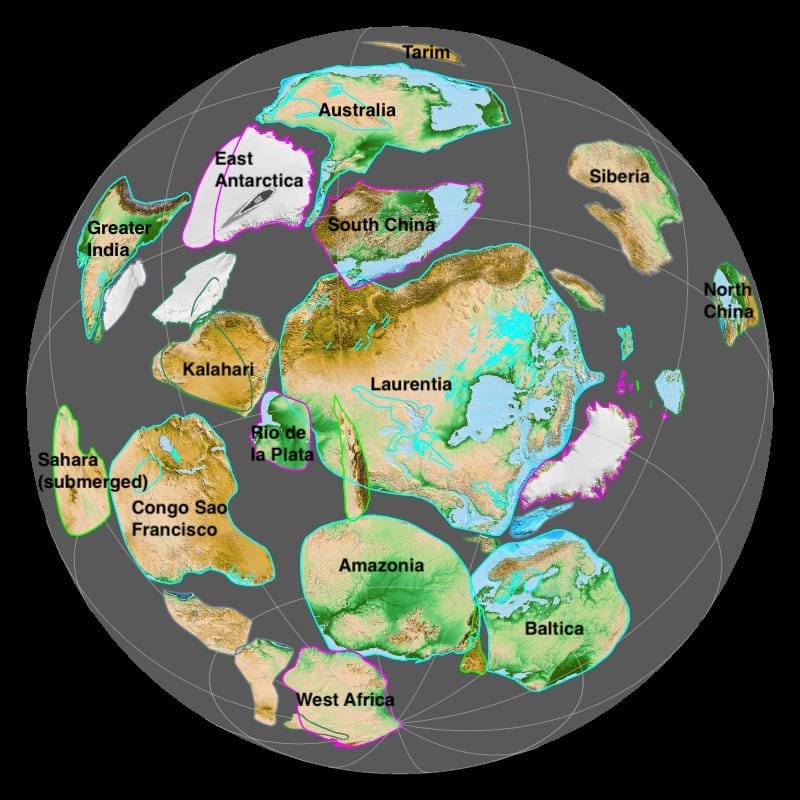
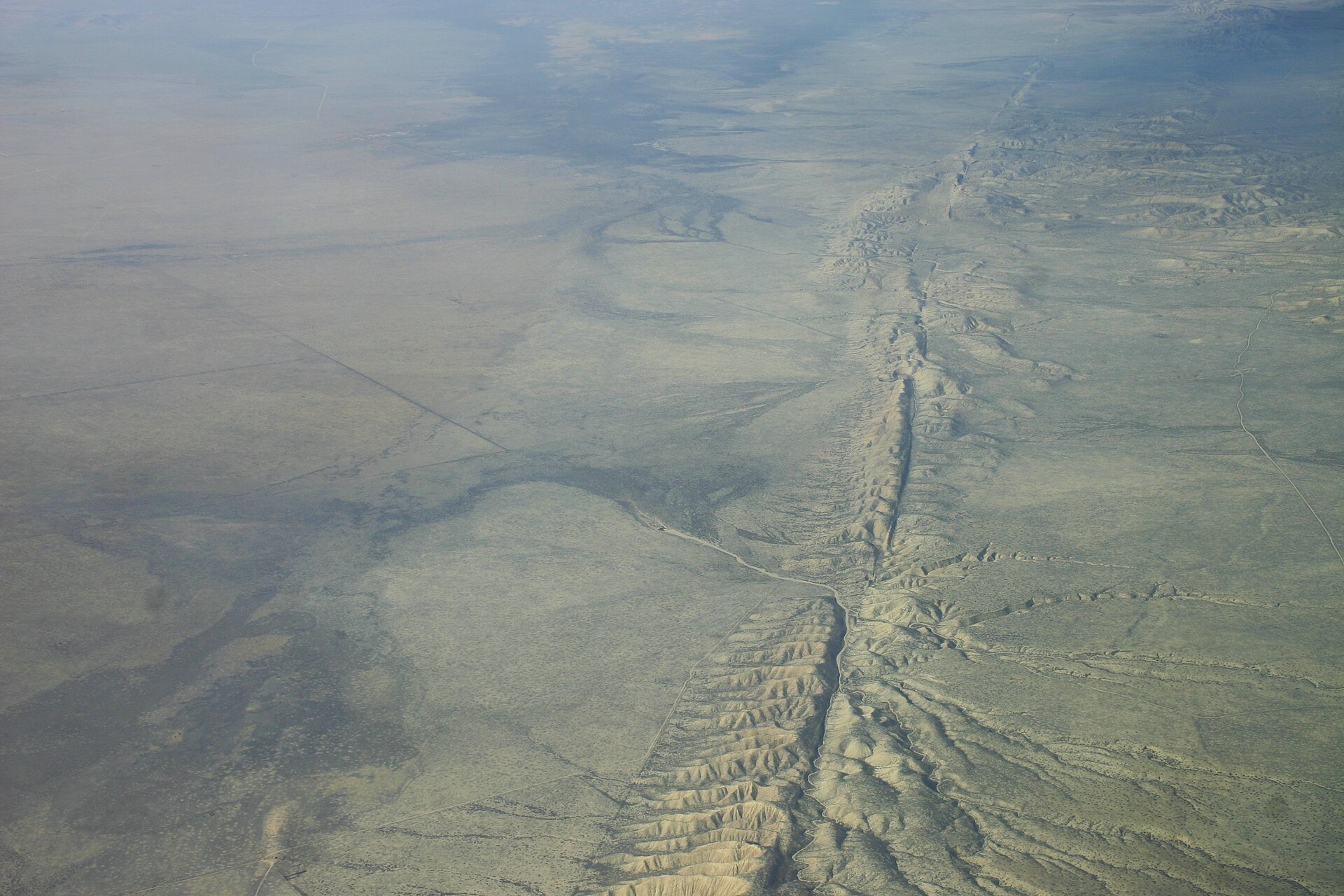
Plate tectonics, treated in its own capsule, is what makes the cycle continuous rather than one-directional. Subduction returns crustal material to the mantle and volcanism brings new material up, so the crust is continually consumed and replaced. This is why the ocean floor is nowhere older than about two hundred million years while the oldest continental rocks approach four billion.
The cycle is not inferred from theory but read from the rocks.
Superposition holds that in an undisturbed sequence, lower layers are older. Cross-cutting relationships hold that anything cutting through a rock is younger than it. These principles, set out by Nicolas Steno in the seventeenth century, allow relative sequences to be established anywhere.
Radiometric dating supplies absolute ages by measuring the decay of unstable isotopes, and it is what converts relative sequence into a timescale.
James Hutton is generally credited with recognising the cycle's implications in the late eighteenth century. Observing at Siccar Point in Scotland where near-vertical strata are overlain by horizontal ones, he inferred that the lower rocks had been deposited, tilted, eroded and then buried again, a sequence requiring far more time than contemporary estimates allowed. His conclusion that the record showed no vestige of a beginning and no prospect of an end established deep time as a working assumption.
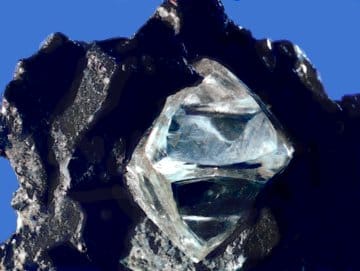
Almost every mineral resource occupies a specific position in the cycle. Metallic ores concentrate in igneous and hydrothermal settings. Coal, oil and gas occur in sedimentary basins, requiring particular burial histories and temperatures. Building stone, sand, gravel and limestone for cement come from identifiable formations.
Exploration is therefore an application of the cycle: knowing what conditions concentrate a substance tells you which rocks to look in.
The cycle also moves carbon on the longest timescale. Weathering of silicate rock consumes carbon dioxide, which is deposited as carbonate and eventually subducted, and volcanism returns it. This operates over millions of years and is the process that has kept the planet's surface temperature within habitable bounds over geological time.
The rock cycle establishes that the solid Earth is a dynamic system rather than a fixed stage, and that the ground is as much a process as the atmosphere or the oceans. It also supplied the first compelling argument for the age of the Earth, since a cycle of this kind visibly requires far more time than any historical account allowed.