A supposed polymeric form of water, reported from the Soviet Union in the 1960s and studied seriously worldwide for about a decade, which turned out to be ordinary water containing dissolved contaminants. It is the standard example of an artefact produced by working at very small sample sizes.
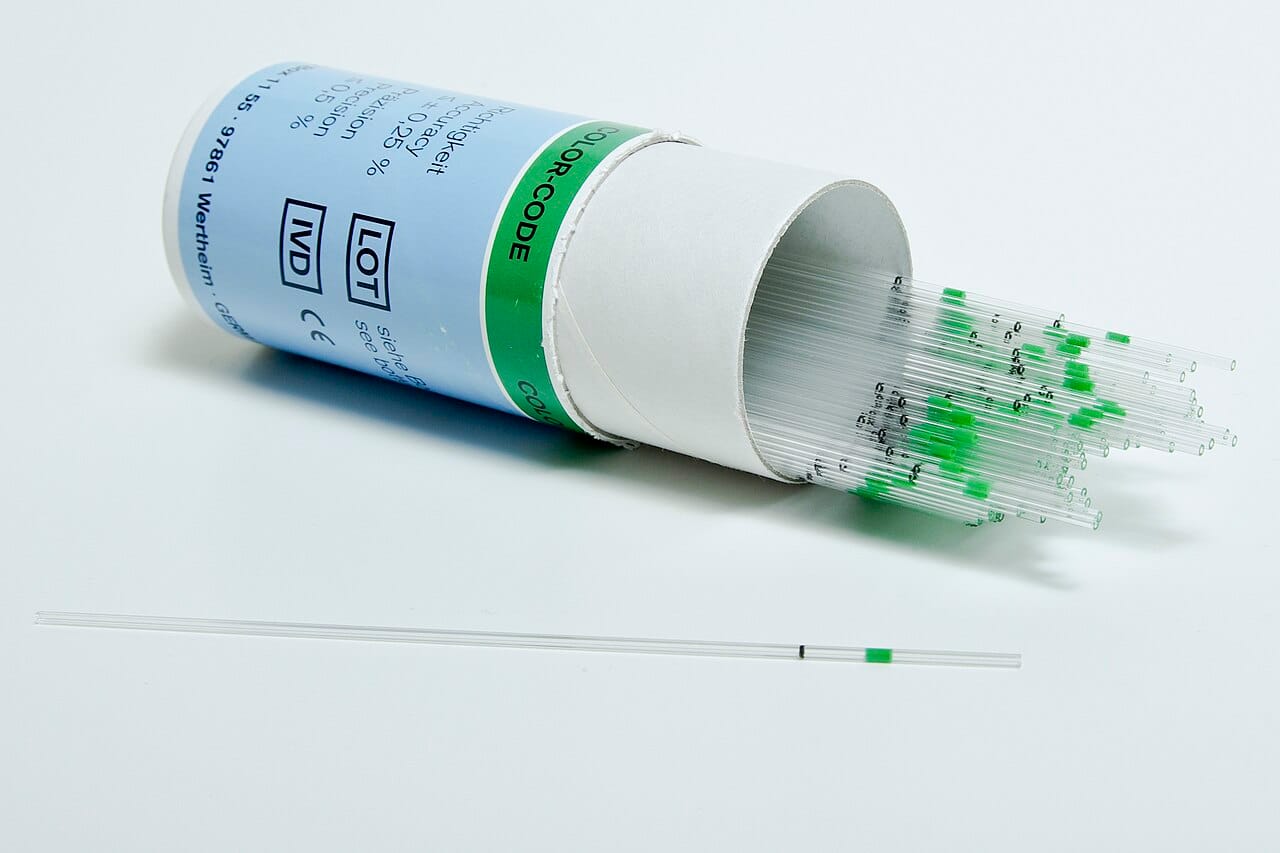
In 1961 Nikolai Fedyakin, working in a provincial Soviet laboratory, condensed water vapour into very fine quartz capillary tubes and found that the resulting liquid behaved oddly. Boris Derjaguin, a distinguished colloid chemist, took up the work and brought it to international attention later in the decade.
The reported properties were dramatic. The substance was around fifteen times more viscous than water, it did not freeze until far below zero, it boiled well above one hundred degrees, and its density was about forty per cent higher. It appeared to be water, since it was made from water vapour, yet it was clearly not ordinary water.
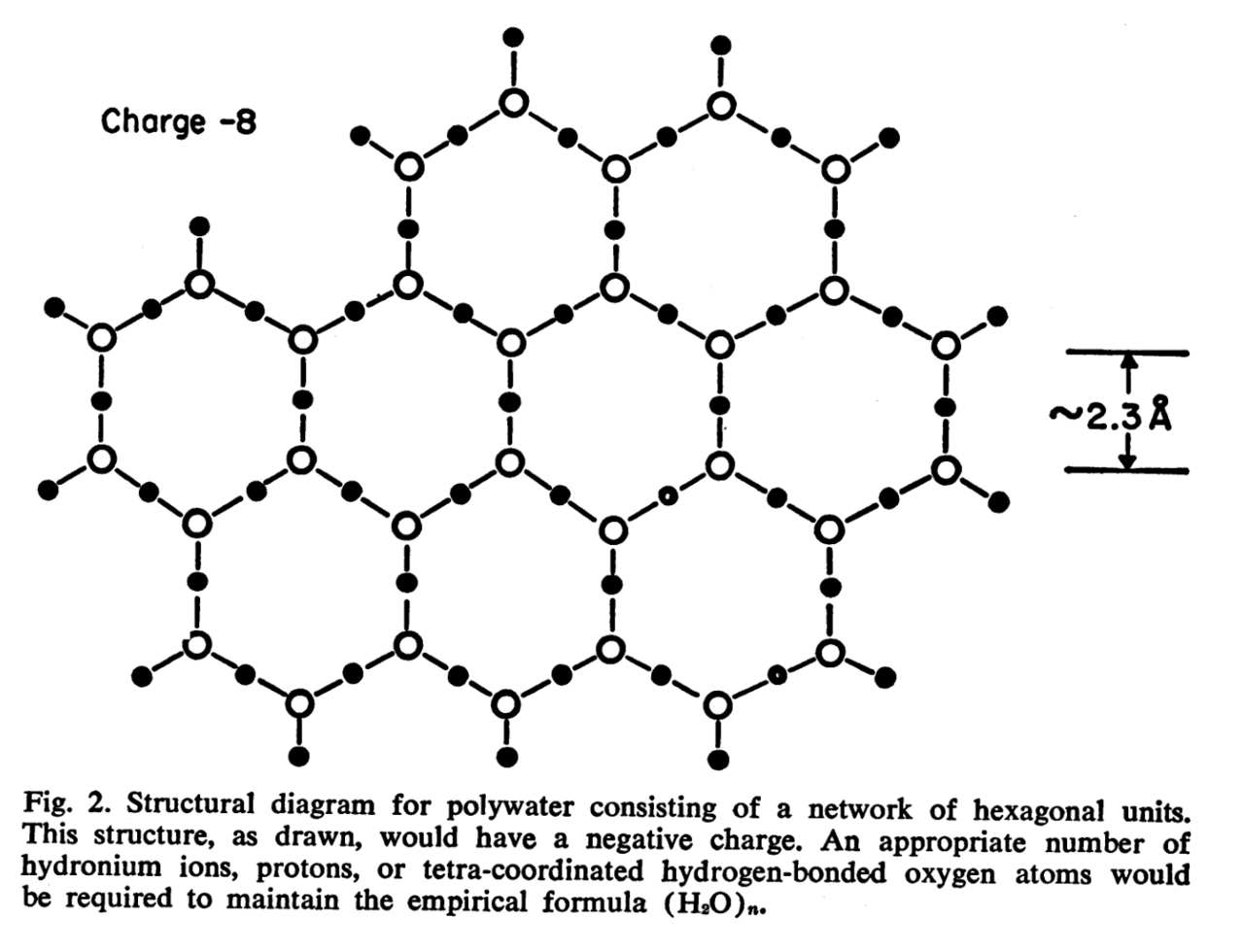
By 1969 the phenomenon had a name, anomalous water, soon shortened to polywater, and a proposed explanation: that water molecules in contact with a silica surface adopted a stable polymeric arrangement with stronger bonding than ordinary hydrogen bonds. Spectroscopic work published in Science that year supported a specific structure.
Several hundred papers followed. The topic was funded, reviewed and taken seriously by capable chemists on both sides of the Cold War.
A letter published in Nature in 1969 raised the possibility that polywater, being the more thermodynamically stable form, might convert ordinary water on contact, and that an escaped sample could in principle propagate through the world's water.
The scenario was speculative and was presented as a caution rather than a prediction, but it was widely reported and it raised the stakes considerably. It is worth recording because it shows how quickly a laboratory anomaly acquired consequences out of proportion to its evidence.
The refutation came from asking what else was in the tubes.
Denis Rousseau and Sergio Porto at Bell Labs examined the spectra and found that they matched not a new form of water but a mixture of ordinary substances: sodium, potassium, chloride, sulphate, borate and organic material. Rousseau made the point memorably by producing liquid with essentially the same anomalous spectrum from his own perspiration after a game of handball.
Further work identified silica leached from the glass walls, along with sweat, grease and airborne contamination introduced during handling.
The mechanism of the error was scale. A capillary experiment yields a sample measured in micrograms, so a quantity of contamination that would be undetectable in a beaker constitutes a substantial fraction of the sample. The narrow tubes that made the effect possible also maximised the surface area in contact with the water, which maximised leaching.
Derjaguin withdrew the claim in a letter to Nature in 1973, stating that the properties should be attributed to impurities. The retraction was unambiguous and came from the researcher most associated with the work, which is a large part of why the episode closed cleanly.
The measurements were real. The liquid in the tubes genuinely was more viscous and did have a depressed freezing point, because a concentrated solution of salts and organic matter behaves that way. The error was not in observing but in inferring that the substance was a form of water rather than water with something in it.
The theoretical proposal was also not absurd on its face. Water does form structured layers at interfaces, and surface effects at nanometre scales are real, so a claim about water behaving differently in confinement was within the range of the plausible.
What was missing was a control. Establishing that the material was a new form of water required showing it contained nothing else, and the composition was assumed rather than measured until Rousseau and Porto measured it.
Polywater is a case where a field corrected itself in roughly a decade, in public, and with the original proponent conceding, which makes it a useful counterweight to accounts of science as incapable of self-correction.
Its practical legacy is a heightened suspicion of results that depend on very small samples or on materials in prolonged contact with container walls, both of which recur in nanoscience, in trace analysis and in claims about structured or otherwise anomalous water, which continue to appear in commercial products and rest on nothing.