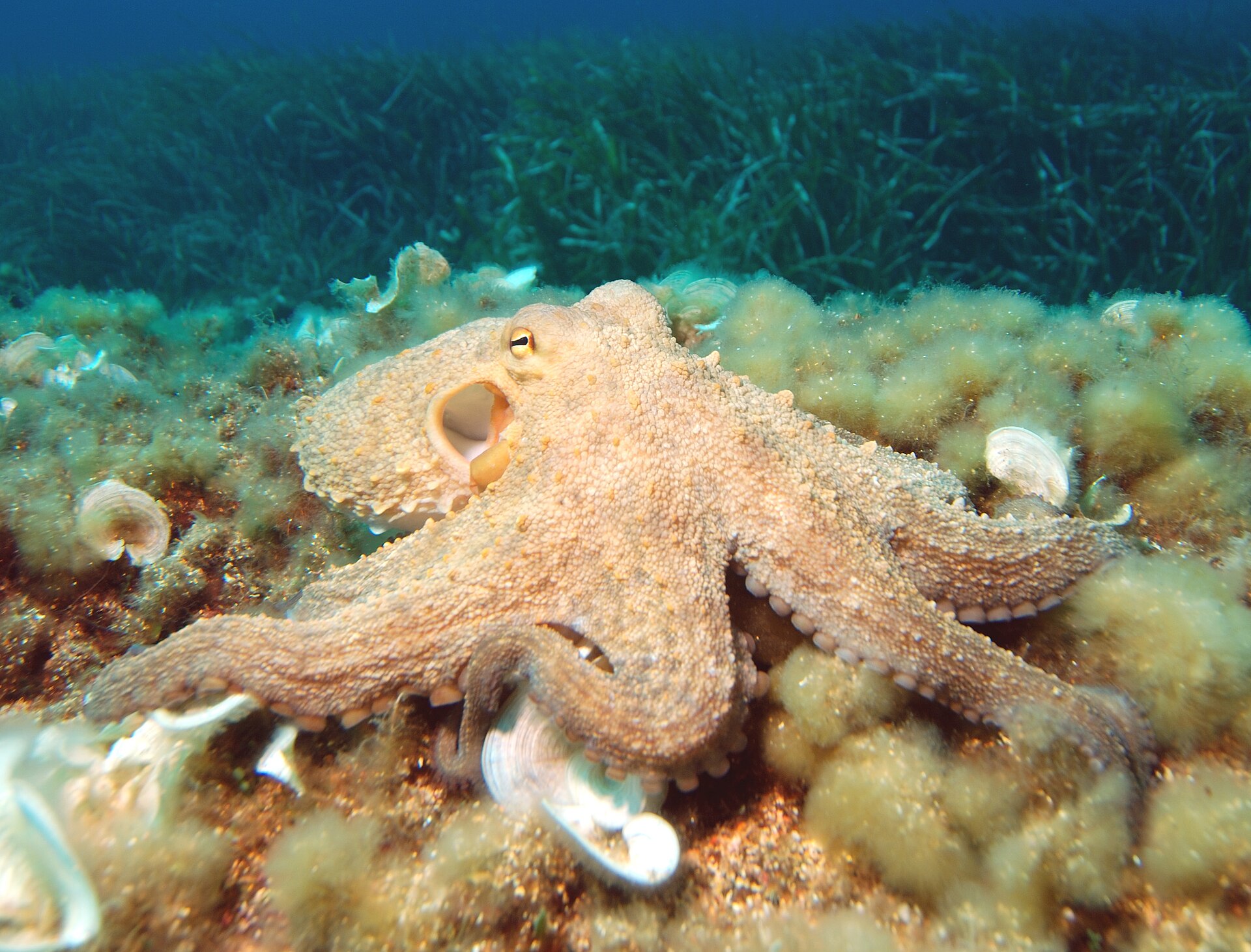
Octopuses are eight-armed cephalopod molluscs, around three hundred species, found in every ocean. They have three hearts, blue blood, no skeleton, the most sophisticated camouflage of any animal, and a nervous system organised so unlike a vertebrate's that it is the standard reference point for what an intelligence not related to ours might be.
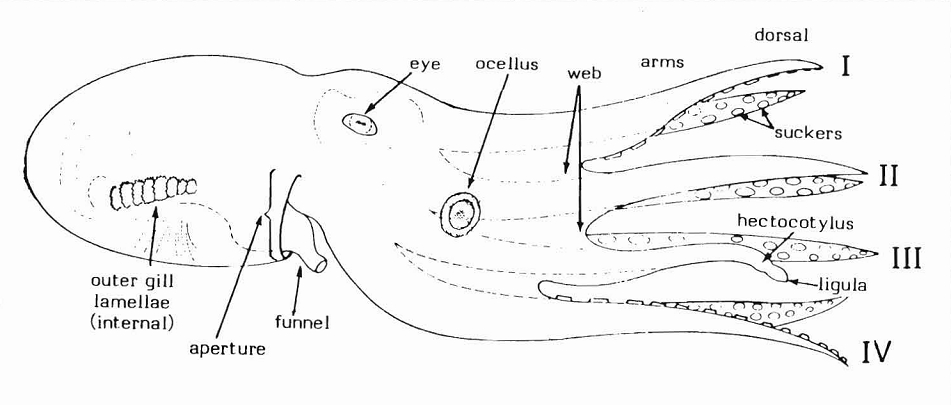
An octopus is a mollusc, related to snails and clams, that abandoned the shell. The consequence is that a large octopus can pass through any gap its beak will fit through, since the beak is the only hard part of it. That single fact accounts for most octopus escape stories.
There are three hearts: two pump blood through the gills and one through the rest of the body. The blood is blue because it carries oxygen on haemocyanin, which uses copper rather than the iron in our haemoglobin. Haemocyanin is less efficient in warm well-oxygenated water and more efficient in cold, low-oxygen conditions, which suits deep and cold seas and leaves octopuses poorly equipped for exertion.
The systemic heart stops beating when an octopus swims, which is why they prefer to crawl: jet propulsion is exhausting and they cannot keep it up.
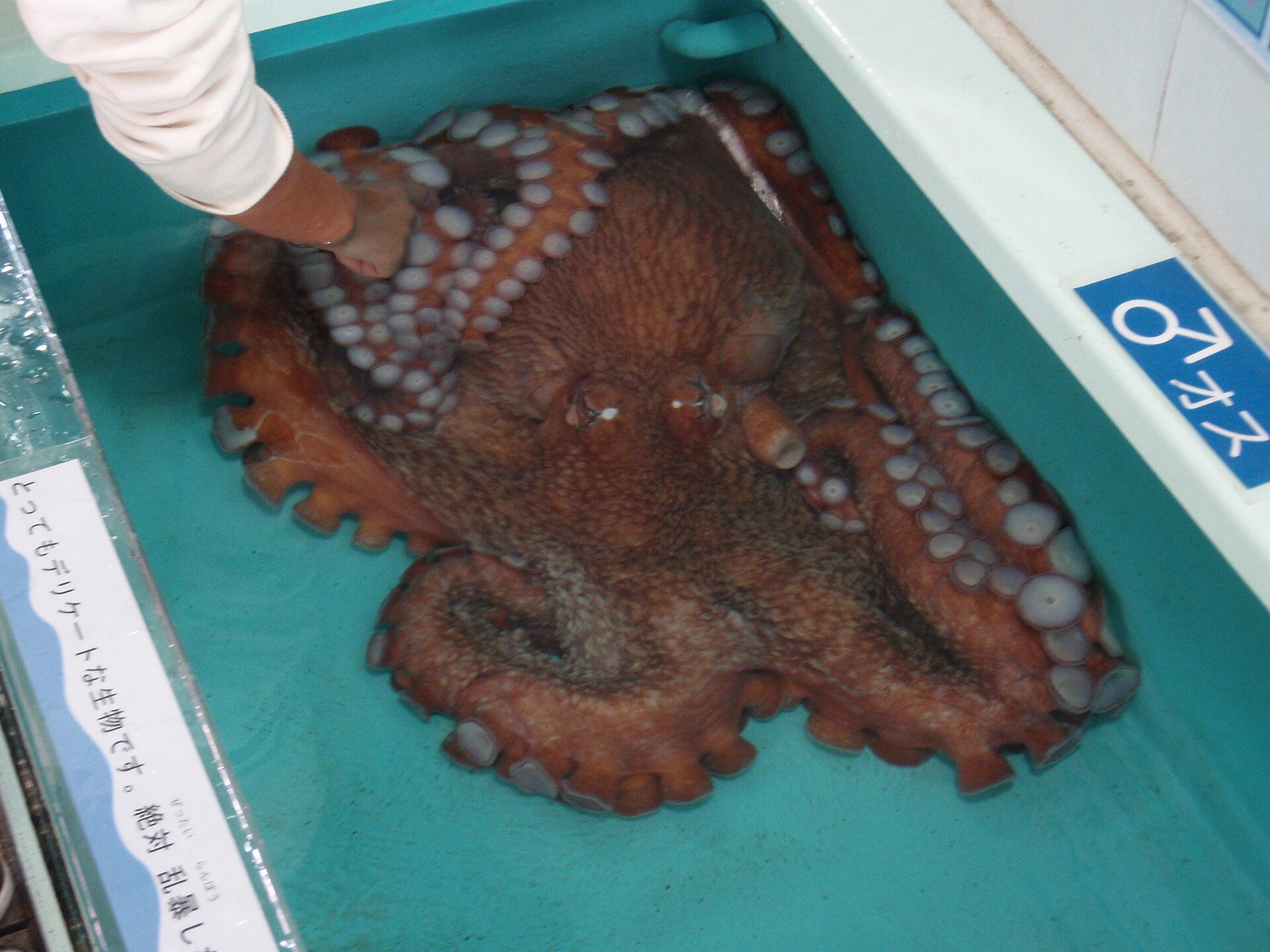
Octopus camouflage is the best in the animal kingdom and it works in three layers. Chromatophores are elastic sacs of pigment, each controlled by radial muscles under direct neural command, that expand to show colour and contract to hide it. Beneath them, iridophores and leucophores reflect and scatter light, producing iridescence and whites the pigments cannot. Above all this, papillae in the skin can be raised into spikes and ridges, so the animal changes texture as well as pattern.
The whole system is under nervous control rather than hormonal, so the change is effectively instantaneous, and an octopus can produce a passable match to gravel, sand, coral or algae in well under a second, and can run patterns across the body as a display.
There is one striking problem with this. Octopuses are, as far as anyone can measure, colour-blind: they have a single visual pigment. An animal with monochrome vision produces exact colour matches to its background. Proposed explanations include chromatic aberration exploited by the odd pupil shape, and a 2015 hypothesis that opsins expressed in the skin itself detect light and colour independently of the eyes. Neither is established, and the mismatch remains genuinely unexplained.
Two thirds of an octopus's roughly five hundred million neurons are not in the brain but distributed through the arms, in ganglia that handle local coordination. A severed arm continues to reach, grip and pass food toward where the mouth would be. This is a fundamentally different architecture from a centralised vertebrate brain, and it raises a question that is not rhetorical: how much of what the arm does is the animal doing it.
The evidence for octopus intelligence is real and often overstated in the retelling. Solidly established: they solve mazes, open containers including screw-top jars, use tools in the specific sense that veined octopuses carry coconut shell halves to assemble as shelter later, learn by observation in some experiments, and show individual behavioural differences stable enough to be called personality. The commonly repeated stories of octopuses recognising individual keepers and squirting the ones they dislike are supported by weaker evidence than their popularity suggests.
What is not in dispute is that this intelligence evolved entirely independently of ours. The last common ancestor of an octopus and a human was a simple bilaterian more than five hundred million years ago, with nothing resembling a brain. Whatever octopus cognition is, it is a second, separate solution.
Octopuses also edit their own RNA to an extent seen almost nowhere else, recoding messenger RNA extensively, particularly in neural tissue and particularly in response to temperature. The trade-off appears to be a slower-evolving genome, since the surrounding DNA sequence must be conserved for the editing to work.
Ink is the familiar defence: a cloud of melanin that obscures and, because it contains tyrosinase, irritates the eyes and disrupts the smell of a pursuing predator.
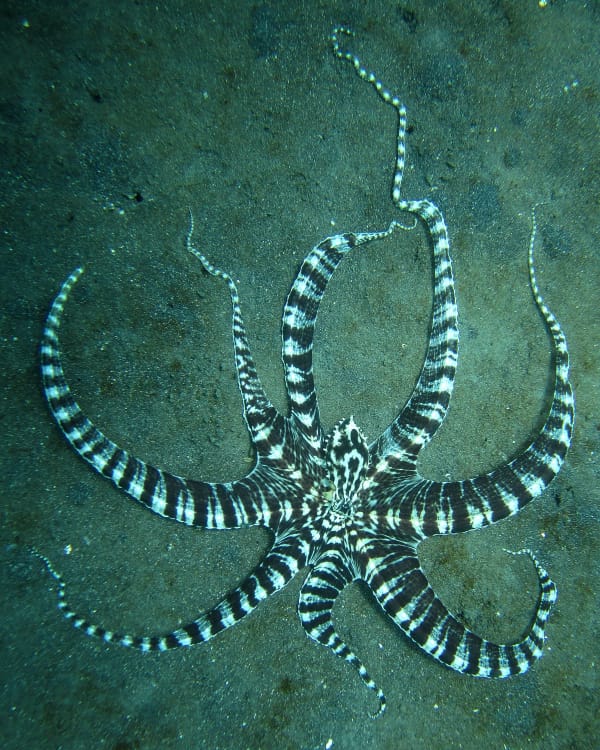
The mimic octopus of Indonesian estuaries does something rarer, altering its shape and movement rather than only its colour, in postures that have been reported as imitations of flatfish, lionfish and sea snakes. How deliberate and how specific these imitations are is debated, since much of the record is observational.
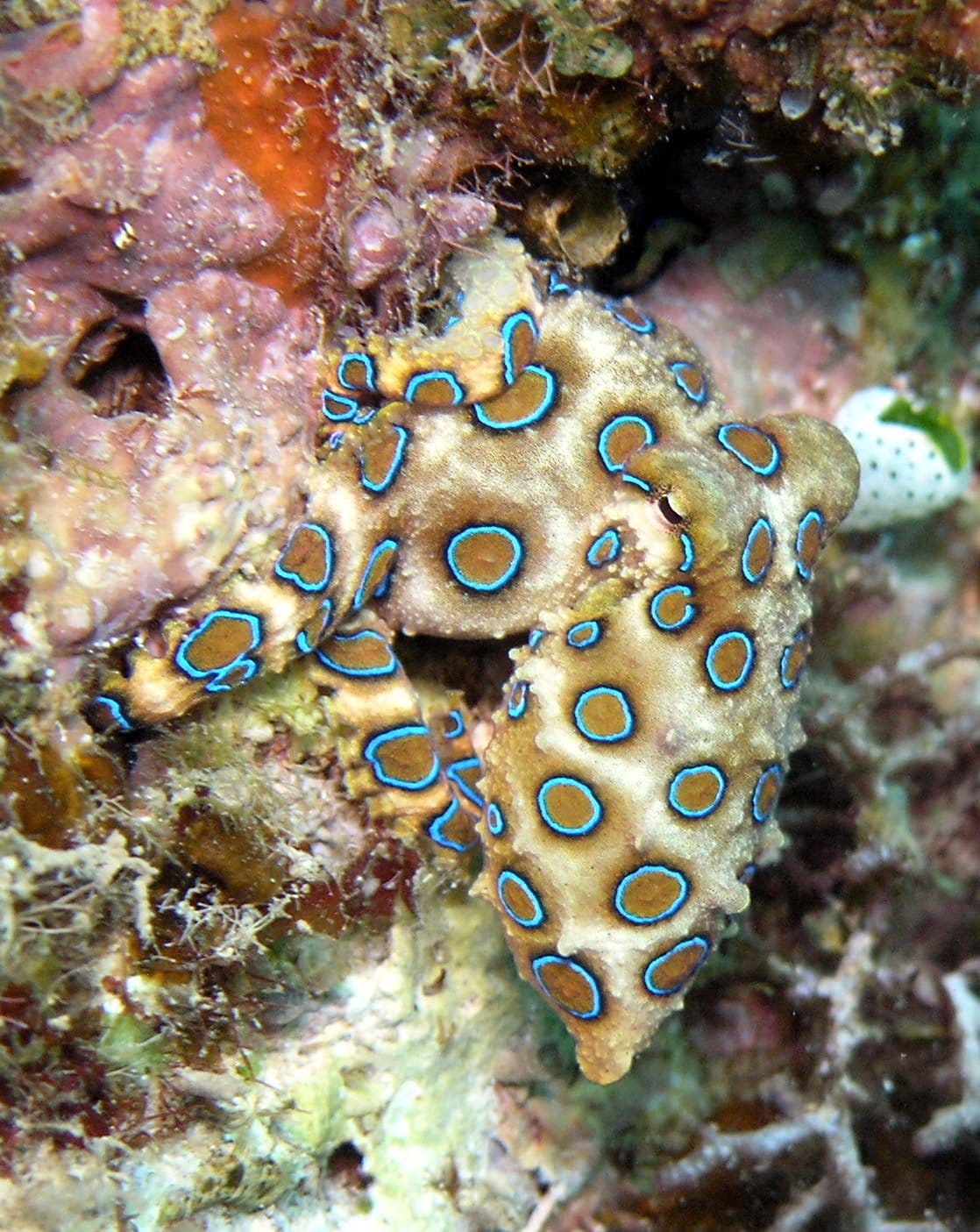
All octopuses are venomous, injecting saliva through the beak to subdue prey. Only the blue-ringed octopuses of the Indo-Pacific are dangerous to people. Their tetrodotoxin is made by symbiotic bacteria, is the same toxin found in pufferfish, blocks sodium channels, and has no antivenom; treatment is artificial ventilation until the toxin clears.
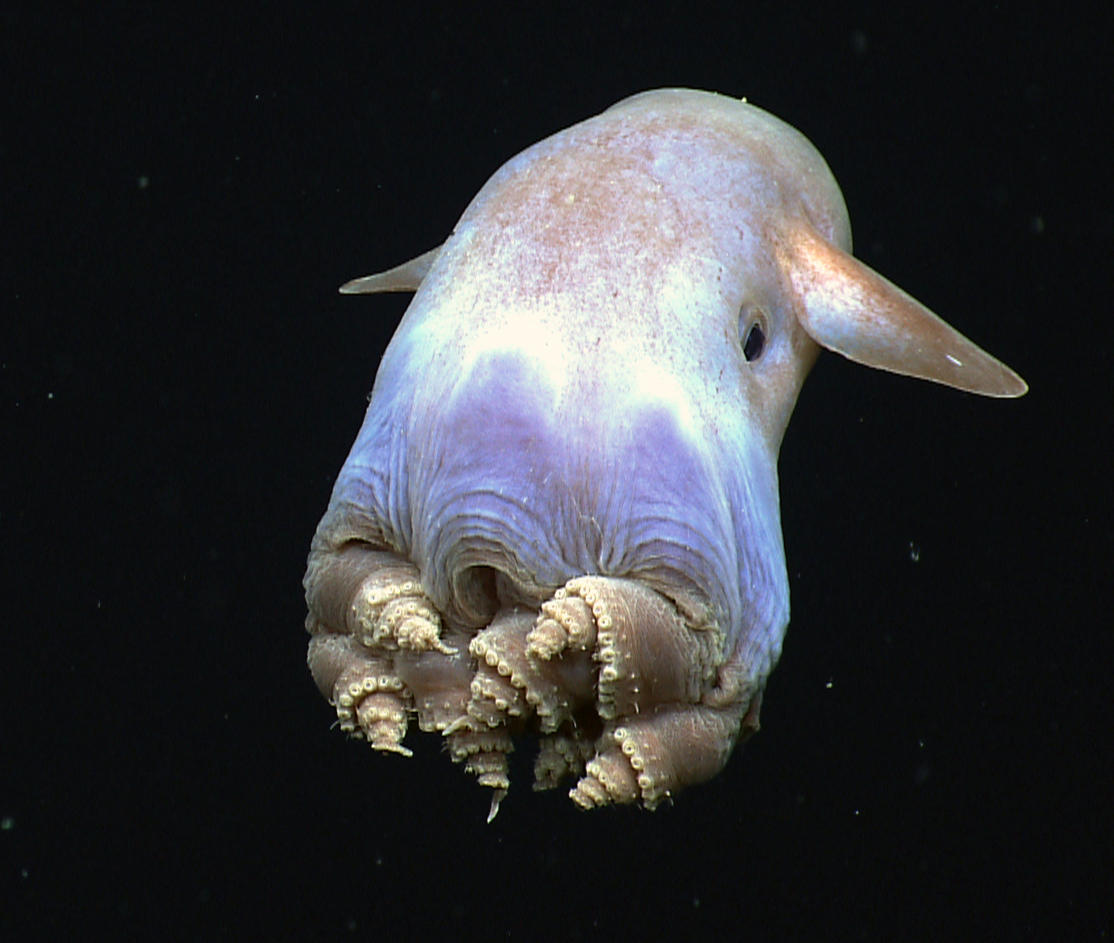
Almost all octopuses are semelparous: they breed once and die. The female stops eating while brooding her eggs, tending and aerating them for weeks to months, and dies around the time they hatch. One deep-sea individual was observed brooding a single clutch for fifty-three months, the longest of any animal.
This is not simple exhaustion but a controlled process. Removing the optic glands from a brooding female, in an experiment by Jerome Wodinsky in 1977, caused her to abandon the eggs, resume feeding and live substantially longer. The glands drive a hormonal cascade that ends the animal.
Most species live one to two years. That an animal this cognitively capable has so little time is one of the stranger facts about them: whatever an octopus learns, it cannot pass on, since it will not meet its offspring.
A 2021 review commissioned by the UK government found strong evidence of sentience in cephalopods, and octopuses were added to the Animal Welfare (Sentience) Act 2022 as a result. They are already covered by laboratory animal legislation in the EU, unusually for an invertebrate.
Commercial octopus farming has been proposed and partly developed, most prominently a facility planned in the Canary Islands. The objections are both ethical and practical: the animals are solitary and territorial, so density causes aggression and cannibalism; they are carnivorous, so farming them consumes more fish protein than it produces; and there is no accepted humane slaughter method. Several jurisdictions, including Washington and California, have legislated against it. The industry position is that wild stocks are under pressure and farming relieves it. This is unresolved and is being decided legislatively rather than scientifically.
If you want to know what a mind looks like when it is not built like ours, the octopus is the only substantial example available. It is a mollusc with distributed cognition, a two-year life, no social learning and no shell, and it nonetheless does things we recognise as thinking.