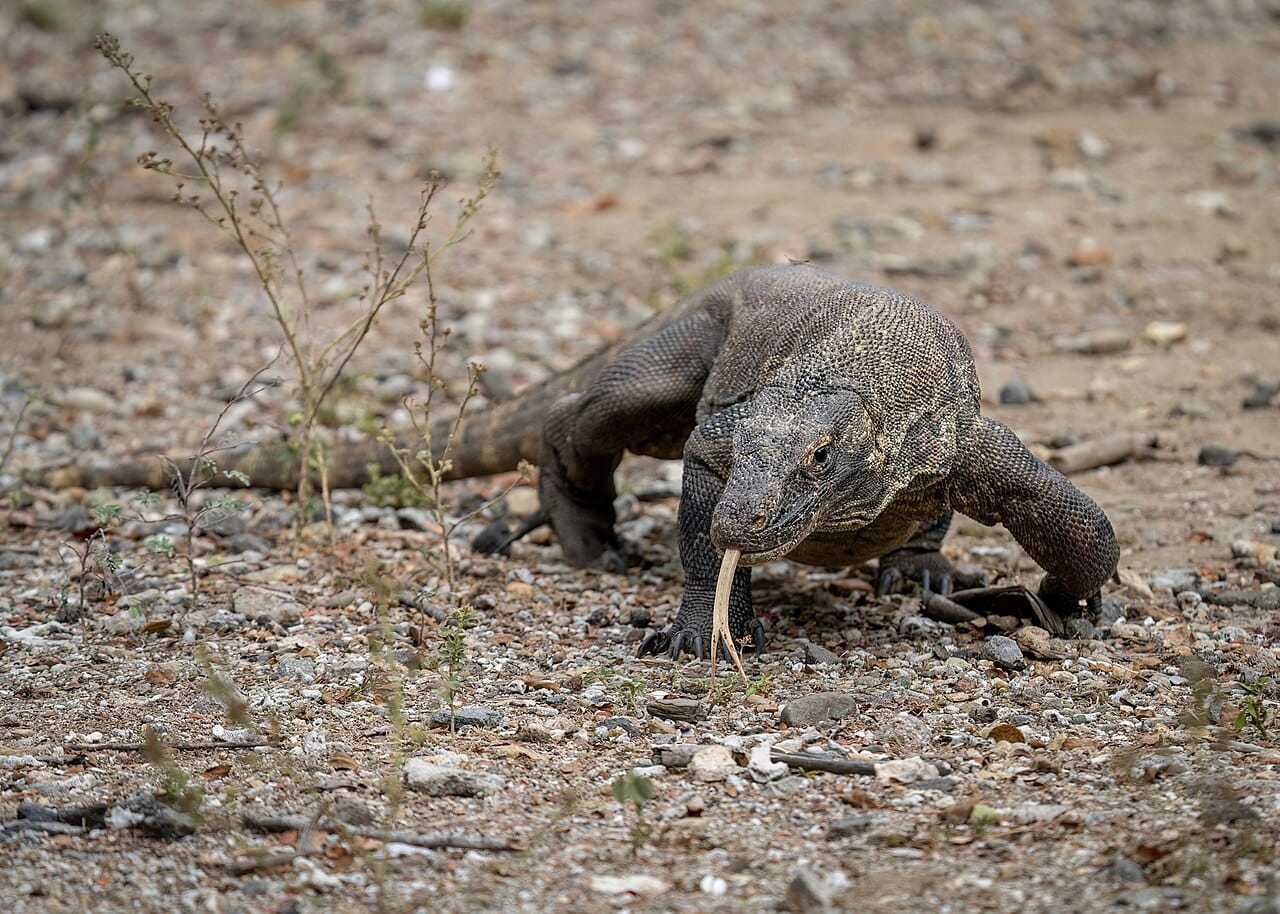
The Komodo dragon, Varanus komodoensis, is the largest living lizard, restricted to a handful of islands in eastern Indonesia. It grows to around three metres and 70 to 90 kilograms, it kills prey much larger than itself, and the mechanism by which it does so was argued about for forty years and is not entirely settled now.
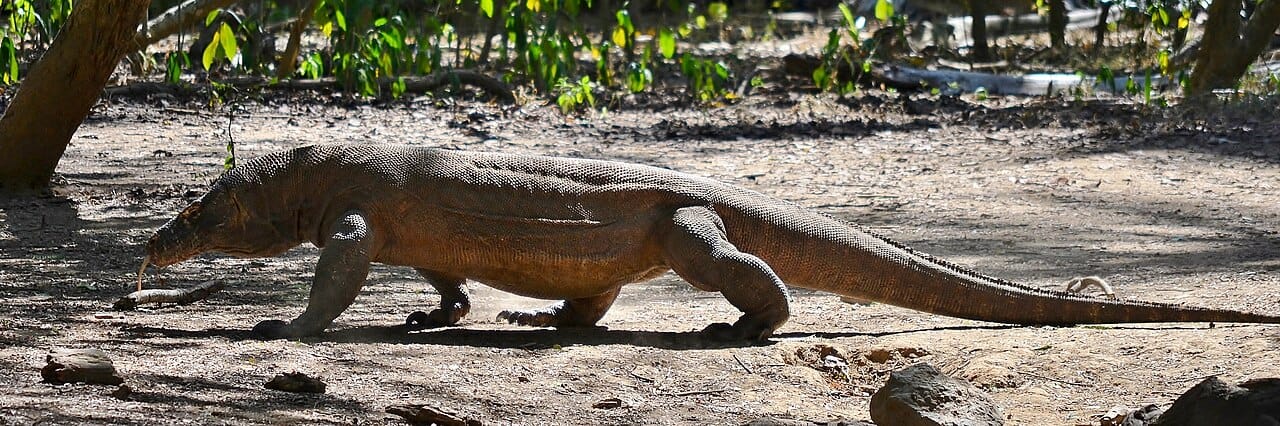
Komodo dragons are monitor lizards, family Varanidae, a group characterised by high aerobic capacity, active foraging and, by reptile standards, unusual behavioural flexibility. They are considerably more active than most large reptiles and can run in short bursts at around 20 kilometres an hour.
Adults are covered in osteoderms, small bones embedded in the skin forming a chain-mail layer. A study using CT scanning published in 2019 found these are absent in juveniles and accumulate with age, and are densest around the head, which suggests they are armour against other Komodo dragons rather than against anything else.
The tongue is deeply forked and used for chemoreception in the manner of a snake, delivering scent particles to the vomeronasal organ. The two tips sample slightly different points in space, giving a directional gradient, which is how a dragon tracks carrion from several kilometres downwind.
Teeth are curved, serrated and replaced continuously. A 2024 study found the serrated edges are capped with a thin layer of iron-enriched material that keeps the cutting edge sharp, a feature not previously described in a living reptile.
For most of the twentieth century the accepted explanation was septic bite: the dragon's mouth was said to carry a uniquely virulent bacterial flora from rotting meat, so that bitten prey escaped and died of infection days later while the dragon followed it.
In 2009 Bryan Fry and colleagues reported mandibular venom glands in Varanus komodoensis, delivering a complex secretion including anticoagulants and compounds that lower blood pressure. On this account prey dies of shock and blood loss, accelerated by an inability to clot, not of infection. The finding fitted a broader argument that venom is ancestral across a large group of lizards and snakes.
The bacterial account has since been substantially undermined from a second direction: sampling of wild Komodo dragon oral flora found bacteria comparable to those of other carnivores rather than anything exceptional, and the dragons were observed cleaning their mouths after feeding. The septic bite story appears to have originated largely from captive animals fed on carrion.
The venom account is not unchallenged either. Critics, including Weinstein and colleagues, have argued the clinical and ecological significance of the secretion is overstated, that the mechanical damage from a serrated bite and consequent blood loss is sufficient to explain prey mortality, and that the evidence for venom-driven kills in the field is thin.
The current defensible position is that the septic bite hypothesis is discredited, that venom glands exist, and that how much of the killing they do relative to straightforward trauma is unresolved.
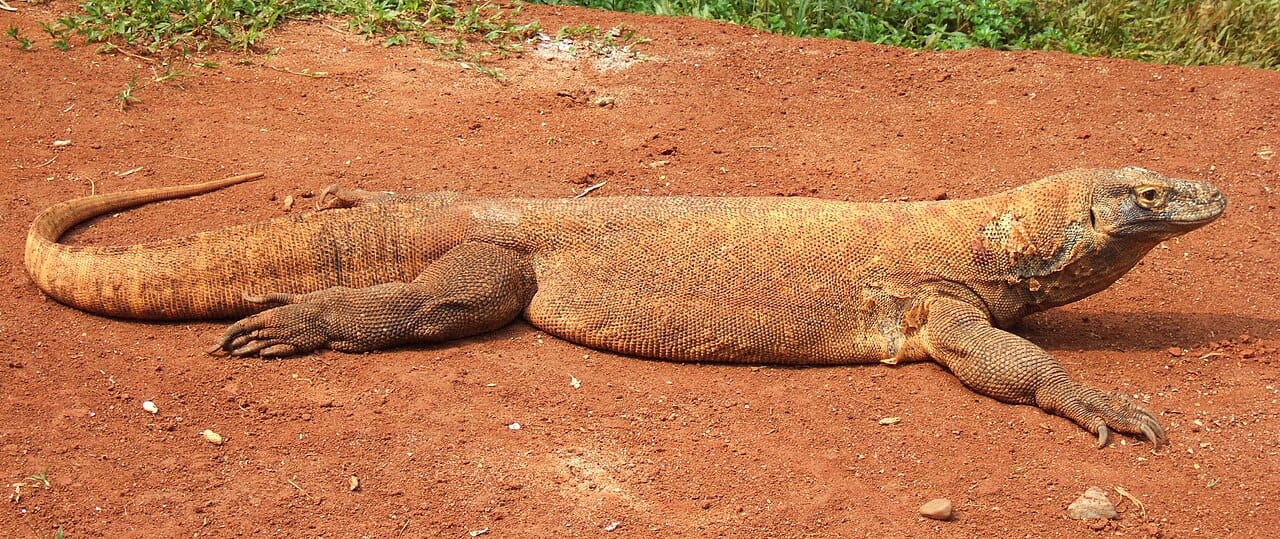
Adults take deer, wild boar, water buffalo, macaques and each other, and scavenge readily. Hunting is typically an ambush from cover beside a game trail, with an attack directed at the legs and underside.
They eat enormously and infrequently, consuming up to eighty per cent of their body weight in a sitting, aided by a loosely articulated jaw, an expandable stomach and a flexible skull. A large meal may be followed by weeks without feeding.
Cannibalism is routine and structures the species' ecology. Juveniles are arboreal for their first years, which keeps them away from adults, and they roll in faecal material, which is generally interpreted as making them unattractive to eat.
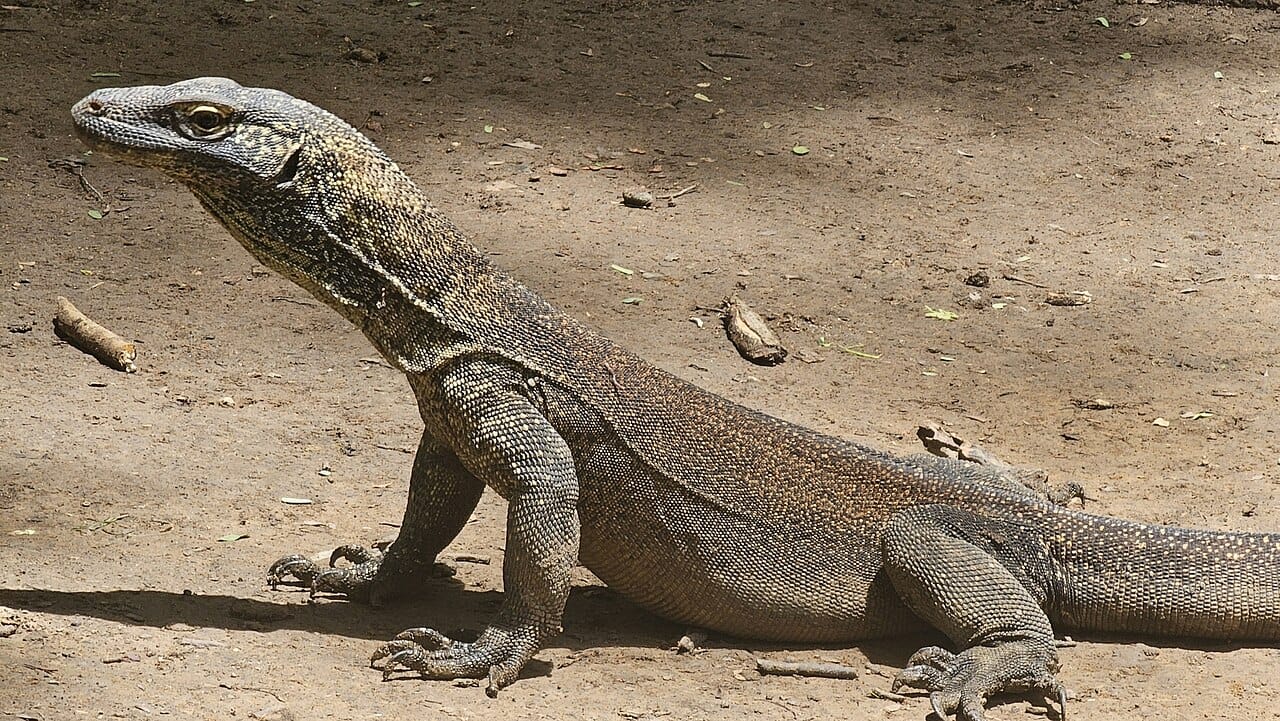
The Komodo dragon is the standard example given for island gigantism, the tendency of some island species to grow larger than mainland relatives in the absence of competition.
The fossil evidence complicates this. Large varanids were widespread through Australia and southeast Asia in the Pleistocene, including Megalania, which was considerably larger. Komodo dragon fossils are known from Australia, and the current view is that the species did not become large on the islands but is a survivor of a formerly widespread group of large monitors that has been reduced to a relict range.
So it is less a case of an animal growing on an island than of the last of a big lineage happening to persist where the pressures that removed the rest did not reach.
Female Komodo dragons can reproduce without males. Cases at Chester Zoo and London Zoo in 2006 produced viable eggs from females with no access to a male, confirmed genetically as parthenogenetic.
The genetics are specific and consequential. Komodo dragons have a ZW sex determination system in which females are the heterogametic sex. Parthenogenesis by the mechanism observed produces offspring that are ZZ or WW; WW is not viable, so all parthenogenetic offspring are male.
This means an isolated female arriving on an empty island could in principle produce sons and then breed with them, which is a plausible colonisation route for an animal on an archipelago, though it produces a severely inbred founding population.
The species occurs on Komodo, Rinca, Flores, Gili Motang and Nusa Kode, within an area of a few thousand square kilometres. The total population is usually put in the low thousands, with a considerably smaller number of breeding females.
It was reassessed as Endangered in 2021, principally because of projected loss of low-lying coastal habitat to sea level rise and warming, which would compress an already small range. Prey depletion by human hunting and habitat conversion on Flores are the immediate pressures.
Tourism at Komodo National Park is both the main source of funding for protection and a source of pressure, and Indonesian proposals to redevelop parts of the park for tourism have been repeatedly contested.
The Komodo dragon is a useful correction to the idea that large predators are ecologically robust. This one exists on five islands, numbers in the low thousands, and is the last of a group of giant monitor lizards that once ranged across a continent. Being the biggest is not the same as being secure.