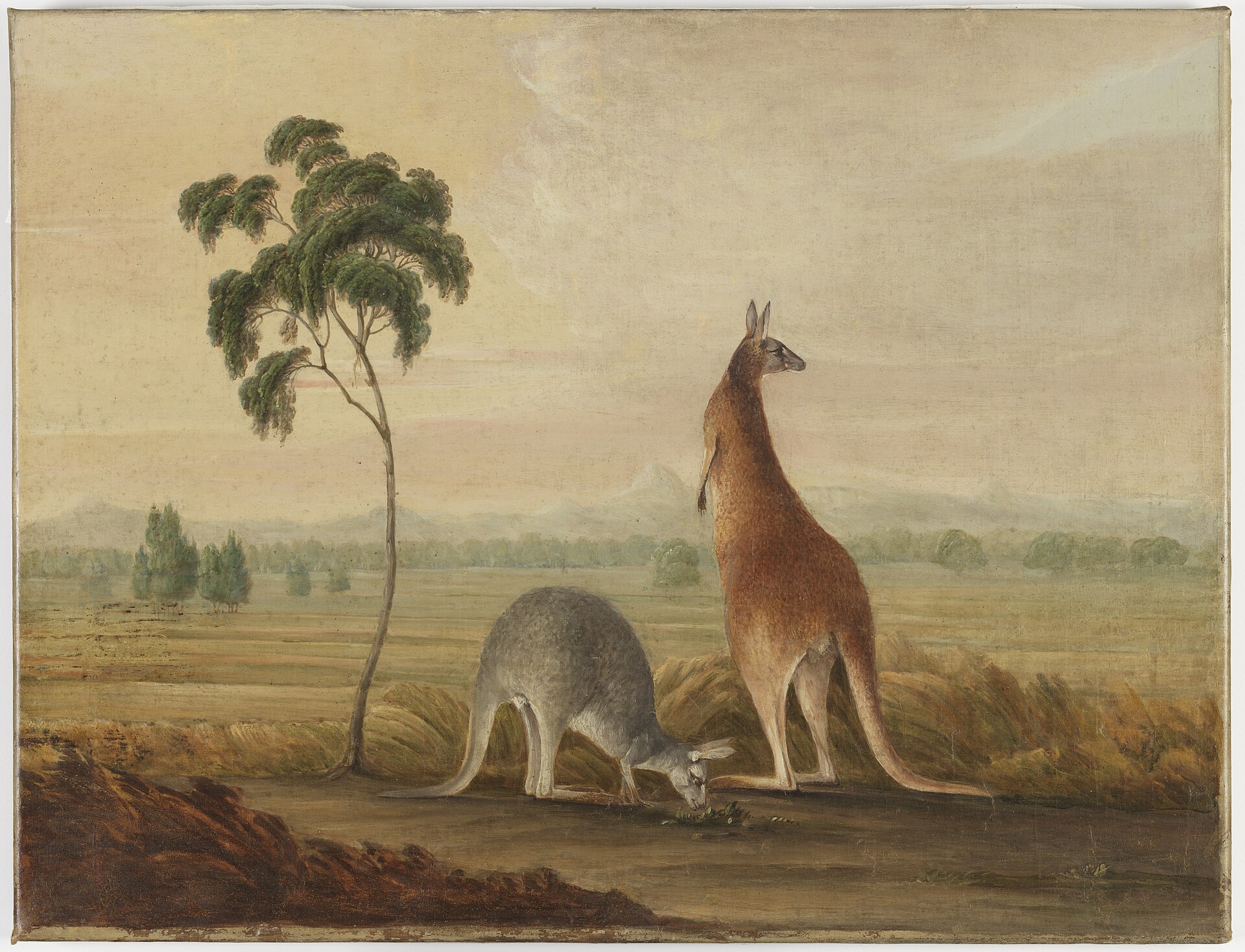
Kangaroos are large marsupials of the family Macropodidae, endemic to Australia and New Guinea. They are the only large animals that hop as their main gait, and the mechanics of that turn out to be unusually efficient. They also run a reproductive system with no real parallel, in which a female can carry three offspring at three different stages at once.
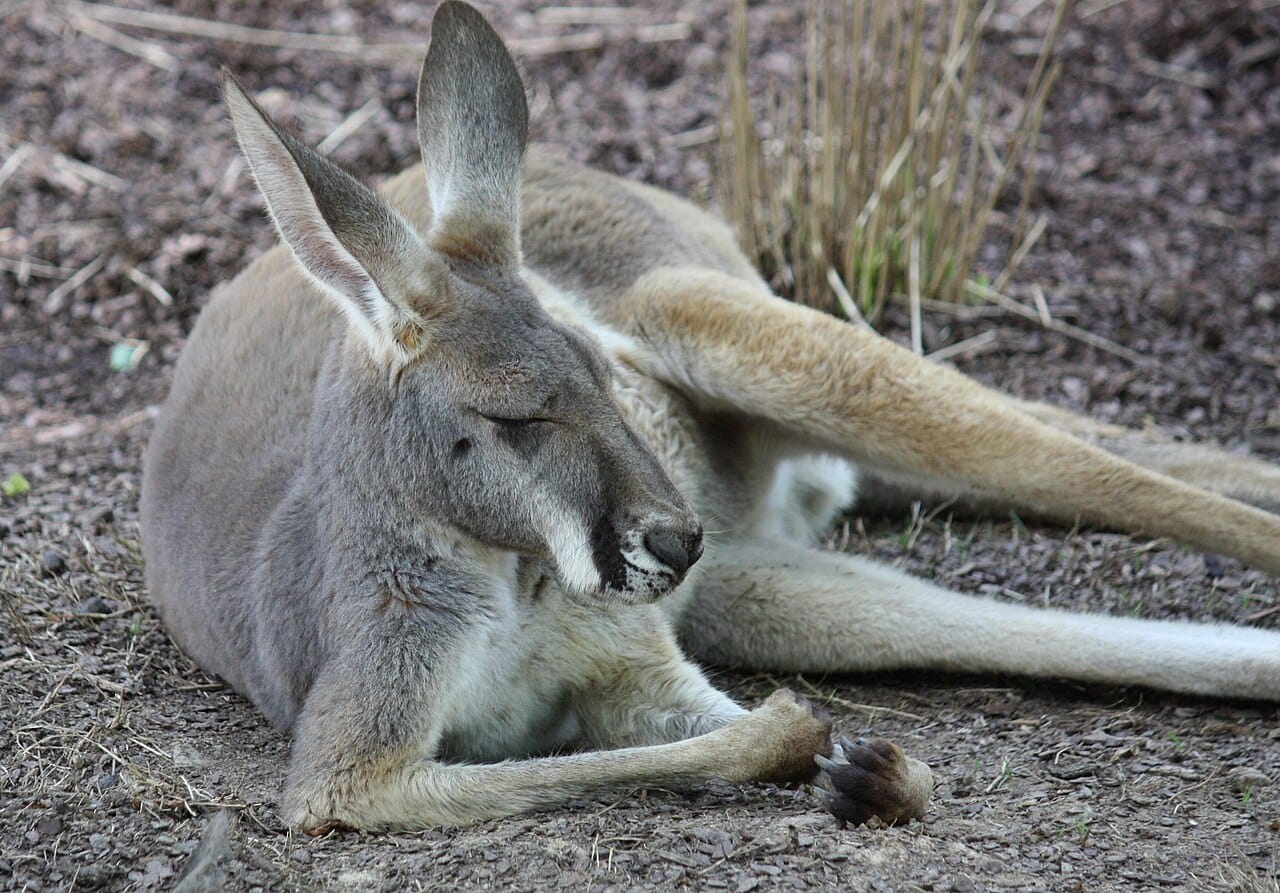
Four species are usually meant: the red kangaroo of the arid interior, the eastern and western grey kangaroos of the wetter margins, and the antilopine kangaroo of the tropical north. Wallabies, wallaroos, tree-kangaroos and quokkas are relatives in the same family, and the line between a kangaroo and a wallaby is size and convention rather than taxonomy.
Males are substantially larger than females and keep growing throughout life, developing heavy forearm and chest musculature used in boxing contests over mating access. These fights are real: kangaroos grapple with the forelimbs and deliver a kick with both hind feet while balanced on the tail, and the claws can open an opponent.
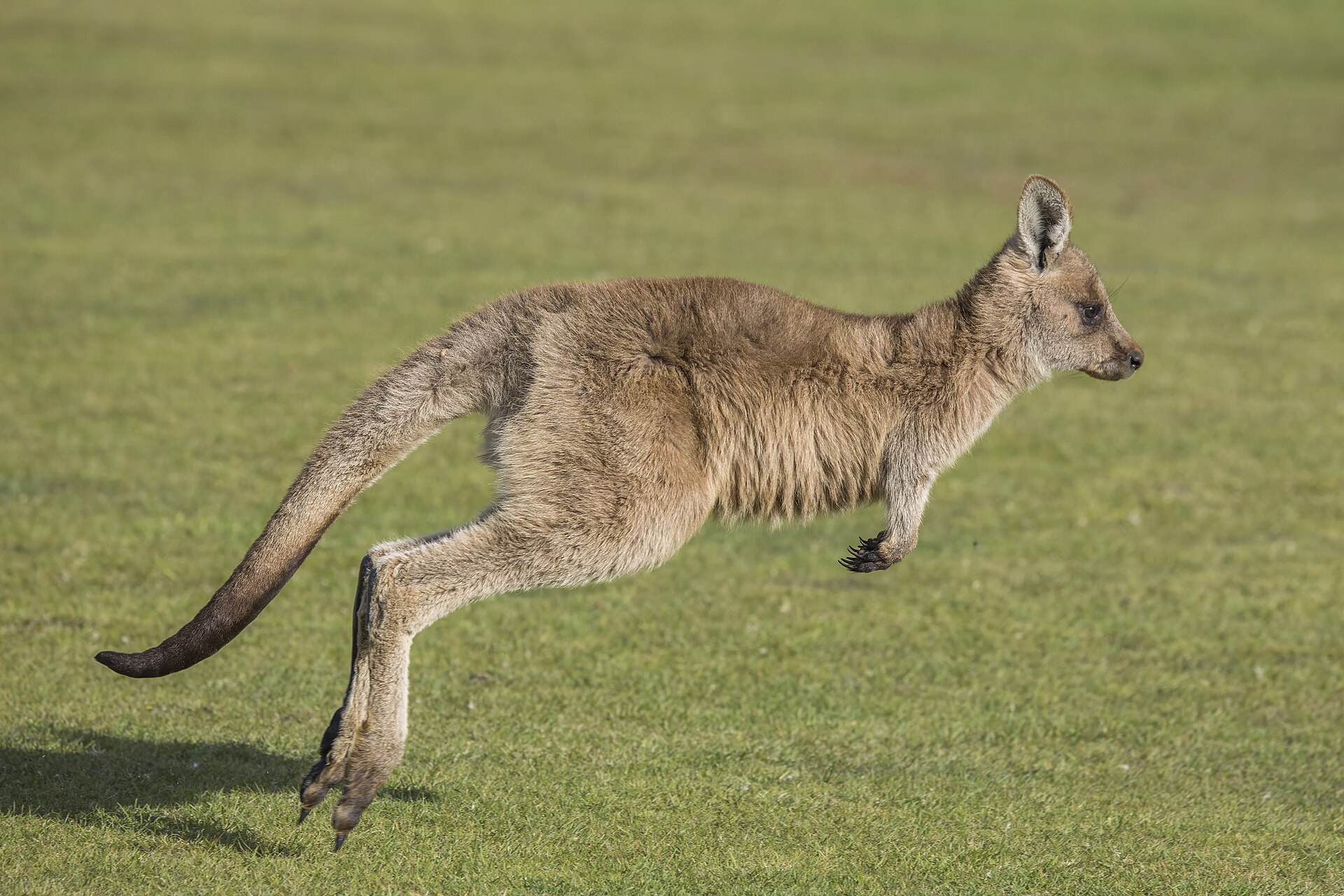
For most animals, the energy cost of moving rises steadily with speed. For a hopping kangaroo above a threshold speed it does not: oxygen consumption stays roughly flat as the animal goes faster, over a considerable range. Very few animals do anything comparable.
The mechanism is elastic storage. The long Achilles and other hind-limb tendons stretch on landing and recoil on take-off, returning much of the energy of the previous hop rather than requiring the muscles to generate it afresh. The kangaroo is bouncing rather than running, and past a certain speed it simply lengthens the hop instead of increasing the effort. Breathing is also coupled to the gait, with the viscera acting as a piston against the diaphragm, so ventilation comes partly free.
At low speed hopping is inefficient, and kangaroos switch to a different gait entirely: pentapedal walking, planting the tail and forelimbs to take the weight while swinging the hind legs forward. Force-plate work published in 2014 showed the tail is not a prop but a propulsive limb, contributing about as much force as the front and hind limbs together. A slow-moving kangaroo is effectively a five-legged animal.
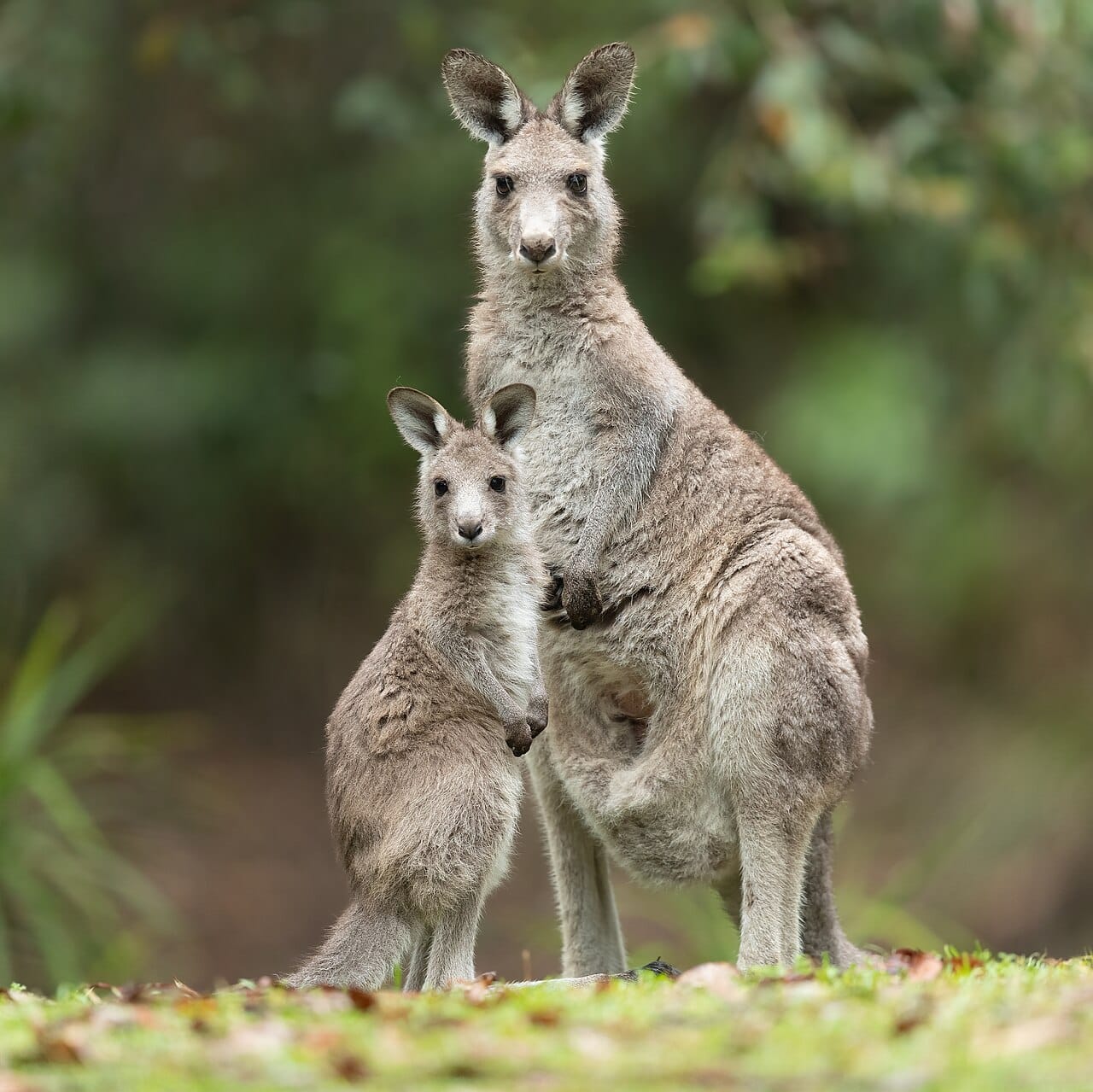
A kangaroo gestates for roughly a month and gives birth to an embryo weighing under a gram, blind, without hind limbs, which crawls unaided up the mother's fur into the pouch using forelimbs that are developed ahead of everything else. It attaches to a teat and remains there for months.
Then the arrangement becomes unusual. The female mates again almost immediately, and the resulting embryo enters diapause, arrested at about a hundred cells, held there by hormonal signals from the suckling joey. When the pouch young leaves or dies, the signal stops and the paused embryo resumes development. A female can simultaneously carry a diapausing embryo, a small joey attached in the pouch, and a large young-at-foot still returning to nurse.
The mother produces two different milks at the same time from different teats, one formulated for a newborn and one for a well-grown joey. In a drought the whole system stalls, and it restarts within weeks of rain, which is why red kangaroo numbers move so sharply with the seasons.
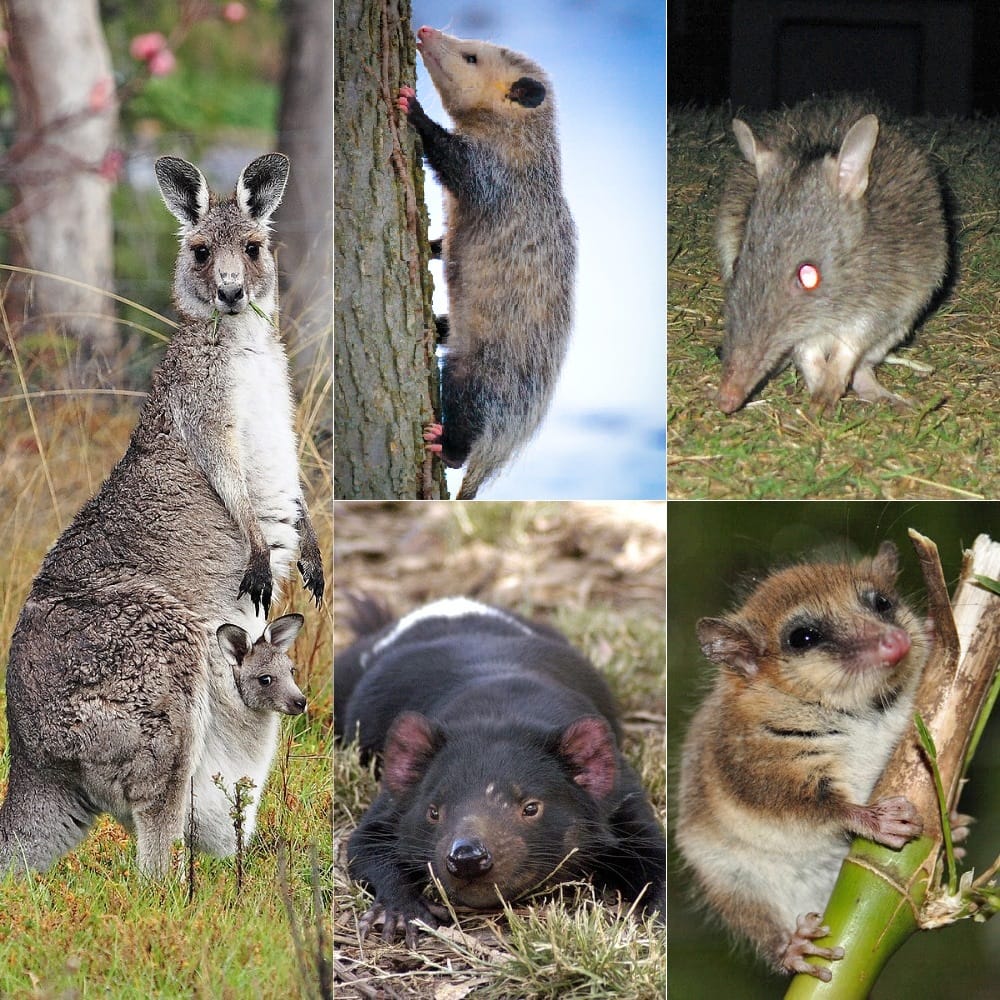
Macropods are marsupials, part of a lineage that separated from placental mammals more than 150 million years ago and that radiated in Australia and South America.
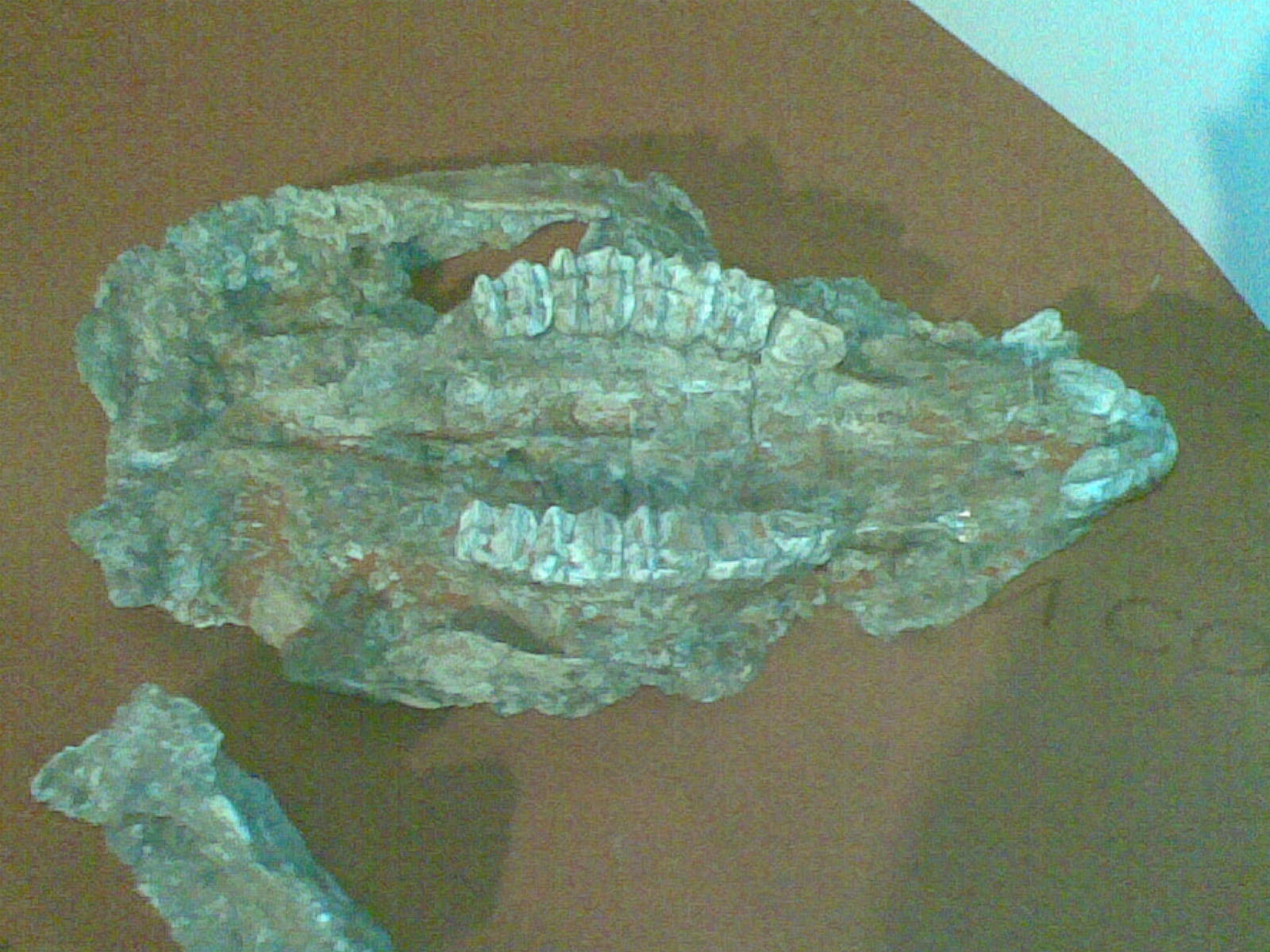
Pleistocene Australia held far larger macropods. Procoptodon goliah, a short-faced kangaroo, weighed around 240 kilograms, and anatomical work published in 2014 argued that the sthenurines did not hop at all: their hip, knee and ankle structure, and a spine capable of supporting weight on one leg at a time, point to walking upright. If correct, that is a bipedal striding gait evolved independently of our own lineage. They disappeared in the late Pleistocene extinctions along with most of Australia's megafauna, in a debate over human arrival and climate that is covered elsewhere.
Kangaroos are not rare. The commercially harvested species total somewhere between about thirty and fifty million animals depending on rainfall, and they have benefited from pastoralism: bores and dams put permanent water in country that had none, and the removal of dingoes reduced predation.
Australia runs the largest commercial harvest of wild land mammals anywhere, taking on the order of one to two million animals a year under state quotas set as a percentage of surveyed populations. It is defended as sustainable and as ecologically preferable to farmed livestock, since kangaroos are soft-footed, need no clearing, and produce lean meat from unimproved rangeland.
The objections are of two kinds and it is worth separating them. The sustainability objection disputes the population surveys and the quota model, and is a technical argument that has not overturned the official assessments. The welfare objection concerns the method: shooting at night in the field, where the code requires a head shot, and above all the treatment of dependent young, since a shot female may carry a pouch joey that is then killed by blunt force. That is not a dispute about numbers and is not resolved by better counting.
A related claim needs qualifying. Kangaroos are often said to produce no methane, which raised hopes of transferring their gut microbes to cattle. They produce considerably less per unit of feed than ruminants, not none, and the microbial transfer idea has not worked.
The story that kangaroo means I do not understand, supposedly a misunderstanding between Cook's crew and Guugu Yimithirr speakers in 1770, is false and was disproved directly: the word gangurru in Guugu Yimithirr does mean a large black kangaroo, confirmed when linguists worked with the language in the 1970s.
The kangaroo appears on the Australian coat of arms alongside the emu, both chosen in part because neither animal can easily walk backwards. It is also, unusually for a national emblem, harvested commercially at scale, which is a tension Australia is fairly relaxed about.
The kangaroo is the clearest demonstration that there is more than one way to be a large grazing mammal. Australia's isolation produced an animal that solves locomotion by bouncing, reproduction by carrying an external embryo, and drought by pausing gestation, and none of those is what the placental world converged on.