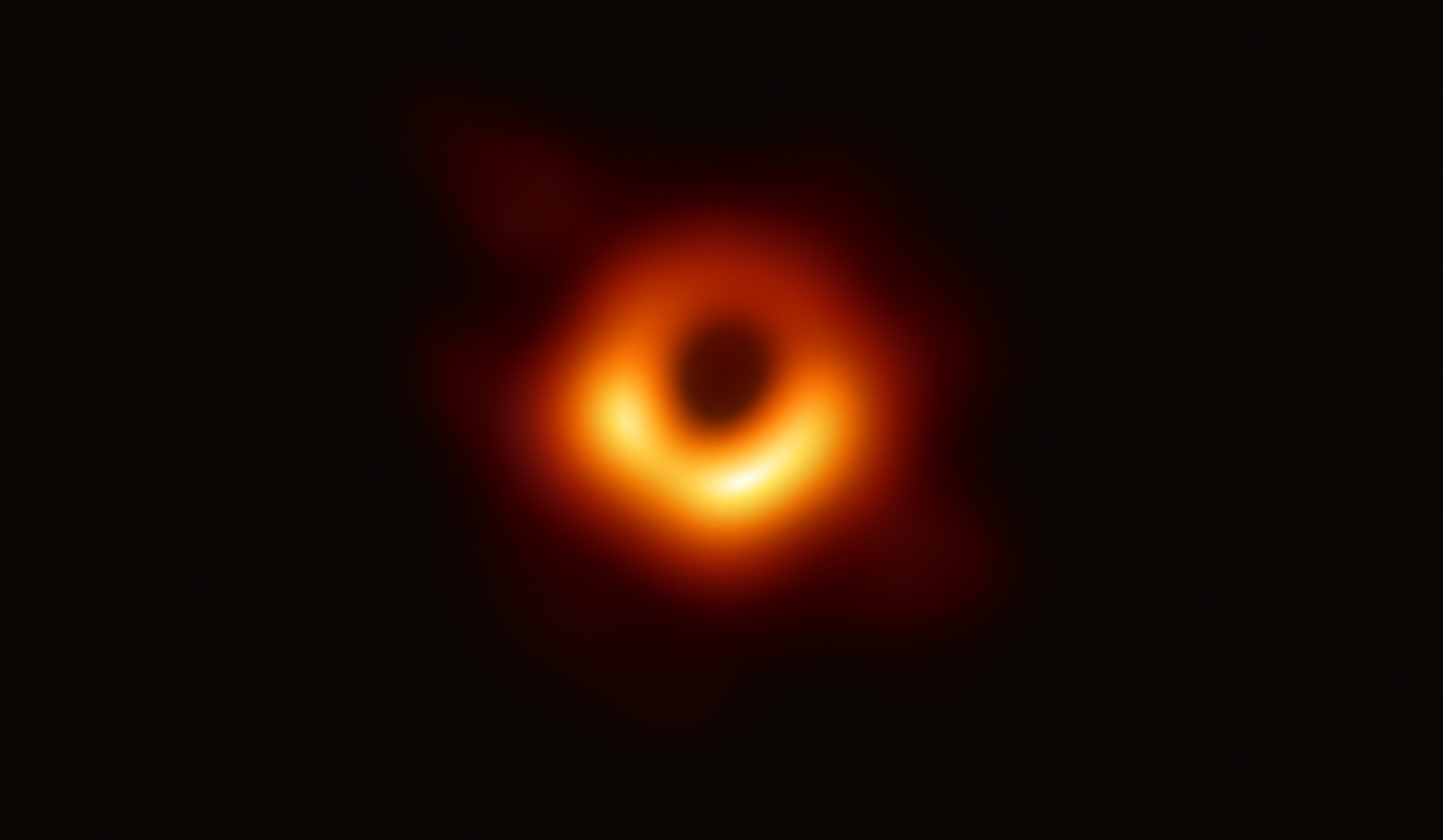
Bodies that formed around other stars and are passing through our solar system on unbound trajectories. Three have been found, the first in 2017 and the most recent in 2025, and they do not resemble one another closely enough for anyone to say yet what the population is like.
An object bound to the Sun follows a closed orbit. An object arriving from outside approaches faster than the Sun's gravity can account for, so its path is hyperbolic and its excess speed at infinity is not zero.
That measurement is unambiguous when the orbit is well determined, which is why the identification of all three has been accepted immediately even where everything else about them has been argued over.
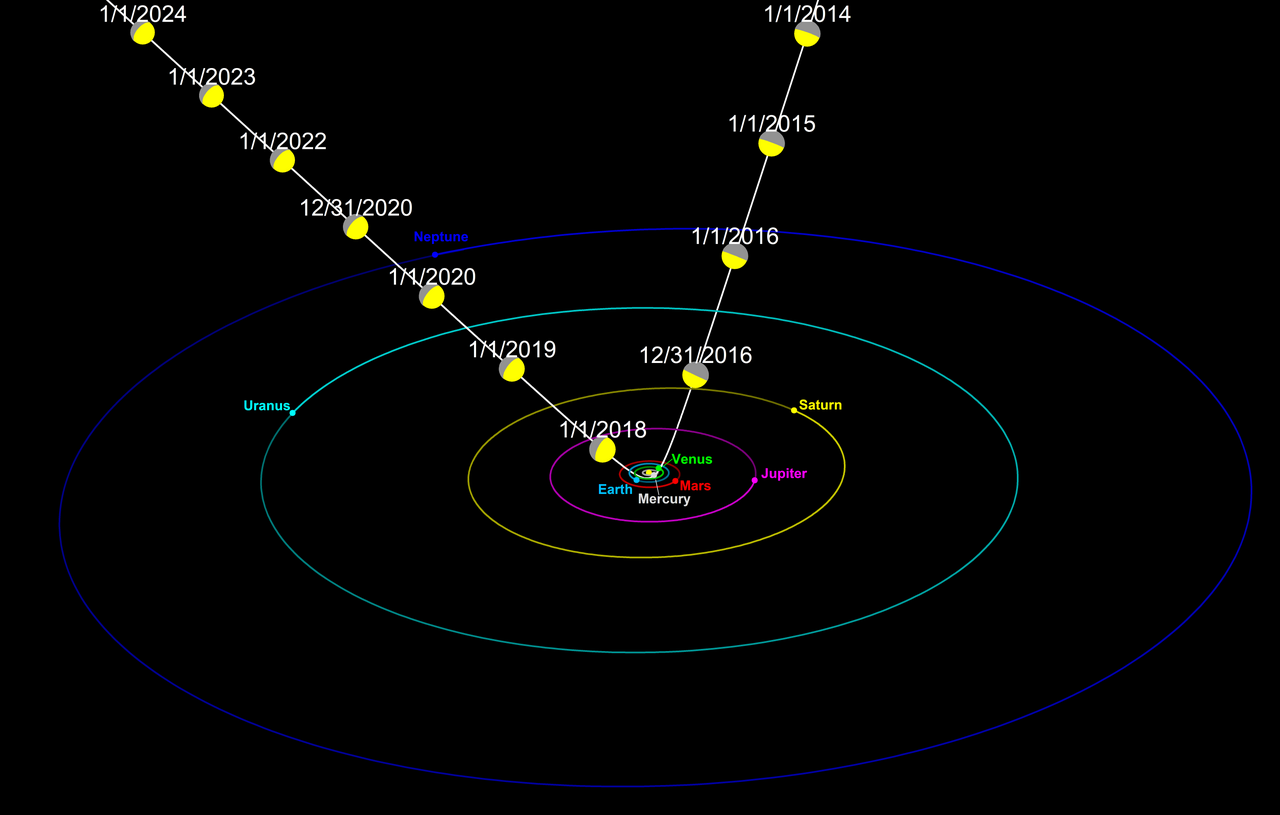
1I/'Oumuamua was found in October 2017 by the Pan-STARRS survey in Hawaii, after its closest approach to the Sun. It was small, of order a hundred metres, extremely elongated or possibly flattened, tumbling rather than rotating smoothly, and red.
Two features made it strange. It showed no coma and no visible tail, so it did not look like a comet. And it accelerated slightly as it left, in a way gravity alone does not produce, which is the signature of outgassing that was not observed.
2I/Borisov, found in August 2019 by the amateur astronomer Gennadiy Borisov, was the opposite case. It was an obvious comet, with a coma and tail, and it behaved so much like an ordinary solar system comet that its interstellar origin was the only unusual thing about it. Its composition was unusual in one respect, being notably rich in carbon monoxide.
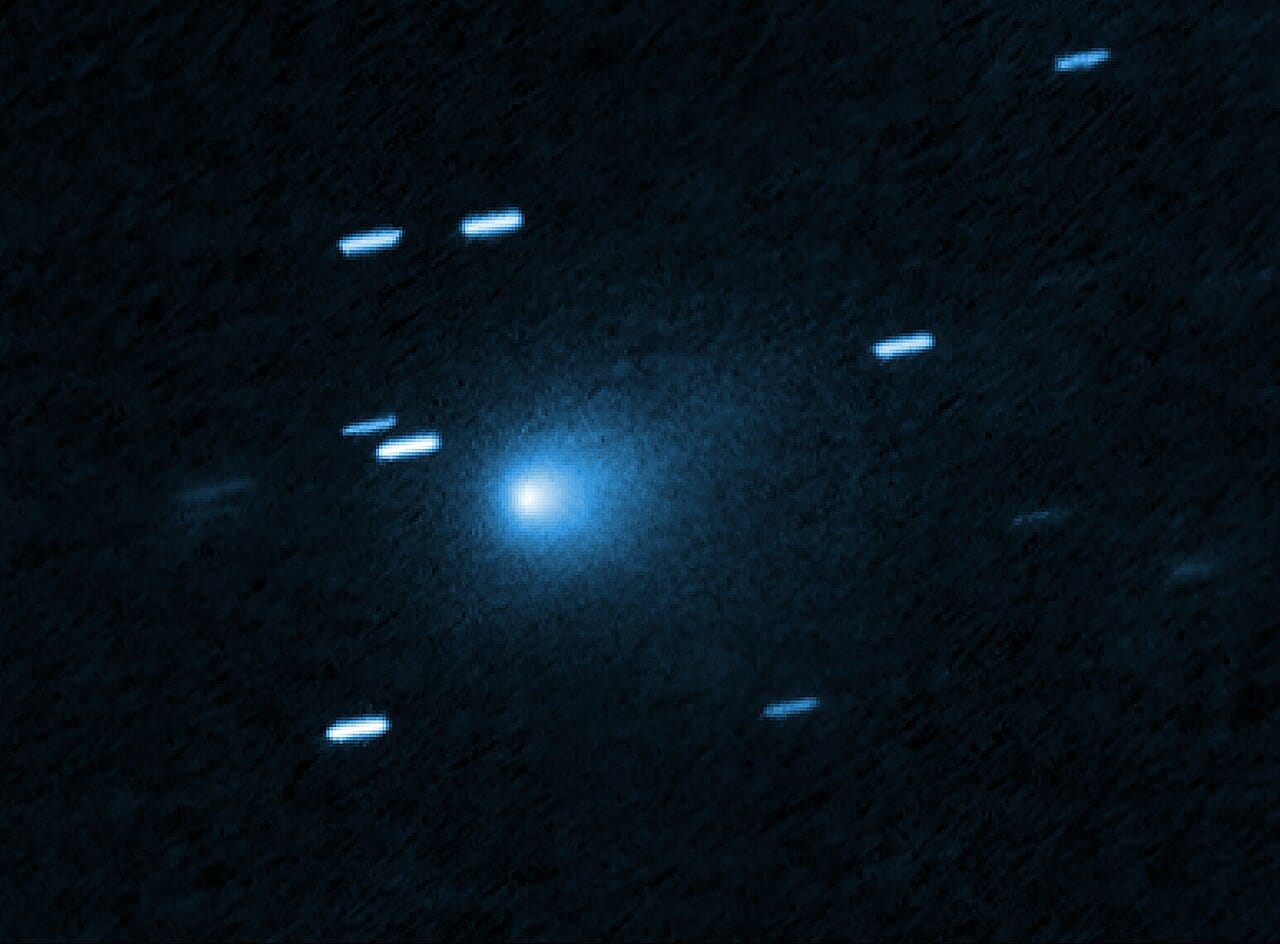
3I/ATLAS was discovered on 1 July 2025 by the ATLAS survey, and unlike its predecessors it was found while still inbound, which allowed a coordinated campaign rather than a scramble. It passed perihelion on 29 October 2025 at about 1.4 astronomical units.
It is a comet. Its activity beyond about three astronomical units was dominated by carbon dioxide, with water sublimation taking over as it approached the Sun. Its spectrum is red and featureless, redder than most solar system comets and closer to the surfaces of some distant trans-Neptunian objects and centaurs. In late 2025 it became the first interstellar comet detected in X-rays, by the XRISM and XMM-Newton observatories.
The first object remains unexplained, and the proposals are mutually exclusive.
A fragment of nitrogen ice, chipped off a body resembling Pluto around another star, would be reflective enough to match the brightness and would outgas nitrogen invisibly. The objection is that it requires an implausibly large amount of such material to be produced galaxy-wide.
A hydrogen iceberg would outgas without a detectable signature, and the objection is that hydrogen ice is difficult to form and would evaporate on the journey.
A very porous fractal aggregate, essentially a loose dust structure, would be pushed by sunlight enough to explain the acceleration without outgassing at all.
Avi Loeb proposed that it was an artefact, a thin lightsail of technological origin, on the grounds that the natural explanations each require unusual conditions. This has been rejected by most of the field, on the argument that an unexplained natural object is not evidence of design and that the specific observations, particularly the tumbling, fit an inert fragment better than a sail. The proposal is well known outside astronomy and is not a mainstream position within it.
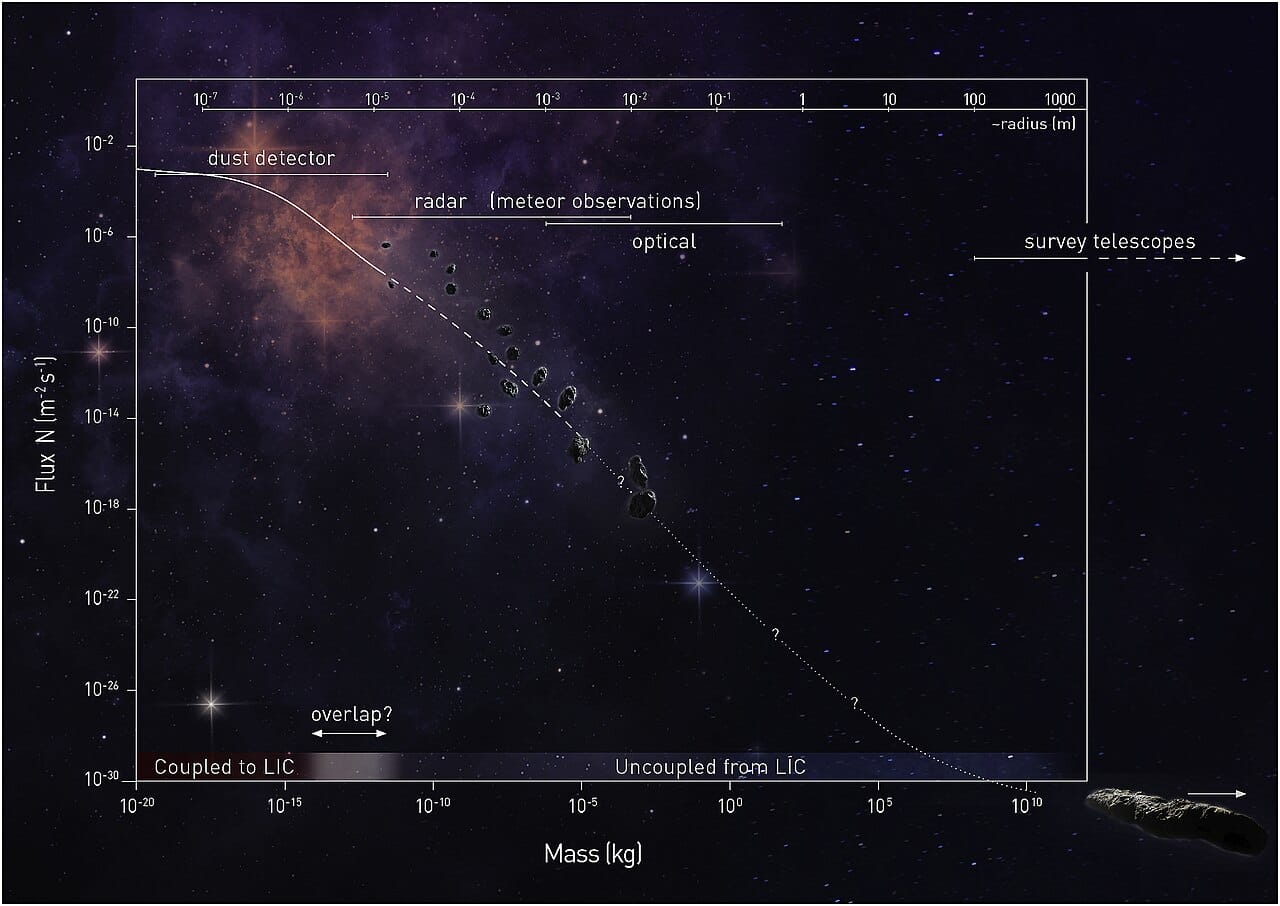
With three objects, almost every general question is open.
The number passing through at any time is inferred from detection rates and survey coverage, and estimates vary widely. The first detections implied a higher density of such bodies than models of planetary system ejection had predicted, which is either a real result or an artefact of small numbers.
Whether the typical interstellar object is comet-like or asteroid-like is undetermined. One of three showed no activity and two were clearly active, which is consistent with almost any underlying ratio.
Where they come from is unresolved. Ejection during planet formation is the standard mechanism, and the population should therefore be dominated by icy bodies from the outer parts of young systems, but the ages, the source stars and the time spent in interstellar space are not established for any of the three.
These are the only samples of material from other planetary systems that can be observed directly rather than inferred from starlight, and they arrive without being asked for.
The Vera C. Rubin Observatory, which began survey operations in this decade, is expected to increase the detection rate substantially, and the field's central problem, that three objects cannot define a population, is one that time and survey coverage will solve rather than argument.