Distant galaxies recede from us, and the further away they are the faster they go. The observation established that the universe has a history rather than being eternal and unchanging, and the rate of expansion is currently the subject of the sharpest disagreement in cosmology.
Vesto Slipher measured the spectra of spiral nebulae from 1912 and found most were redshifted: their spectral lines were displaced toward longer wavelengths, indicating recession.
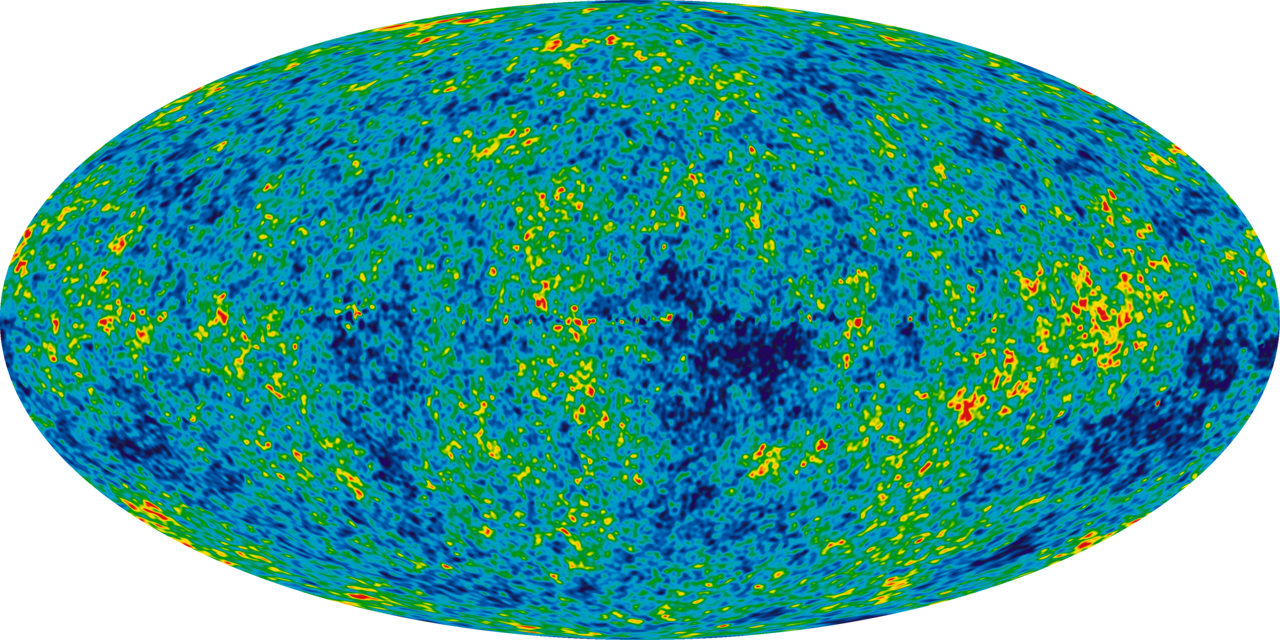
Edwin Hubble, using the 100-inch telescope at Mount Wilson, established two things that made those measurements meaningful. First, in 1924, that the spirals are galaxies far outside our own, settling a long dispute about the scale of the universe. Second, in 1929, that recession velocity is proportional to distance.
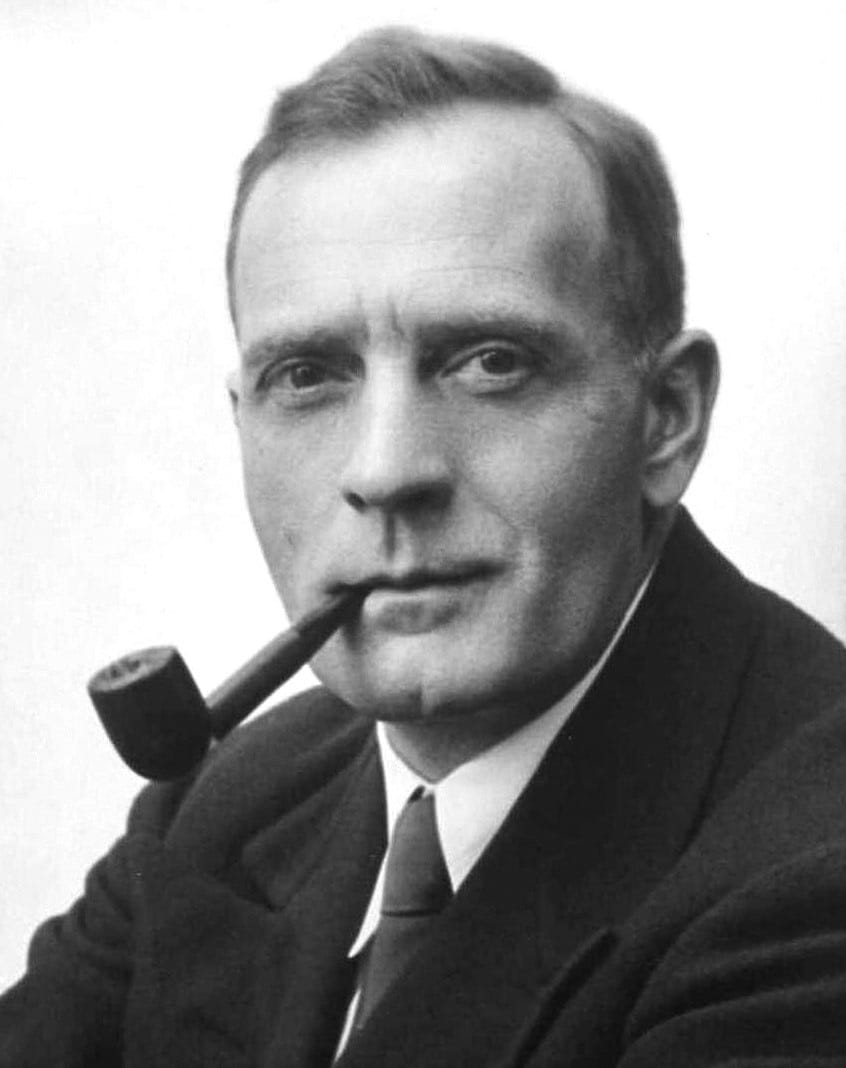
Georges Lemaitre, a Belgian priest and physicist, had derived the expanding solution from general relativity and published the velocity-distance relation in 1927, two years before Hubble, in a French-language journal that went largely unread. The relation is now often called the Hubble-Lemaitre law.
The common picture of galaxies flying apart through space is wrong in a way that matters.
Space itself is expanding, and galaxies are carried with it. There is no centre and no edge; every observer sees the same recession in every direction, which is what the observations show and what a centre-and-explosion picture cannot produce.
The redshift is not a Doppler shift from motion through space. It comes from the expansion of space during the light's journey, stretching the wave along with it. This is why very distant objects can recede faster than light without violating relativity, which limits motion through space and says nothing about the expansion of space itself.
Bound systems do not expand. Atoms, planets, stars and galaxies are held together by forces vastly stronger than the expansion, and even galaxy clusters remain bound. Only the space between unbound systems grows.
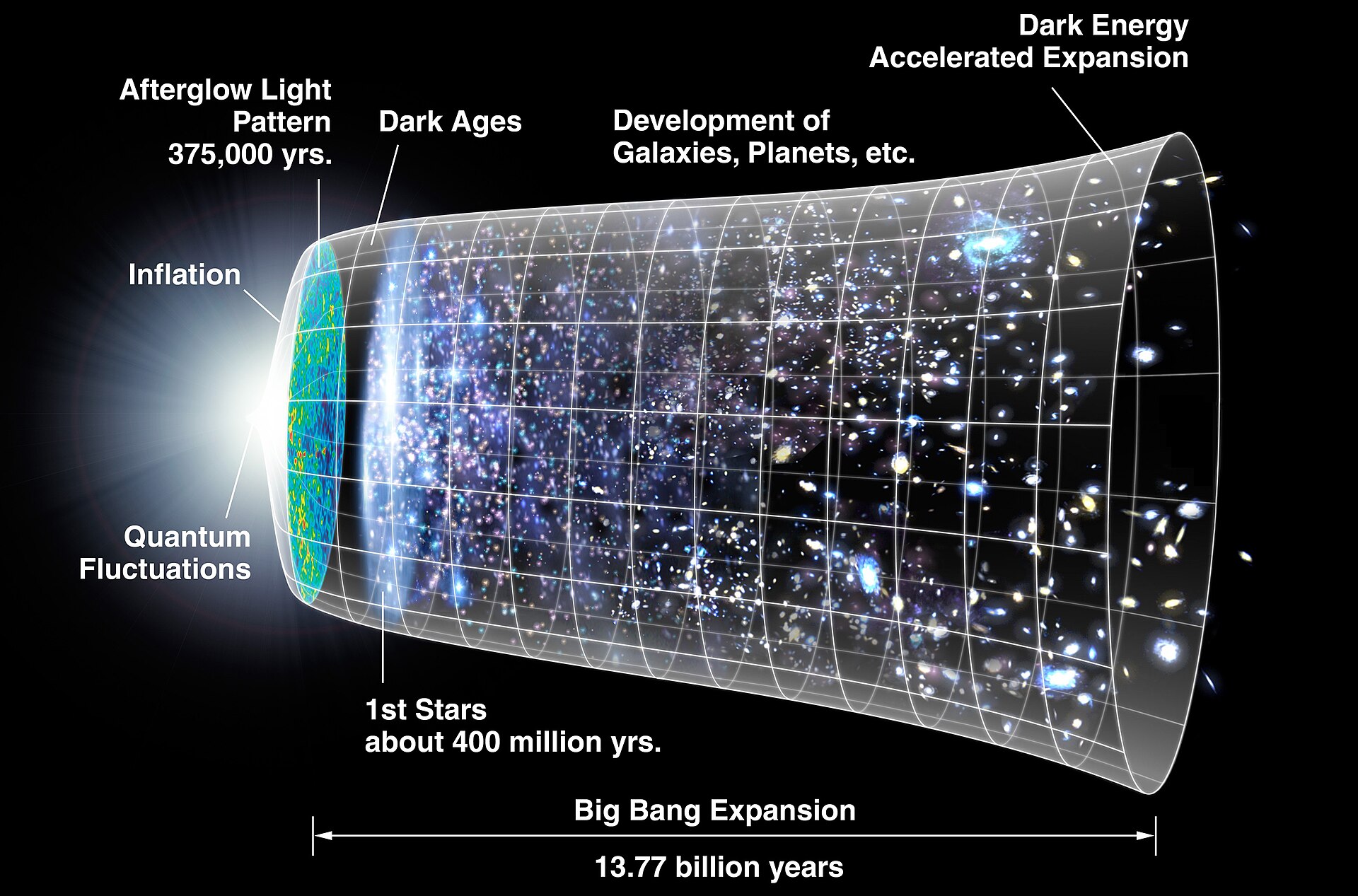
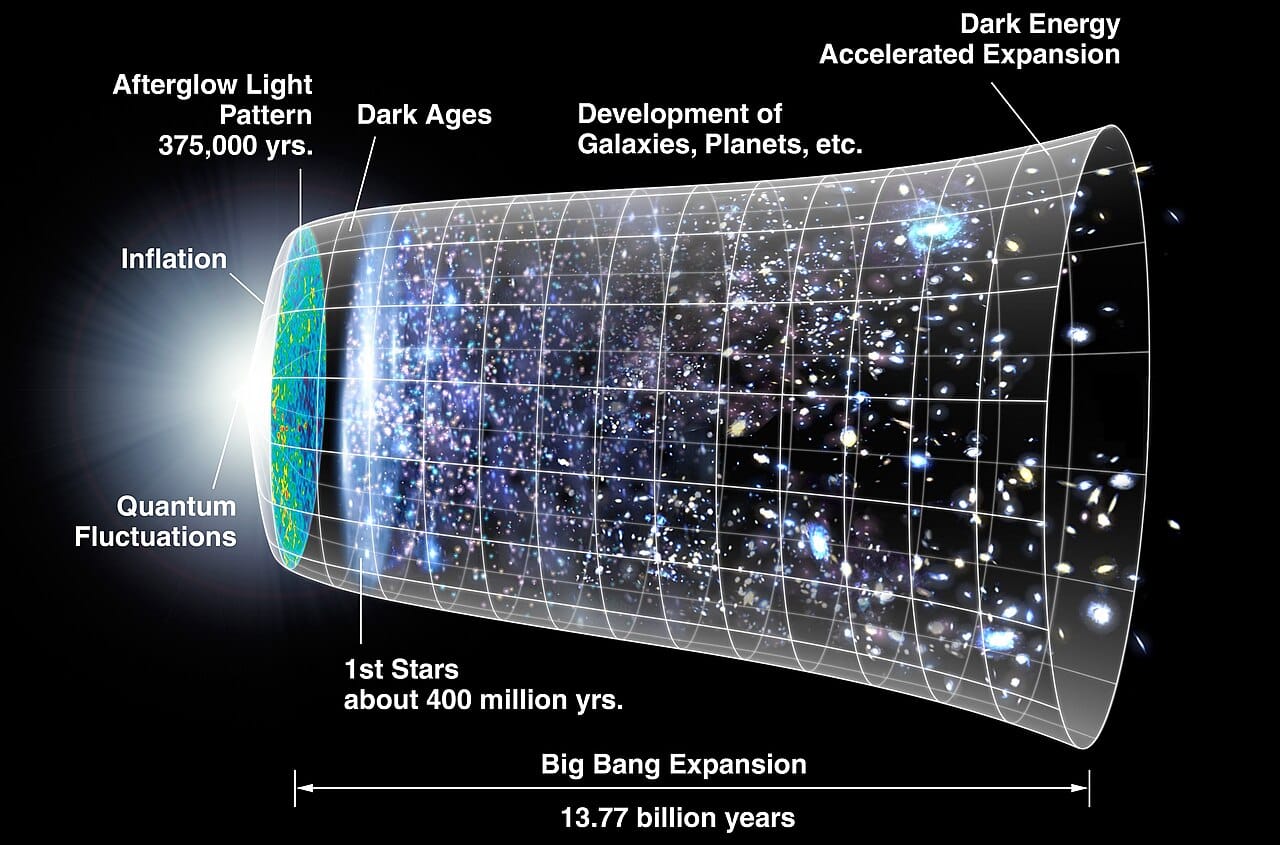
Running the expansion backwards gives a hot dense early state, which is the Big Bang, and the model has three independent confirmations that do not depend on Hubble's measurement at all.
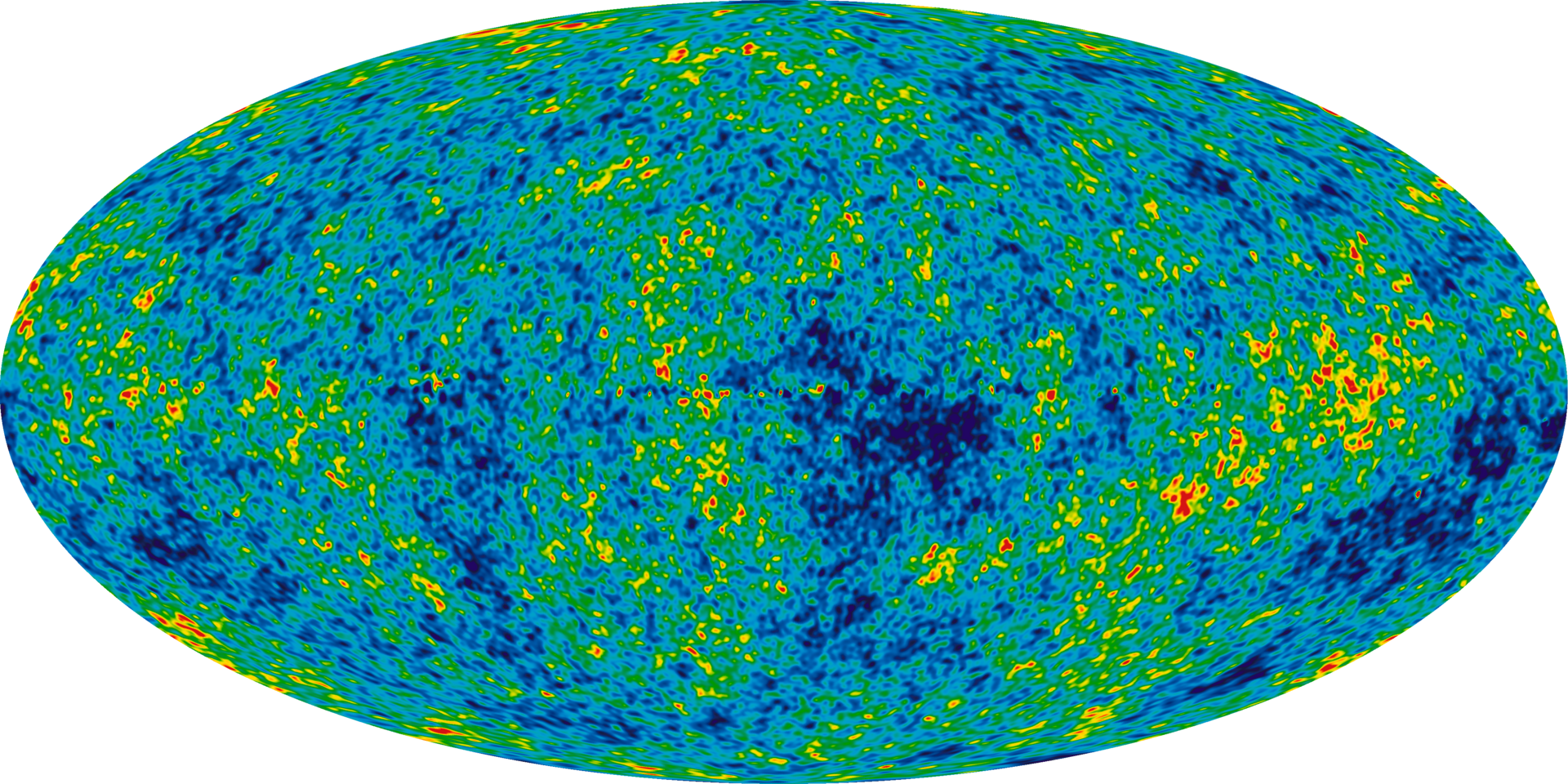
The cosmic microwave background is thermal radiation from about 380,000 years after the beginning, when the universe cooled enough for atoms to form and light to travel freely. It was found accidentally in 1965 and matches the predicted spectrum extremely precisely.
The abundances of the lightest elements match what nucleosynthesis in the first few minutes predicts, across several elements spanning many orders of magnitude in abundance.
And the universe changes with distance, which is to say with time. Distant galaxies look different from nearby ones, which an eternal unchanging universe cannot produce.
The expansion is not in doubt. Its rate is, and the disagreement has grown rather than resolved.
Two methods measure it. The distance ladder works outward from nearby objects: parallax to Cepheid variable stars, Cepheids to calibrate type Ia supernovae, supernovae to reach far enough for expansion to dominate. This gives roughly 73 kilometres per second per megaparsec.
The other route predicts the rate from the early universe, fitting the cosmic microwave background with the standard cosmological model. This gives roughly 67.
The two are about five standard deviations apart, which is the threshold physics conventionally treats as a discovery rather than a fluctuation.
The obvious explanation, that one measurement has an error, has been pursued hard. The James Webb Space Telescope was expected to settle it by resolving whether crowded fields were biasing Cepheid photometry, and its observations found no such bias, leaving the ladder value intact. An independent method using the tip of the red giant branch gives values between about 69 and 72, closer to the middle but not bridging the gap. Methods avoiding the ladder entirely, including gravitational lensing time delays and supernova spectral modelling, have not resolved it either.
If both measurements are right, the standard cosmological model is missing something between the early universe and now. Proposals include additional relativistic particles in the early universe, evolving dark energy, and modifications to gravity, and none is established. As of 2026 the tension is unresolved and, on several independent probes, growing.
That a quantity measured to better than one percent by two methods is the source of cosmology's central problem is a good illustration of what precision buys: it turns a rough agreement into a definite disagreement, which is progress even when it is uncomfortable.