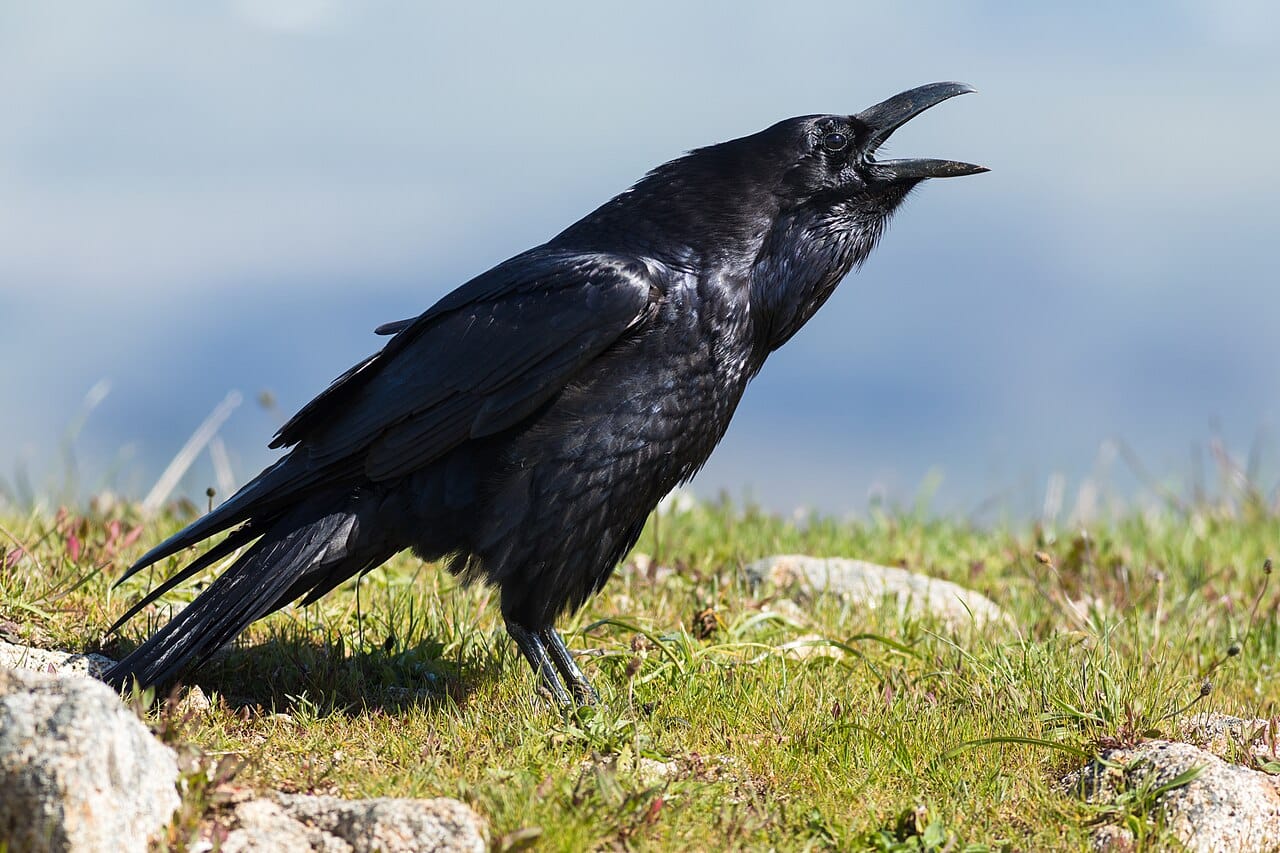
The common raven, Corvus corax, is the largest songbird in the world and among the most widely distributed birds on Earth, occupying the whole northern hemisphere from high Arctic tundra to desert. It is the subject of more cognitive research than almost any other bird, and of correspondingly more overstatement.
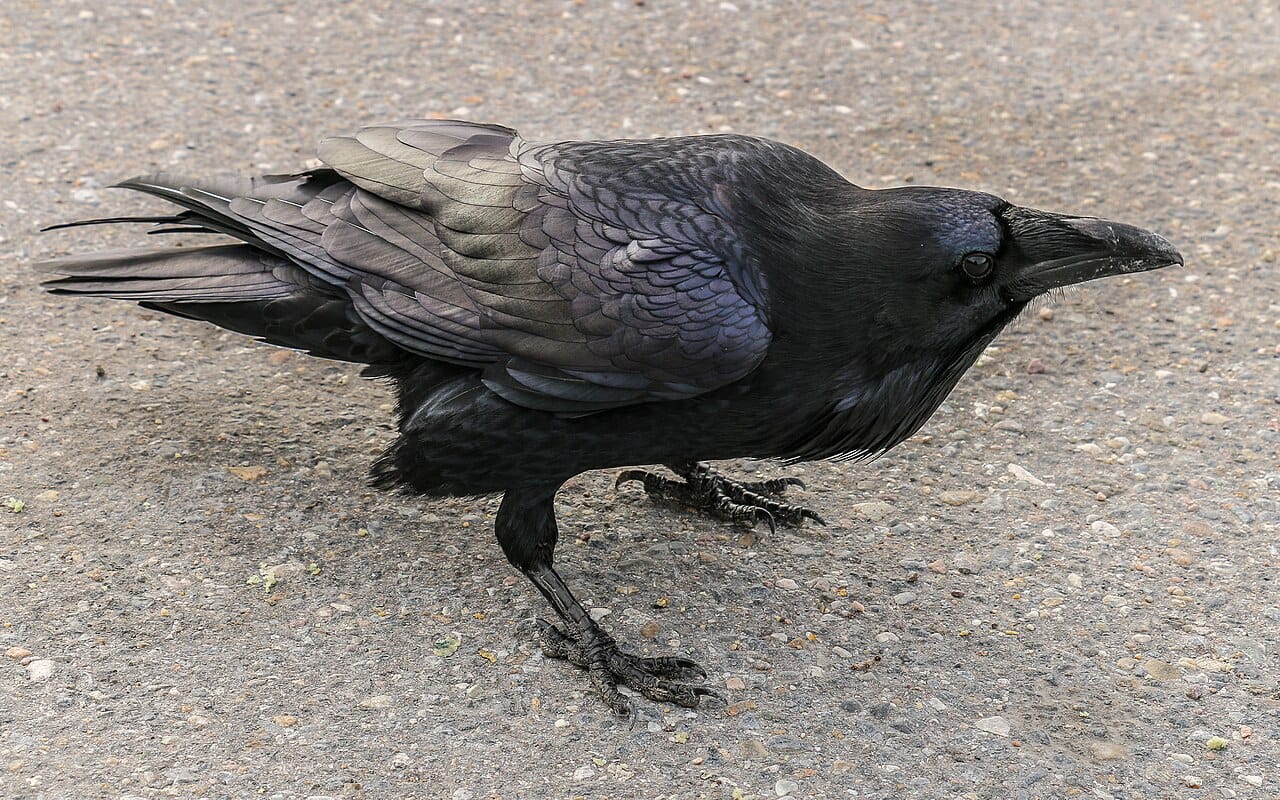
Ravens are big: 55 to 70 centimetres long, with wingspans over a metre and weights of around one to one and a half kilograms, several times the mass of a carrion crow. In flight the wedge-shaped tail is the reliable distinction, along with a habit of soaring and tumbling that crows do not share.
The bill is heavy and slightly curved, and the throat carries elongated hackle feathers raised in display. The plumage is black with an iridescent sheen that is structural rather than pigmentary, appearing blue or purple depending on the light.
Vocally the raven is not limited to the croak it is named for. Recorded repertoires run to dozens of distinct call types, and captive birds mimic human speech and mechanical sounds accurately, which is why the species recurs in folklore as a bird that talks.
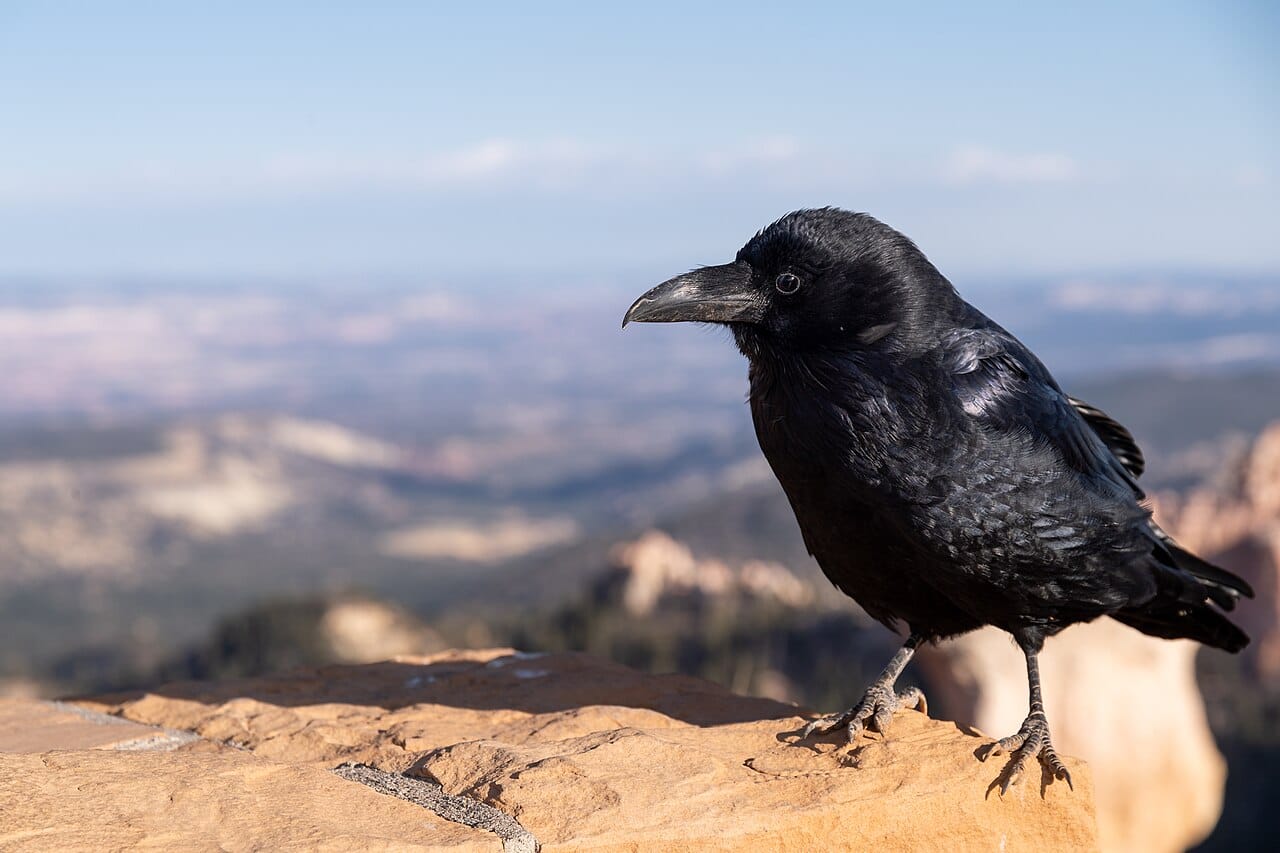
The range covers North America, Europe, Asia and North Africa, and includes ground almost nothing else tolerates: high Arctic islands, the Tibetan plateau, the Sahara's margins, and the mountains of the western United States. It is entirely at home in cities, and one of a small number of large birds that has expanded rather than contracted alongside human settlement.
The diet is opportunistic to the point of being uninformative: carrion, small mammals, eggs, nestlings, insects, grain, fruit, human refuse. Ravens scavenge heavily at wolf kills in the north, and there is a well-documented relationship in which ravens follow wolves and, in some accounts, lead them to carcasses.
They cache food and remember where, and they take account of who was watching when they did it. A raven that has been observed caching will return and re-cache when the observer is gone, and will do so more readily if the observer was a bird that has previously stolen from it.
Corvid cognition is a field with a serious replication and interpretation problem, and the raven is at the centre of it.
The strong claims are well known. A 2017 study in Science by Kabadayi and Osvath reported that ravens selected a tool for use fifteen minutes and seventeen hours in the future, passing up an immediate smaller reward to do so, at rates near ninety per cent. The authors concluded that ravens plan flexibly in domains they do not encounter in the wild, paralleling great apes.
The criticism is equally serious. Reviewers have argued that these results, and a good number of comparable ape results, do not exclude associative learning: an animal that has been rewarded for picking up a particular object may pick it up again without representing anything about the future. A 2018 paper in Learning and Behavior made the case that apes and corvids have been overinterpreted in parallel, by the same mechanism of preferring the richest available explanation.
The reasonable position is that ravens perform impressively on tasks that are difficult for most animals, that the mechanism producing that performance is not established, and that the popular framing in which ravens are said to plan like humans runs well ahead of the evidence.
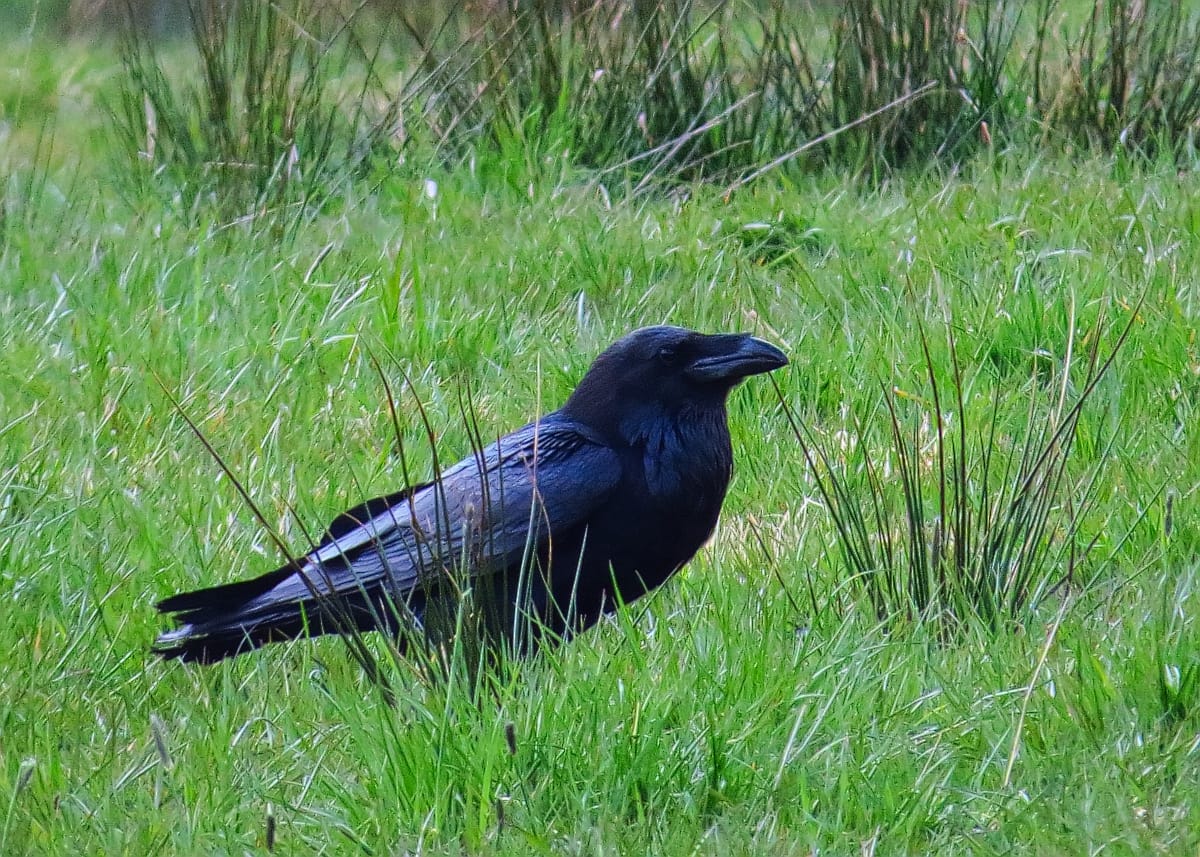
Adult ravens form long-term pairs holding a territory year-round, often for life. Non-breeding juveniles form roving flocks, sometimes of dozens, and this age structure is central to how the species works: young birds gang up to overwhelm the territorial pair at a carcass, and calling to recruit others is in the recruiting bird's interest for exactly that reason.
Ravens play. They slide down snowbanks, hang upside down from branches, and pass objects to each other in flight. This is one of the least ambiguous cases of play in a non-mammal, and it is not obviously reducible to practice for anything.
The raven carries more mythological weight than any other bird in the northern hemisphere, and unusually the weight is not consistent.
In Norse tradition Odin's ravens Huginn and Muninn, thought and memory, fly over the world and report back. In the traditions of the Pacific Northwest coast, Raven is a creator and a trickster who brings light into the world and is also greedy and unreliable. In European Christian and later Gothic usage the bird is an omen of death, a reading fixed for English-language readers by Poe in 1845.
The Tower of London ravens, whose departure is said to foretell the fall of the kingdom, are a case worth noting for a different reason: the legend appears to be Victorian at the earliest, with no reliable record of it before the nineteenth century, and possibly later.
Ravens are a test of how well we can describe an animal's mind without either flattening it or inflating it. They do things that are genuinely hard to account for, and the field's difficulty in saying precisely what those things are is not a failure of the birds.