The proposal that the cell nucleus originated as a large DNA virus that took up permanent residence in an ancestral cell. It is a minority position with specific supporting observations, and it addresses the one part of eukaryotic origins that the standard account handles least well.
Eukaryotic cells differ from bacteria and archaea in several respects, and their origins are not equally understood.
Mitochondria are settled. They descend from a bacterium taken up and retained, which is endosymbiotic theory, and the evidence is overwhelming: their own genome, their double membrane, their bacterial-type ribosomes, their division by fission. Chloroplasts have the same story with a cyanobacterium.
The nucleus does not. It has no genome of its own, does not divide independently, and its double membrane is continuous with the endoplasmic reticulum rather than separate. The endosymbiotic model that works so well for mitochondria does not obviously apply.
The standard explanation is autogenous: the nuclear envelope arose by infolding of the cell membrane, gradually enclosing the genome. This is plausible and leaves several features unexplained.
Philip Bell set out the viral version in 2001, building on earlier suggestions by Masaharu Takemura and others.
The proposal is that a large DNA virus infected an archaeal cell and, instead of killing it, persisted. Large DNA viruses commonly build a compartment inside the host, a viral factory, in which they replicate their genome separately from the host's machinery. The hypothesis is that such a factory became permanent and became the nucleus.
The observations offered in support are specific.
Eukaryotic nuclei and large DNA viruses share several features not found in bacteria or archaea: linear chromosomes with capped ends, separation of transcription from translation, messenger RNA capping, and in some cases a spindle-like apparatus for segregating DNA.
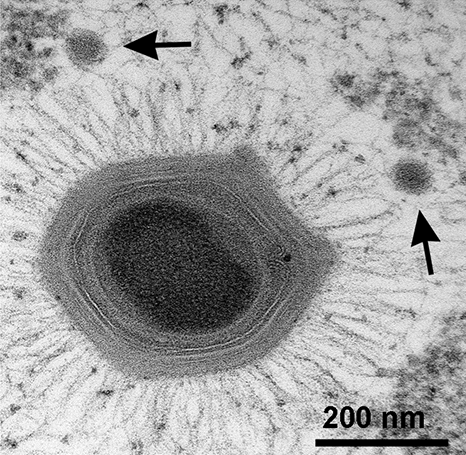
Giant viruses, discovered from 2003, changed what was considered possible. Mimivirus has a genome larger than some bacteria, encodes translation components previously thought exclusive to cells, and builds an elaborate replication factory. Pandoraviruses and pithoviruses are larger still. A virus of that complexity taking up residence is not obviously less plausible than a bacterium doing so.
And the timing works. The Asgard archaea, identified from 2015, are the closest known relatives of eukaryotes and lack a nucleus, so nuclear origin postdates that divergence and is a discrete event to be explained.
The evidence is homology of features rather than descent, and shared features can arise from convergent solutions to the same problem. Separating transcription from translation is useful for any system with a large genome and introns, and viruses and nuclei may have arrived at it independently.
No trace of a viral genome remains. Mitochondria kept their DNA; the nucleus has none to inspect, so the strongest evidence available for endosymbiosis cannot be brought here.
The direction of inference is contested. Several researchers argue that giant viruses acquired their cell-like features from hosts by gene transfer, rather than contributing them, which reverses the argument and is at least as well supported.
The autogenous account also does real work. Infolding of membranes explains the continuity of the nuclear envelope with the endoplasmic reticulum, which the viral account handles less naturally, and there is a coherent selective story: an archaeal cell that acquired a mitochondrion would face a flood of bacterial genes and mobile elements, and separating transcription from translation protects against exactly that.
Eukaryogenesis happened once. Every eukaryote descends from a single event, roughly two billion years after life began, and nothing comparable has occurred since. A step that singular is one of the strongest candidates for a hard step in the history of life, which is why it appears in discussions of the Great Filter.
An event that happened once is also the hardest kind to reconstruct, because there is no comparison case and no repetition.
The viral hypothesis remains a minority position. Its value is less that it is likely true than that it keeps a genuinely unresolved question open: the standard account of the nucleus is a plausible story rather than a demonstrated one, and the difference between those is worth preserving.