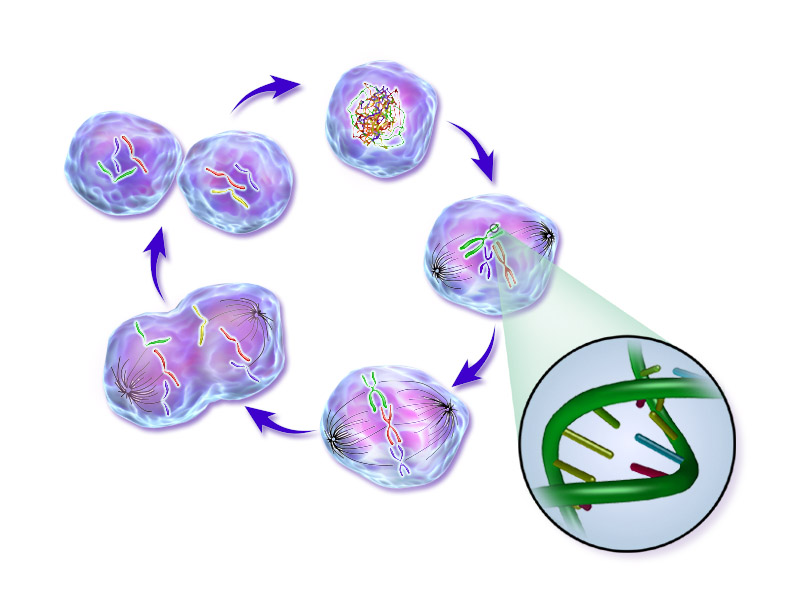
Cancer caused by loss of a tumour suppressor requires both copies of the gene to be knocked out. Alfred Knudson deduced this in 1971 from the statistics of a childhood eye tumour, before anyone knew what the gene was, and it was confirmed directly fifteen years later.
Retinoblastoma is a tumour of the developing retina, occurring in young children.
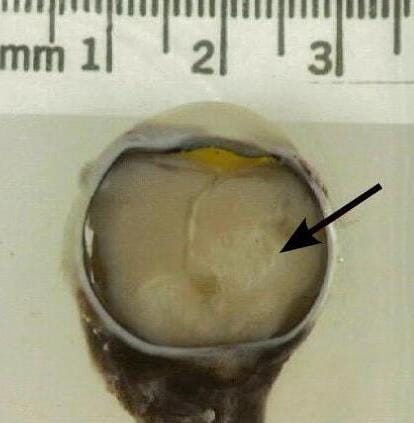
It comes in two forms. The hereditary form runs in families, usually appears earlier, and frequently affects both eyes with several tumours. The sporadic form has no family history, appears later, and is almost always a single tumour in one eye.
Both forms are the same disease under the microscope, which is what needed explaining.
Knudson analysed the age at diagnosis in both groups, in a 1971 paper of a few pages.
The distributions differed in a specific way. Hereditary cases followed the pattern expected if a single random event were required. Sporadic cases followed the pattern expected if two independent random events were required in the same cell.
His conclusion was that two mutations are necessary in both forms. Children with the hereditary form inherit one already present in every cell, so a single further event in any retinal cell suffices, which is why tumours are multiple and early. Children with the sporadic form must acquire both hits in the same cell, which is far less likely, so tumours are single and later.
This is inference from arithmetic. Knudson had no gene, no sequence and no molecular technique. He had ages at diagnosis and a probability model.
The RB1 gene was identified and cloned in 1986 by Thaddeus Dryja and Stephen Friend, and it confirmed the prediction directly.
Hereditary patients carry one mutated copy in every cell, and their tumours show loss of the remaining normal copy. Sporadic tumours show both copies lost, and normal tissue from the same patient has neither.
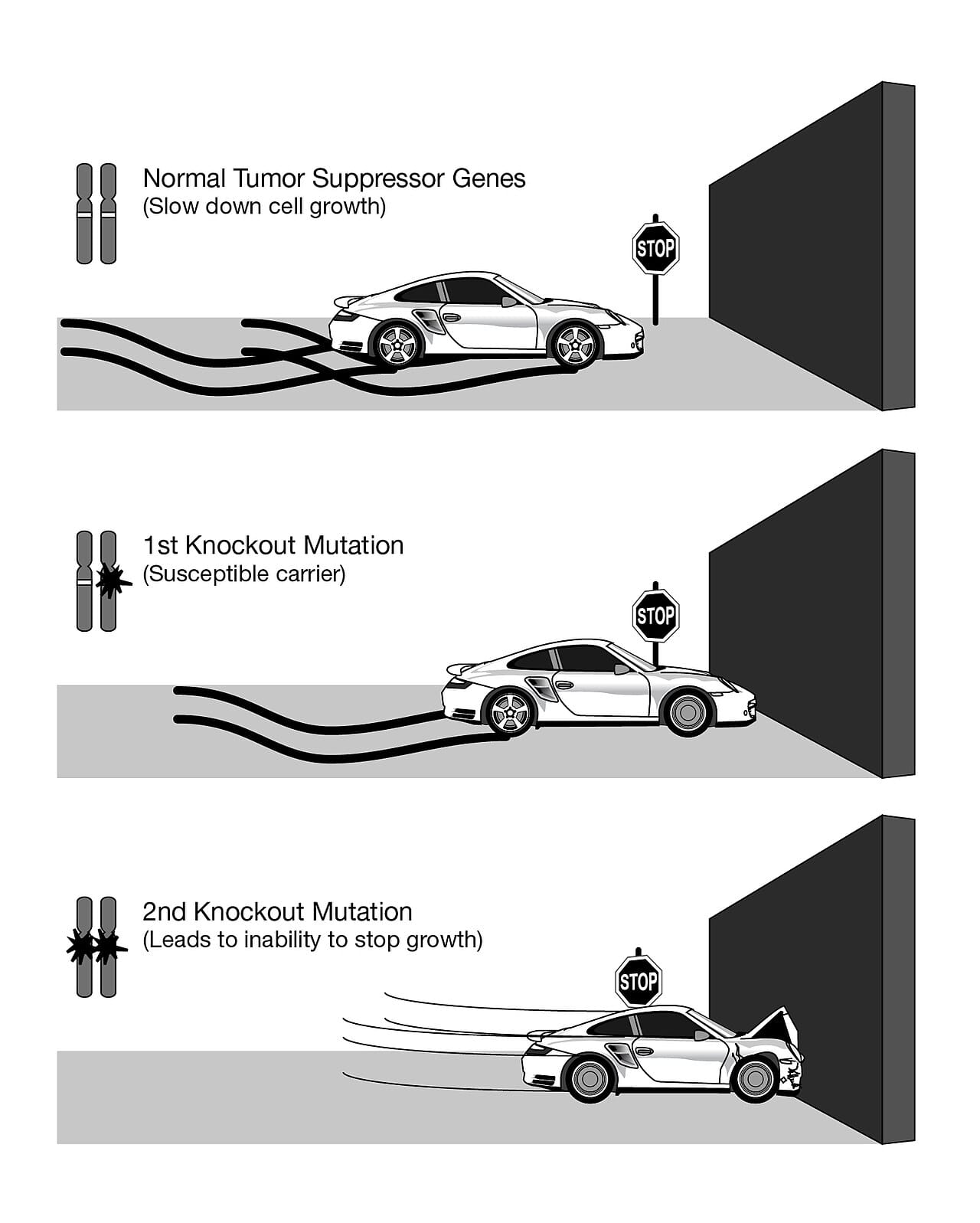
RB1 was the first tumour suppressor gene identified, and the protein turned out to restrain the transition from G1 into S phase in the cell cycle, which is exactly the kind of brake the model implied.
The name of the hypothesis records how it was proposed. Its status is not hypothetical: it was predicted quantitatively, confirmed molecularly, and has held for every tumour suppressor examined since.
The distinction between two classes of cancer gene follows from it.
Oncogenes are accelerators. A single activating mutation in one copy is sufficient, because gaining a function does not require the other copy to be silent. They are dominant at the cellular level.
Tumour suppressors are brakes. Both copies must be lost, because one working copy still applies the brake. They are recessive at the cellular level, while inherited predisposition to cancer caused by them is dominant at the level of the family, since inheriting one damaged copy makes the second loss likely somewhere in a lifetime.
That apparent contradiction, recessive in the cell and dominant in the pedigree, confused the field before Knudson and is resolved by his model.
Loss of heterozygosity became a standard tool as a result. Finding that tumour tissue has lost one parental version of a chromosomal region, while normal tissue retains both, indicates a tumour suppressor in that region, and this was how many were located before sequencing was routine.
The pattern recurs across hereditary cancer syndromes.
BRCA1 and BRCA2 in breast and ovarian cancer, APC in familial adenomatous polyposis of the colon, VHL in von Hippel-Lindau disease, NF1 and NF2 in the neurofibromatoses, and TP53 in Li-Fraumeni syndrome all follow it.
In each case an inherited mutation in one copy raises lifetime risk substantially without guaranteeing disease, because the second hit is still required and may not occur.
The model is a foundation rather than a complete account, and the refinements matter.
Haploinsufficiency occurs where losing one copy is enough to contribute, because half the normal protein level is not sufficient. Several genes behave this way, which the strict model does not allow.
Epigenetic silencing can serve as a hit without any mutation. Methylation of a gene's promoter switches it off as effectively as deleting it, and this is common in sporadic cancer.
And most cancers require far more than two events. Colorectal cancer typically accumulates mutations in several genes in sequence, and genome sequencing finds substantial numbers of alterations in a typical tumour. Two hits is the minimum for a single suppressor, not the total for a cancer.
The model's importance is that it established the logic. Cancer arises from accumulated genetic damage in a lineage of cells, the number of events required shapes the epidemiology, and inherited predisposition means starting partway along. All of that came from counting how old children were.