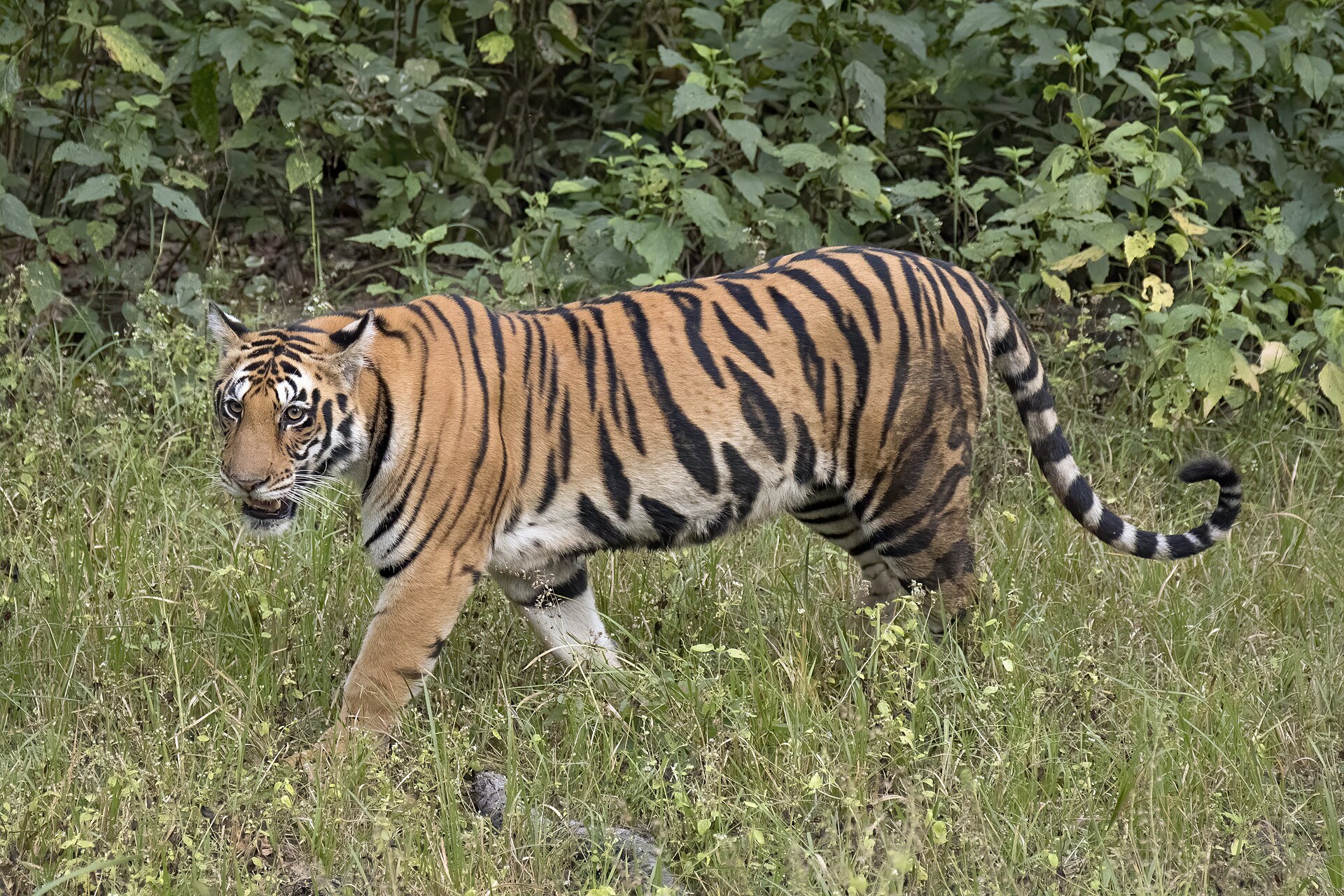
The tiger, Panthera tigris, is the largest living cat, a solitary ambush predator of Asian forest, grassland and mangrove. It occupies something like seven per cent of the range it held a century ago, its wild population fell to perhaps 3,200 around 2010, and it has since risen. It is one of very few large carnivores whose numbers are currently going up.
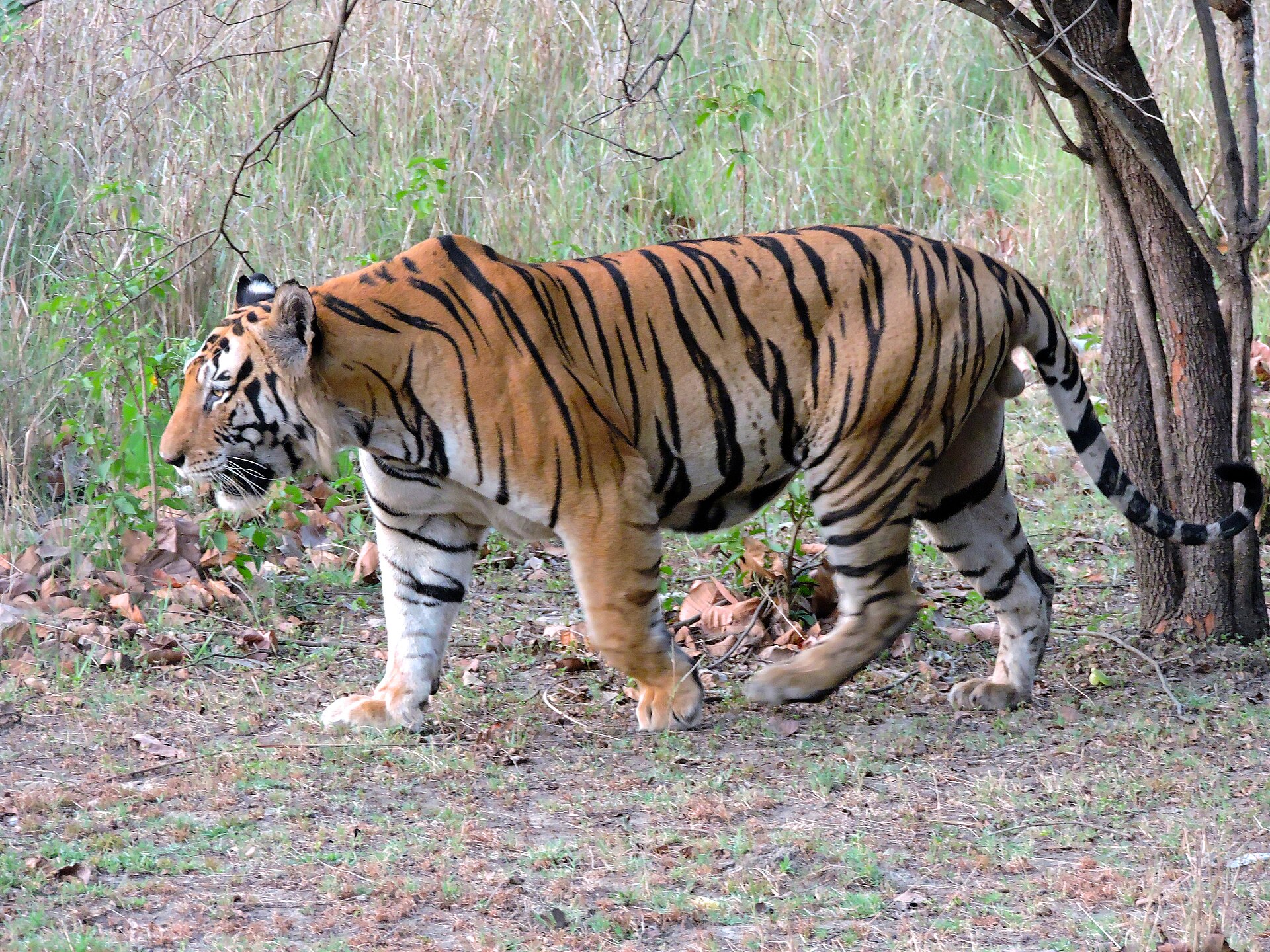
Large males of the Amur and Bengal populations reach 250 to 300 kilograms; Sunda island tigers are much smaller, around 100 to 140. The stripes are unique per animal in the way a fingerprint is, and they are in the skin as well as the fur, so a shaved tiger is still striped.
The pattern is disruptive camouflage. Tigers hunt mostly at dusk and dawn in broken vegetation, and their principal prey, deer and wild pig, are dichromats that cannot distinguish orange from green. To a sambar, a tiger is not an orange animal in green foliage.
Hunting is a stalk to within twenty or thirty metres followed by a rush, and it usually fails; a tiger may make a kill once in ten to twenty attempts, and eats infrequently and enormously. Tigers are strong swimmers, unusually among cats, and will cross rivers and hunt in water, which matters in the Sundarbans.
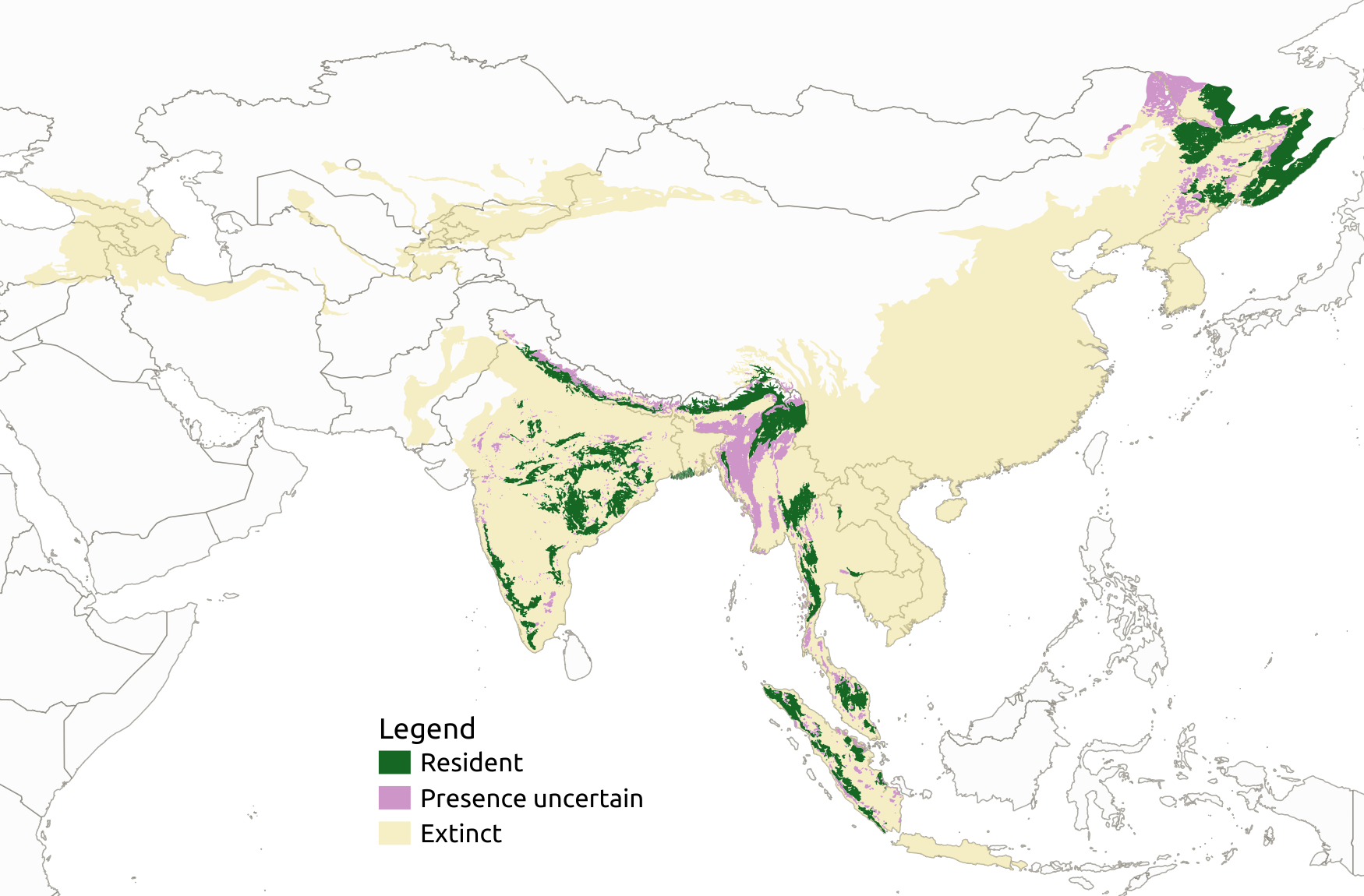
The historical range ran from eastern Turkey through Central Asia to the Russian Far East and south to Indonesia. What remains is a set of fragments across India, Nepal, Bhutan, Bangladesh, Thailand, Malaysia, Indonesia, Russia and China, with India holding around three quarters of the world's wild tigers.
Habitat runs from the Siberian taiga to tropical rainforest to the mangrove of the Sundarbans, where tigers swim between islands and where the human death toll is higher than anywhere else in the range.
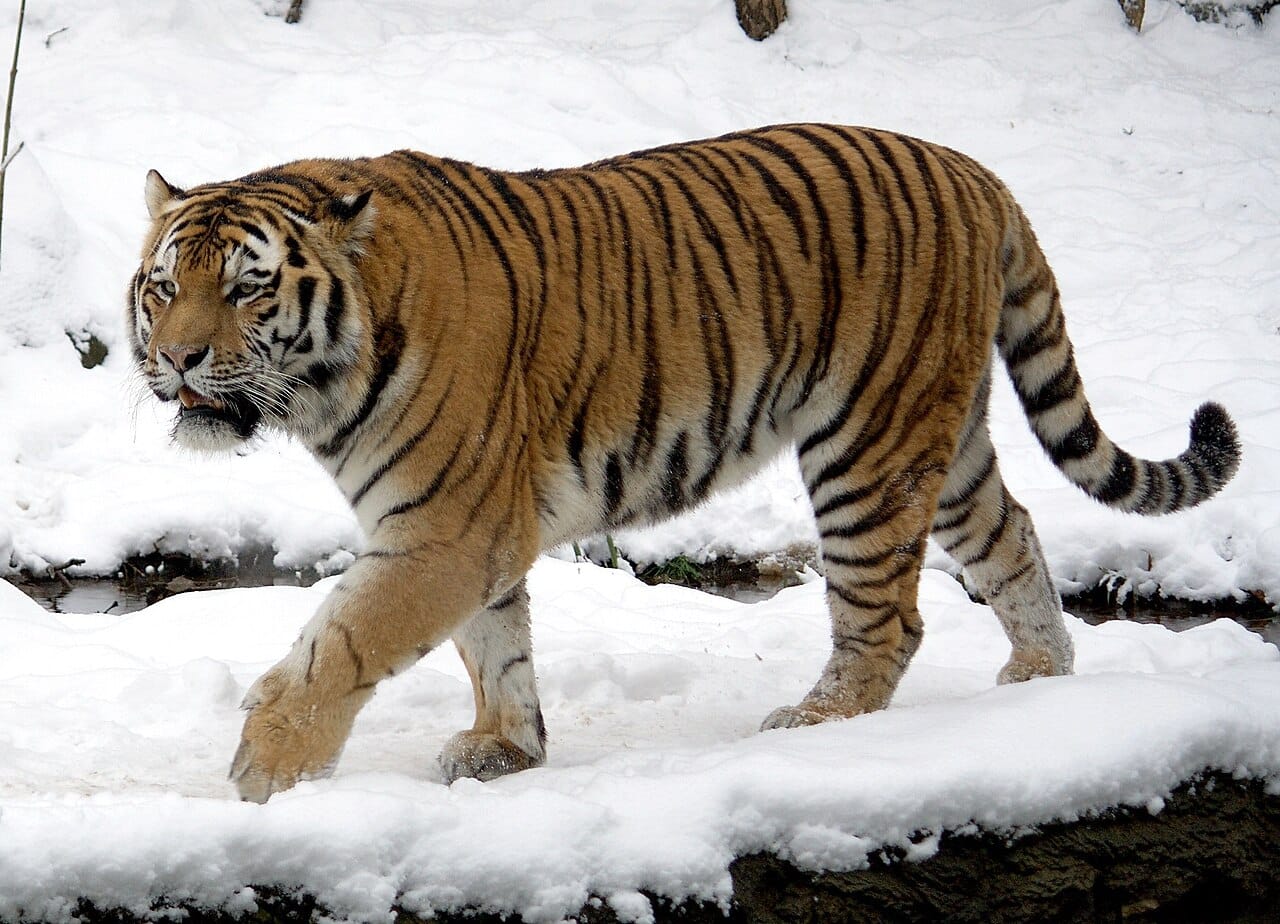
Nine subspecies were traditionally named. A 2017 revision cut this to two: Panthera tigris tigris on the Asian mainland, and Panthera tigris sondaica on the Sunda islands. The mainland grouping folds together the Bengal, Indochinese, Malayan, South China, Amur and the extinct Caspian tigers, which are less genetically distinct from each other than their names suggest.
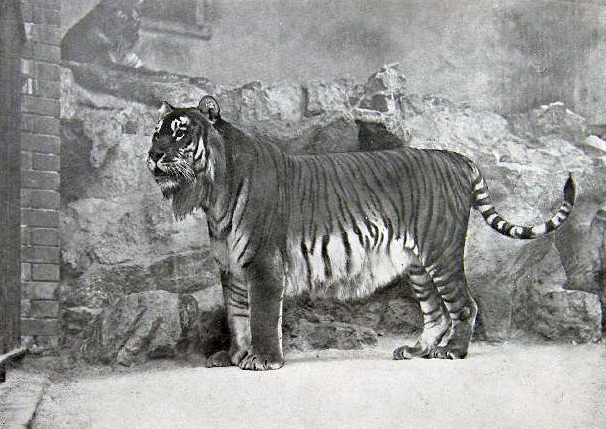
Three populations are extinct. The Bali tiger was gone by the 1940s and the Javan by the 1970s or 1980s. The Caspian tiger, which ranged from Turkey through Iran and Central Asia, was gone by the 1970s.
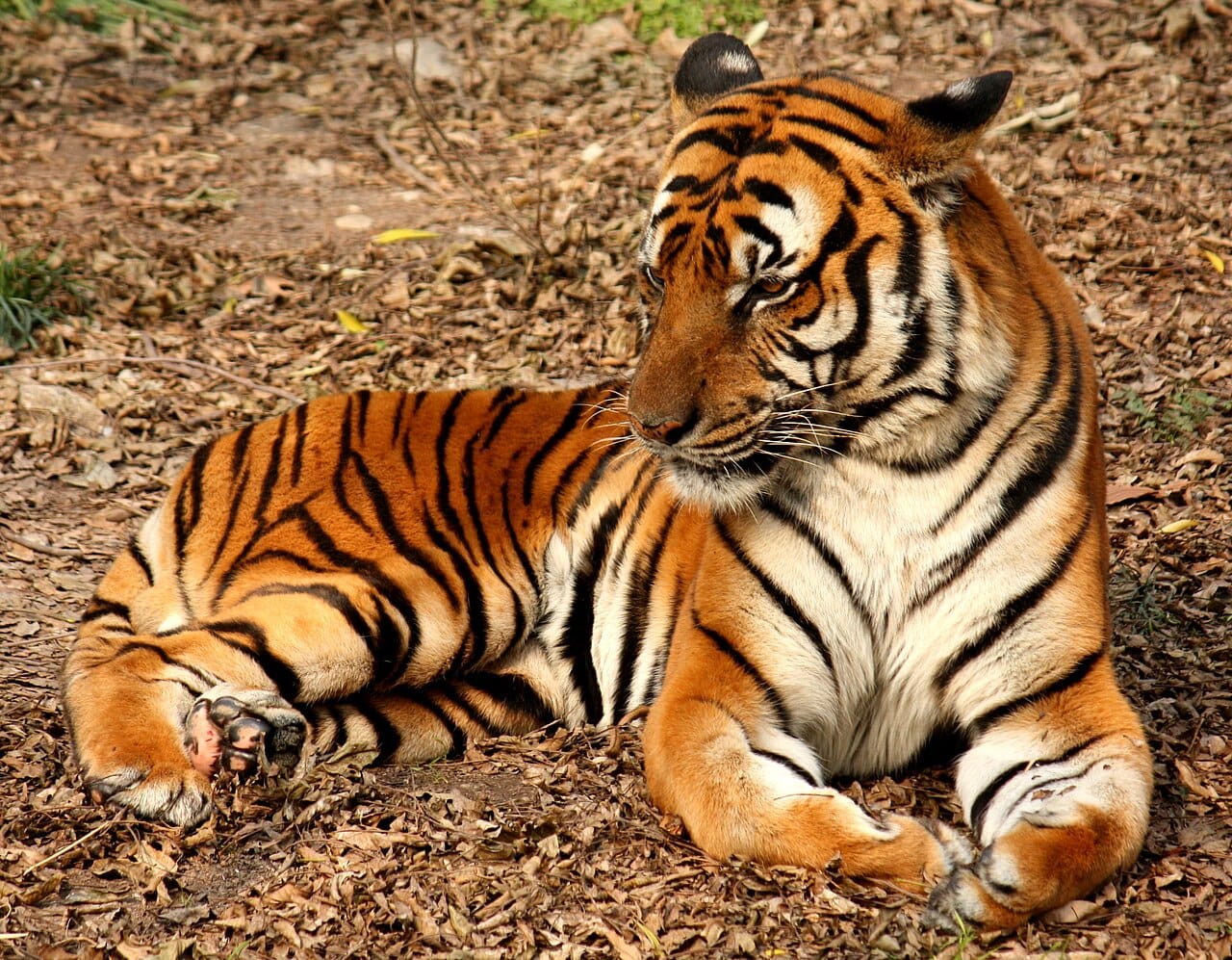
The Caspian case has an unusual coda. Genetic work published in 2009 found the Caspian and Amur tigers to be almost identical, separated only recently and by the narrow corridor of Central Asian habitat between them. That makes reintroducing Amur tigers to parts of the Caspian range a biologically defensible proposal rather than a substitution, and a project in Kazakhstan began releasing tigers into the Ili-Balkhash region in 2024.
The wild population was estimated at around 3,200 in 2010, when the thirteen range states agreed the TX2 goal of doubling numbers by 2022. Current estimates run between roughly 4,500 and 5,600, and India's 2022 census reported 3,682. The direction is real and it is a genuine achievement.
The interpretation is disputed on two grounds. First, methods changed: India moved to intensive camera-trapping and spatial capture-recapture over the same period, so part of the rise is better counting rather than more tigers, and statisticians have criticised specific extrapolations from surveyed to unsurveyed areas. Second, the gains are concentrated. India, Nepal, Bhutan and Russia account for nearly all of the increase, while Southeast Asia has continued to lose tigers, with Cambodia, Laos and Vietnam now considered to have none breeding in the wild.
So the global figure conceals a redistribution as much as a recovery.
There are more tigers in captivity than in the wild. Estimates of the United States captive population have been widely quoted at around 5,000, a figure that traces to a single early-2000s estimate and that later surveys suggest is substantially too high; the true number is likely in the low thousands, and the point stands either way.
The more consequential captive population is in tiger farms in China, Laos, Vietnam and Thailand, holding several thousand animals. The argument for them is that farmed supply relieves pressure on wild tigers. The evidence runs the other way: a legal parallel market gives cover for laundering wild-caught animals and sustains demand for products that would otherwise be socially extinct. Trade in tiger parts has been banned under CITES since 1975 and domestically in China since 1993.
The tiger is the test case for whether an apex predator can be brought back inside a densely populated landscape. India has roughly 1.4 billion people and a rising tiger population at the same time, which was not obviously possible and required protected core areas, relocation of villages on negotiated terms, and payment for livestock losses. It works where it is funded and enforced, and Southeast Asia is what happens where it is not.