The periodic rise and fall of sea level caused by the gravitational pull of the Moon and Sun acting unequally across the Earth. The cause has been understood since Newton, but the height and timing at any given coast are set by the shape of the ocean basin rather than by the Moon's position alone.
Gravity weakens with distance, so the Moon pulls the near side of the Earth more strongly than the centre, and the centre more strongly than the far side.
The tide-raising force is that difference, not the pull itself. Working in a frame that falls with the Earth's centre, the residual force points toward the Moon on the near side and away from it on the far side, which is why there are two bulges and two high tides a day rather than one.
The far-side bulge is the part that most explanations get wrong. It is not centrifugal force in any rotating-Earth sense: it is simply that the far side is pulled less than the Earth's centre and therefore lags behind it.
Because the effect depends on the difference in pull across the Earth, it falls off as the cube of distance rather than the square. The Sun is vastly more massive than the Moon but far away, and its tidal effect is about 46 per cent of the Moon's.
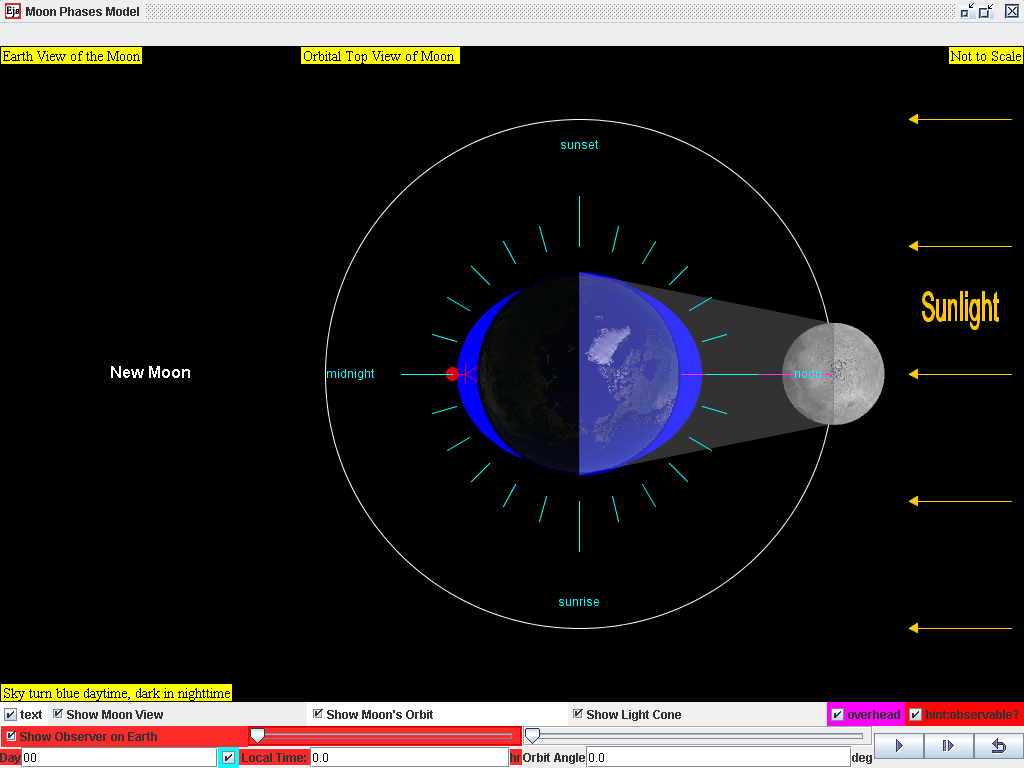
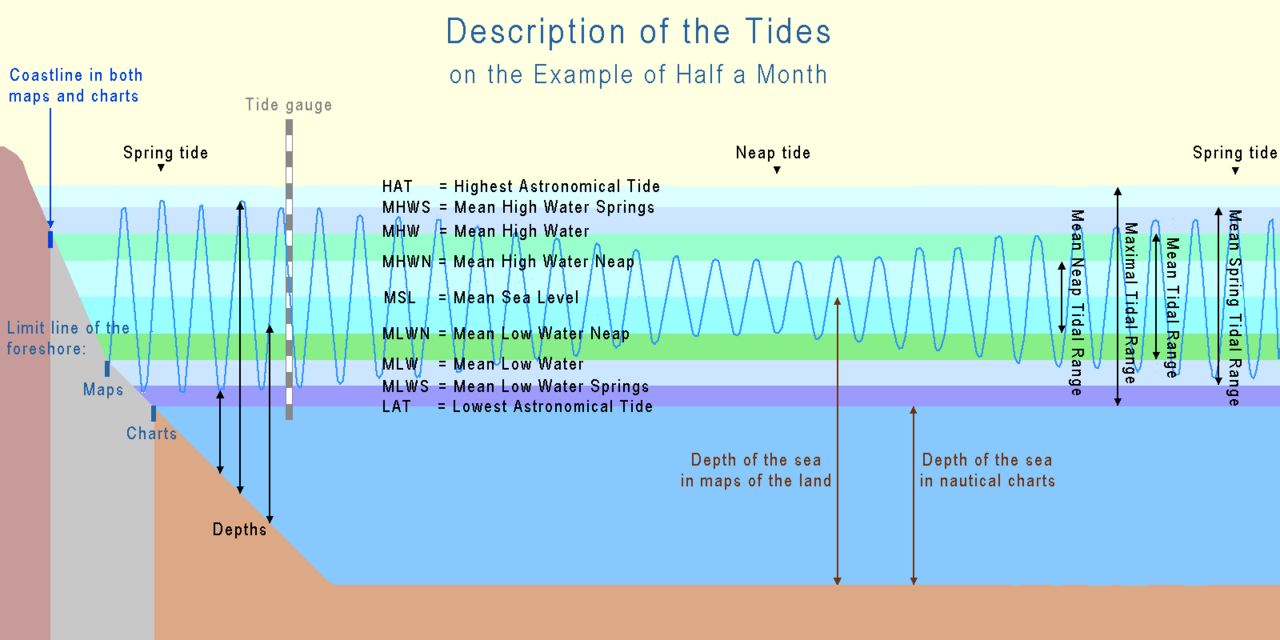
When the Sun and Moon are aligned, at new and full moon, their contributions add and the tidal range is largest. These are spring tides, named for the sense of welling up rather than for the season.
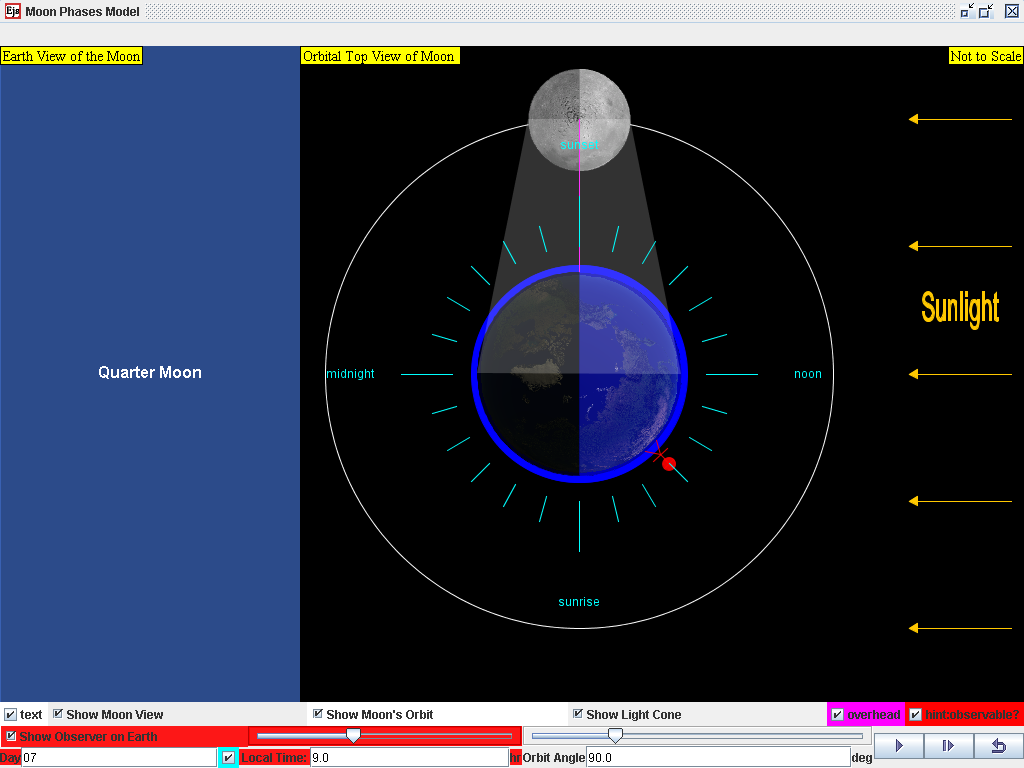
When the Moon is at first or last quarter, the two pull at right angles and partly cancel, giving neap tides with the smallest range. The cycle repeats roughly every two weeks.
Because the Moon advances in its orbit while the Earth turns, the lunar day is about 24 hours and 50 minutes, so high tides arrive roughly 50 minutes later each day.
If the ocean were a uniform layer over a featureless globe, two bulges would track the Moon and every coast would see the same modest range. Neither is true.
Continents block the bulges from travelling freely, so the real ocean responds as a set of basins each with its own natural period, driven at the tidal frequencies. What is observed is a forced oscillation of a basin, not a bulge passing by.
The tide in each basin rotates around fixed points called amphidromic points, where the tidal range is nearly zero and the tidal wave sweeps around like the hand of a clock. This structure was worked out by William Whewell in the 1830s from tide observations and is confirmed in detail by satellite altimetry.
Consequences follow that a bulge model cannot produce. Most coasts have two high tides a day, some have one, and some have two of unequal size, depending on the basin's response. Tidal range varies from a few centimetres in parts of the Mediterranean to about 16 metres in the Bay of Fundy, where the basin's natural period is close to the driving period and the response is near resonance. High tide does not generally occur when the Moon is overhead, and the offset is a property of the basin.
Laplace put this on a proper footing in 1776 by treating tides as a dynamical response of a fluid on a rotating planet, replacing Newton's static equilibrium picture. Modern tide prediction decomposes the record at a location into constituents at known astronomical frequencies and fits their amplitudes and phases, which is why predictions are accurate even though the underlying hydrodynamics is complicated.
Tidal flows dissipate energy as friction, mainly in shallow seas, and that has measurable long-term effects.
The Earth rotates faster than the Moon orbits, so friction drags the tidal bulge slightly ahead of the Earth-Moon line. The bulge's gravity then pulls the Moon forward, raising its orbit, while the Moon pulls back on the Earth, slowing its spin.
Both effects are measured directly. Lunar laser ranging off the retroreflectors left by Apollo missions gives a recession rate of about 3.8 centimetres per year, and the lengthening of the day appears in the record of ancient eclipse timings and in fossil growth bands.
The same process, run to completion, is why the Moon keeps one face toward us. Tidal locking is the general outcome for a small body close to a large one, and it accounts for the rotation states of most large moons in the solar system.
Tides were the first phenomenon connecting the sky to daily terrestrial experience through a quantitative law, and Newton's account of them was a major part of the case for universal gravitation. They also matter practically: navigation, coastal engineering, storm surge risk and tidal power all depend on predicting them, and tidal heating driven by the same differential forces is what keeps the interiors of Io and Europa warm.