The explosive destruction of a star, briefly outshining an entire galaxy. Supernovae produce and disperse most of the heavy elements, they trigger new star formation, and one type serves as the standard measure of cosmic distance.
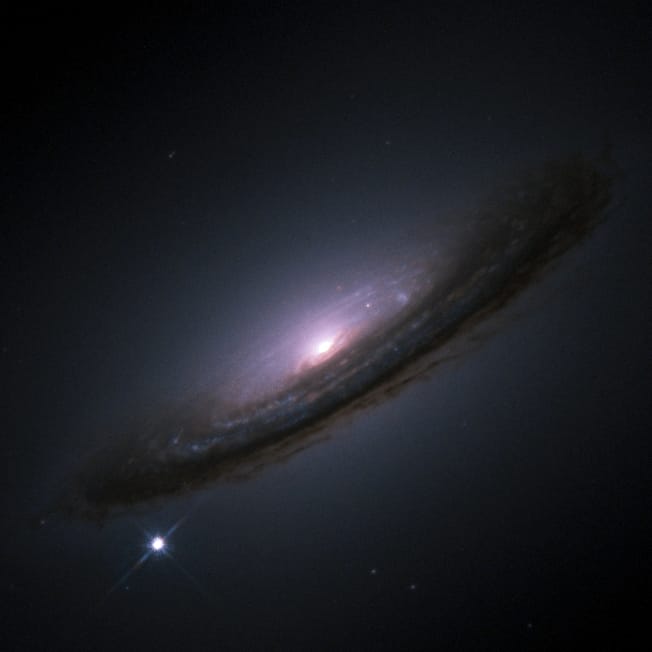
A supernova releases in weeks as much energy as the Sun emits over its whole ten billion year lifetime, and at peak it can outshine the combined light of its host galaxy.
The visible light is a small fraction of the total. Most of the energy leaves as neutrinos, and a further large share as kinetic energy in the expanding debris.
They are rare in any one galaxy, perhaps a few per century, which is why observed examples are mostly in other galaxies and why surveys covering thousands of galaxies find them regularly.
Core collapse occurs in stars considerably more massive than the Sun. Fusion builds progressively heavier elements in shells, ending at iron, which cannot release energy by fusing further. When the iron core exceeds the mass its electron pressure can support, it collapses in under a second to nuclear density, rebounds, and the resulting shock, assisted by the enormous neutrino flux, blows the outer layers apart.
What remains is a neutron star, or a black hole if the core is massive enough.
Thermonuclear supernovae, designated type Ia, have a different cause. A white dwarf, the dense remnant of a low-mass star, accretes material from a companion. On approaching a critical mass, carbon fusion ignites across the star almost simultaneously and it is destroyed entirely, leaving no remnant.
The classification scheme is historical and based on spectra rather than mechanism, which is why the labels do not map cleanly onto the two physical processes. Types Ib, Ic and II are all core collapse.
Supernovae are where most elements heavier than iron are made and where the elements made earlier are released.
Fusion in a star builds elements up to iron. Beyond that, building heavier nuclei absorbs energy rather than releasing it, so it does not happen in ordinary stellar burning. The rapid neutron capture process, which requires an intense burst of neutrons, occurs in core collapse events and in neutron star mergers, and produces roughly half the elements heavier than iron.
Just as important, the explosion disperses the material. Elements locked in a star are unavailable until something releases them, and supernovae are the principal mechanism.
The consequence is direct: the calcium in bone, the iron in blood and the oxygen in air were made in stars and distributed by their deaths. This is the literal content of the observation that people are made of star material, and it is treated further in the stellar nucleosynthesis capsule.
The expanding shock also compresses surrounding gas, which triggers the collapse of clouds into new stars, so a supernova both supplies the material for later generations and prompts their formation.
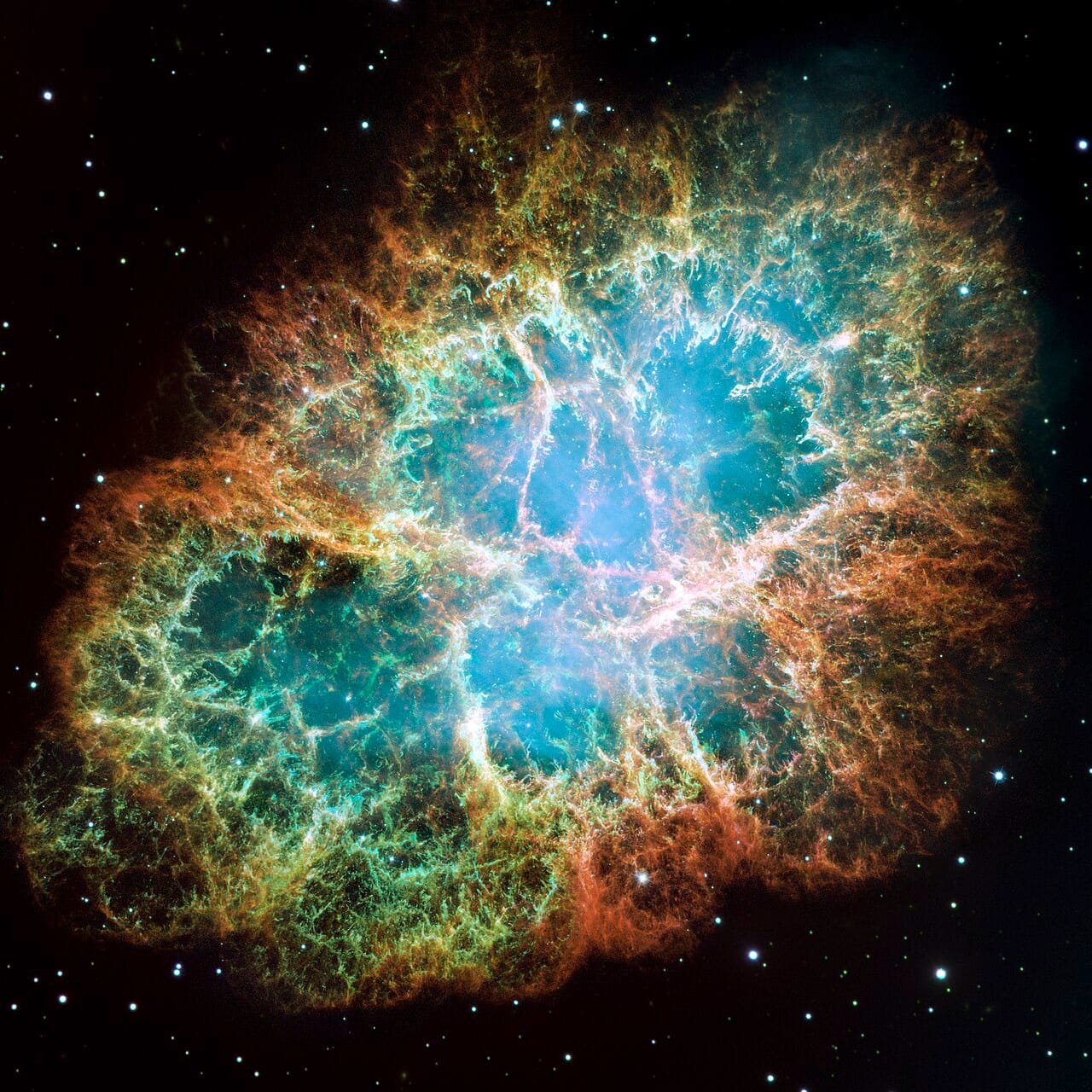
Only a handful of supernovae in our own galaxy have been observed with the naked eye in recorded history, and the records are valuable because they date the remnants precisely.
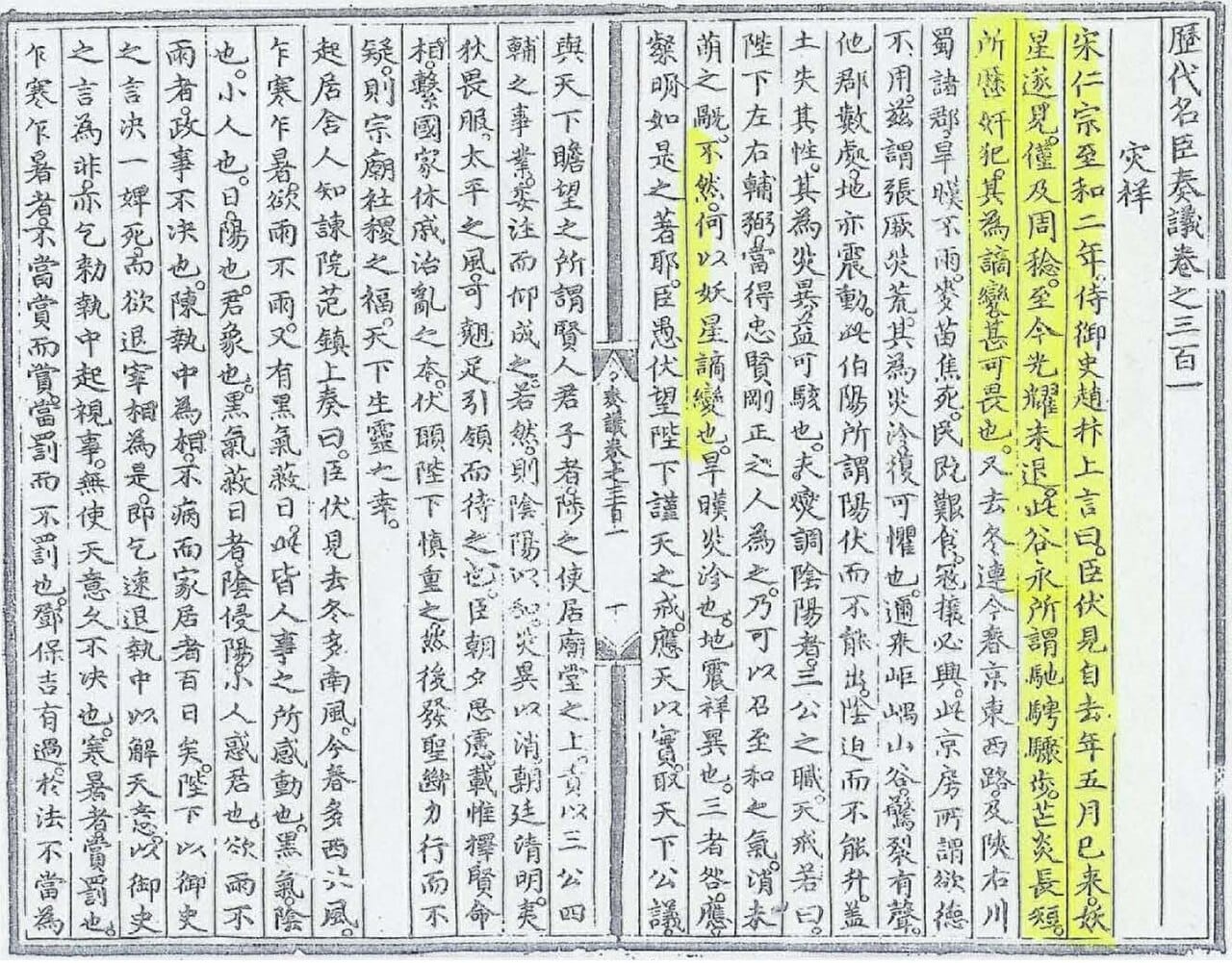
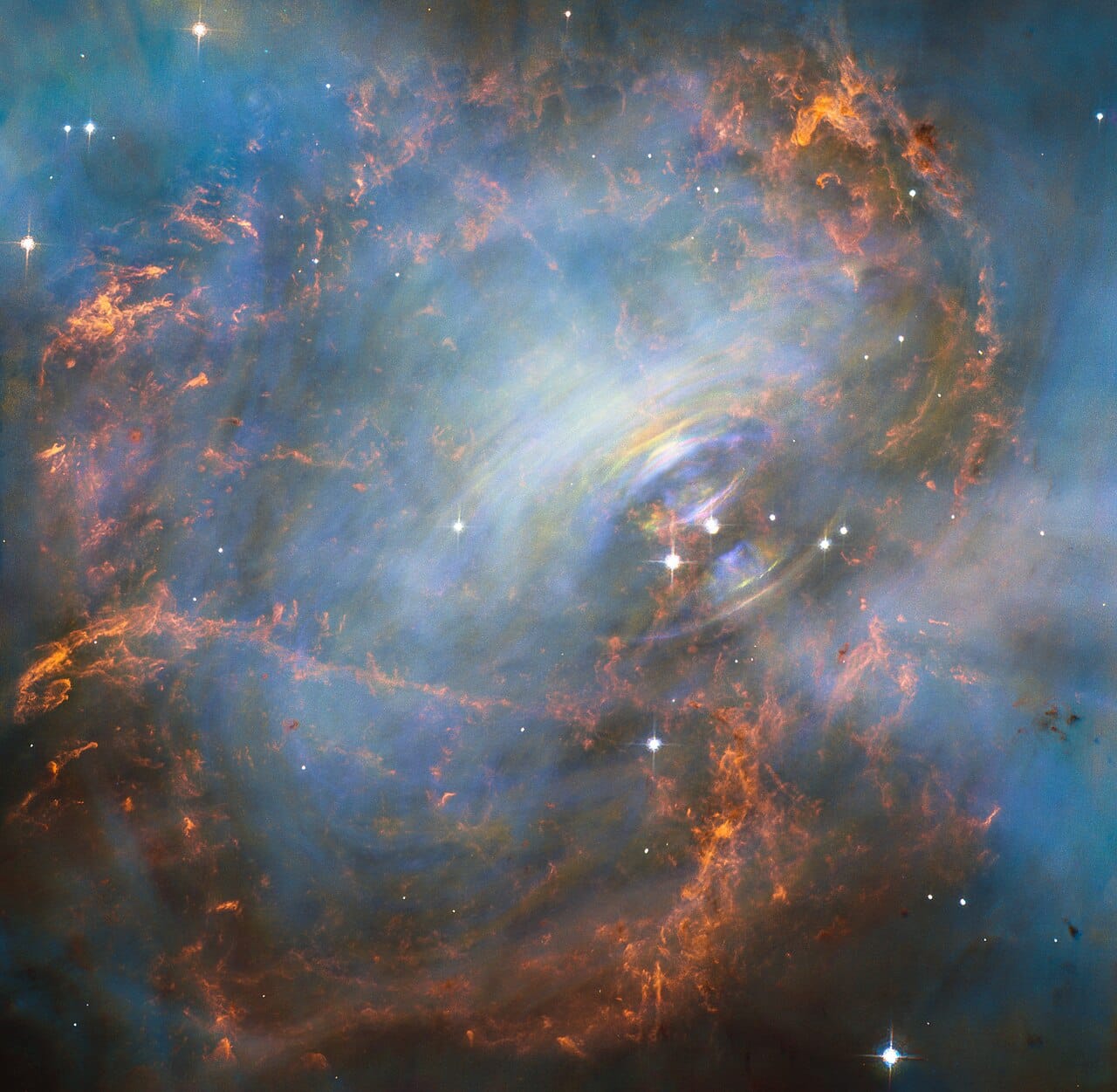
The event of 1054 was recorded in detail by Chinese and Japanese astronomers, who noted a guest star visible in daylight for over three weeks. Its position matches the Crab Nebula, whose measured expansion traced backwards gives the same date.
Tycho Brahe observed one in 1572 and Johannes Kepler in 1604. These mattered beyond astronomy, since a new star appearing and fading contradicted the doctrine that the heavens beyond the Moon were unchanging, and Tycho's demonstration that it showed no parallax placed it firmly among the fixed stars.
SN 1987A, in the Large Magellanic Cloud, is the closest observed since. Neutrino detectors on Earth registered a burst hours before the light arrived, exactly as core collapse models predicted, which confirmed the mechanism directly.
Type Ia supernovae are used as standard candles, objects of known intrinsic brightness whose apparent brightness therefore gives distance.
They work for this because they explode at a consistent mass and so with consistent energy, and because a relationship between peak brightness and how quickly they fade allows the remaining variation to be corrected.
Their extreme brightness makes them visible across billions of light years, which is why they are the tool for measuring cosmic distances at large scale.
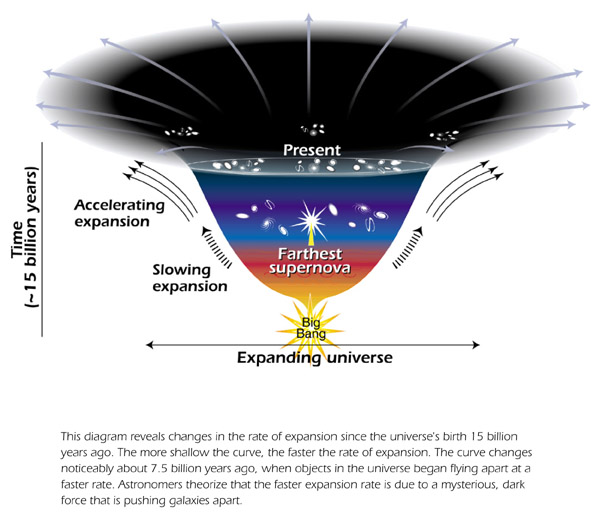
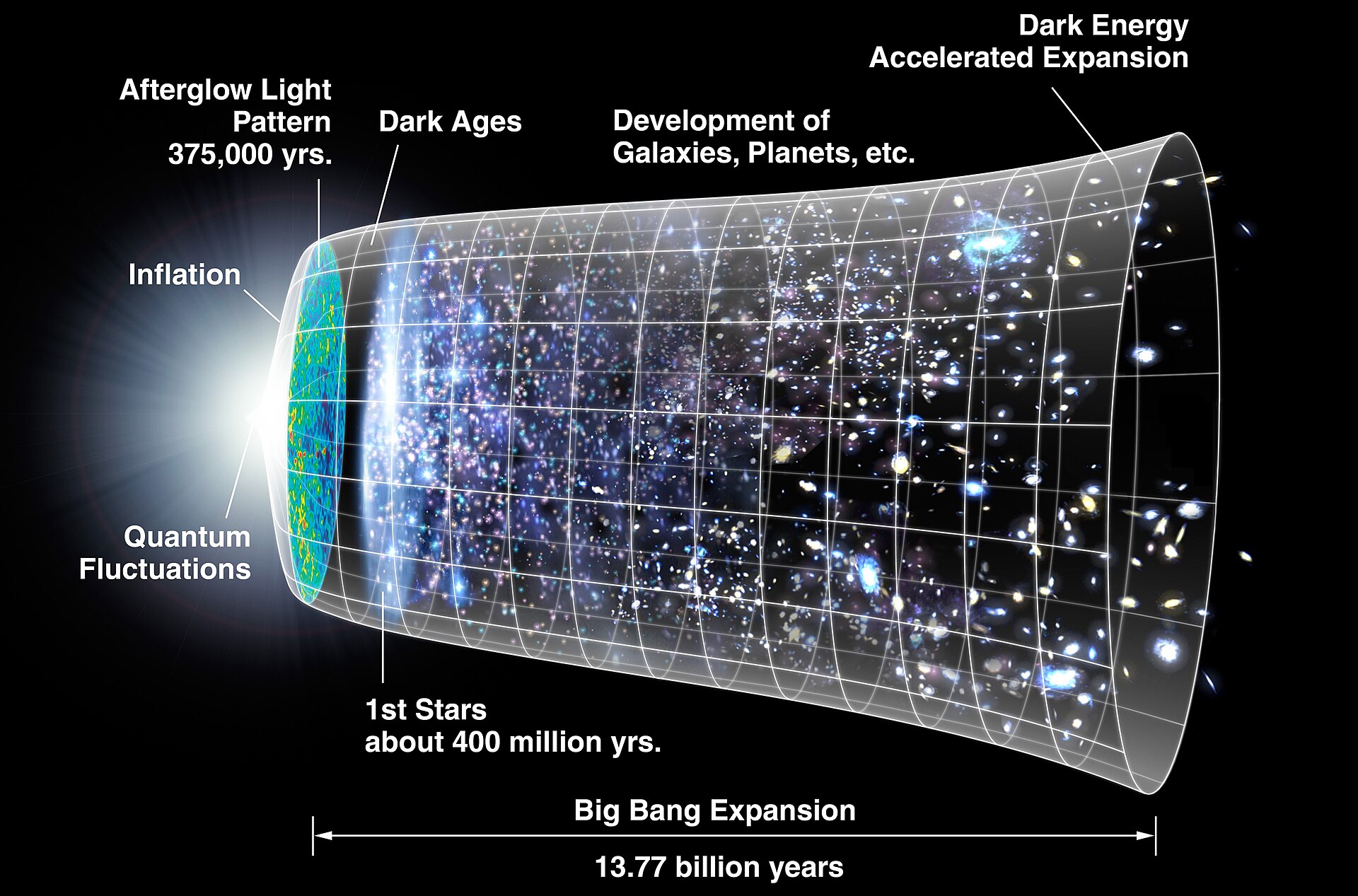
Observations of distant type Ia supernovae in the late 1990s found them fainter, and therefore further away, than expected. This was the evidence that the expansion of the universe is accelerating, and it earned the 2011 Nobel Prize in Physics. What drives that acceleration is treated in the dark energy capsule.
Supernovae are the mechanism connecting stellar physics to chemistry: they make the heavy elements and put them where planets and organisms can be built from them.
They are also among the few astronomical events whose importance is both theoretical and instrumental. The same objects that produced the calcium in a skeleton are the rulers with which the expansion history of the universe was measured.