The collapsed cores left by massive stars, containing more than the Sun's mass within a sphere about twenty kilometres across. They are the densest objects that can be directly observed, and matter inside them exists in a state that cannot be produced in any laboratory.
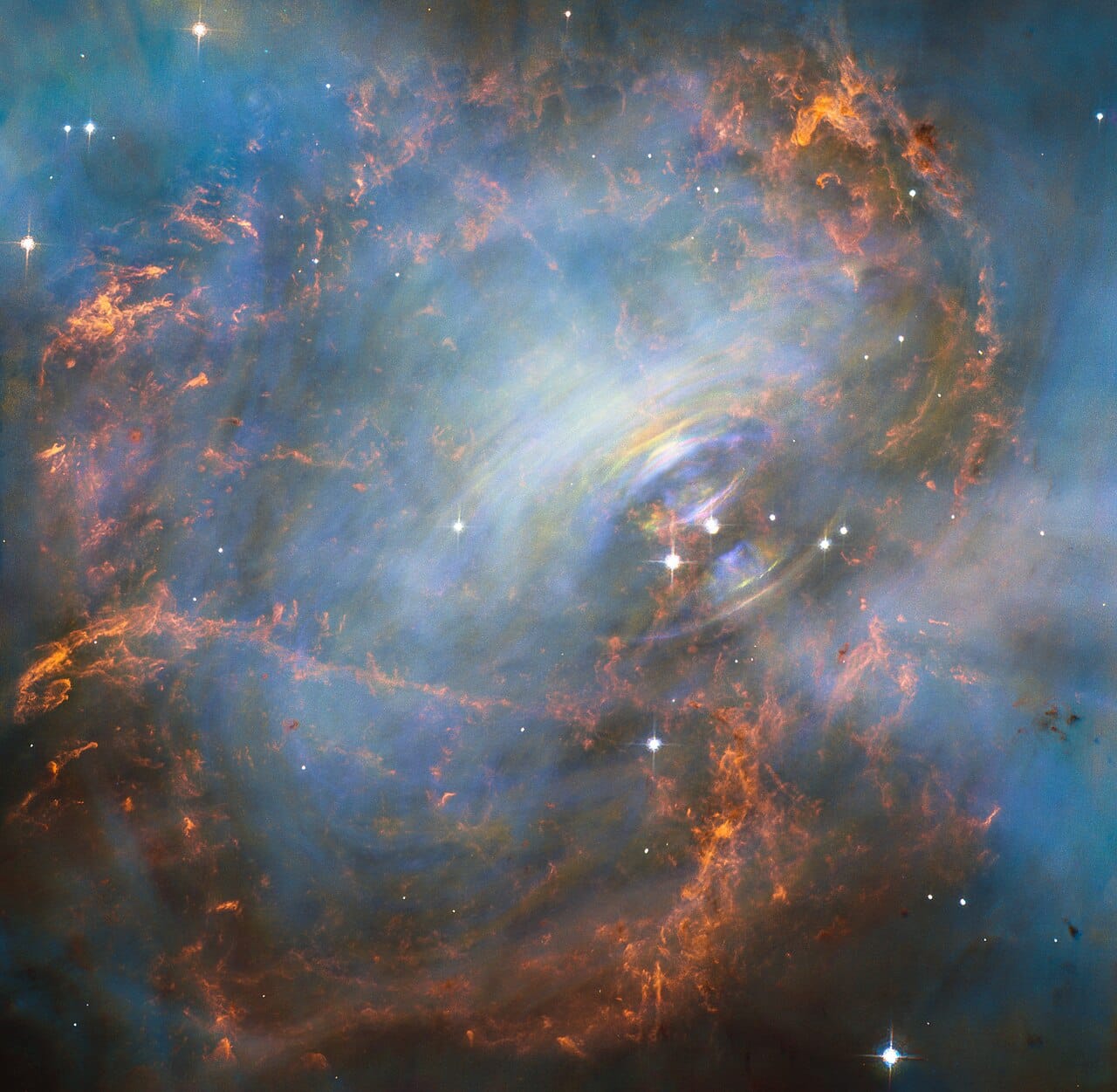
When a massive star exhausts its fuel, its iron core collapses, as the supernovae capsule describes.
The collapse is halted when nuclear densities are reached. Protons and electrons combine into neutrons, and the resulting neutron degeneracy pressure, together with the repulsive part of the nuclear force, resists further compression.
What remains is a sphere of roughly ten to twelve kilometres radius containing between about one and two solar masses.
If the core exceeds a limiting mass, currently estimated at somewhere above two solar masses, no known pressure resists gravity and a black hole forms instead.
The density exceeds that of an atomic nucleus. A teaspoon of the material would weigh comparably to a mountain range.
The structure is layered. A thin atmosphere overlies a solid crust of nuclei arranged in a lattice, beneath which nuclei become progressively more neutron-rich and eventually dissolve into a fluid of neutrons with some protons and electrons.
What exists at the very centre is not known. Proposals include a superfluid of neutrons, matter containing hyperons, or free quarks in a deconfined state, and distinguishing between them is a principal goal of current observation.
Surface gravity is around two hundred billion times Earth's. Magnetic fields reach a trillion times Earth's, and in magnetars far higher still, strong enough to distort atomic structure.
Rotation is rapid, since angular momentum is conserved as the core collapses. Periods range from seconds down to milliseconds, and the fastest known rotates over seven hundred times per second, meaning its surface moves at a substantial fraction of light speed.
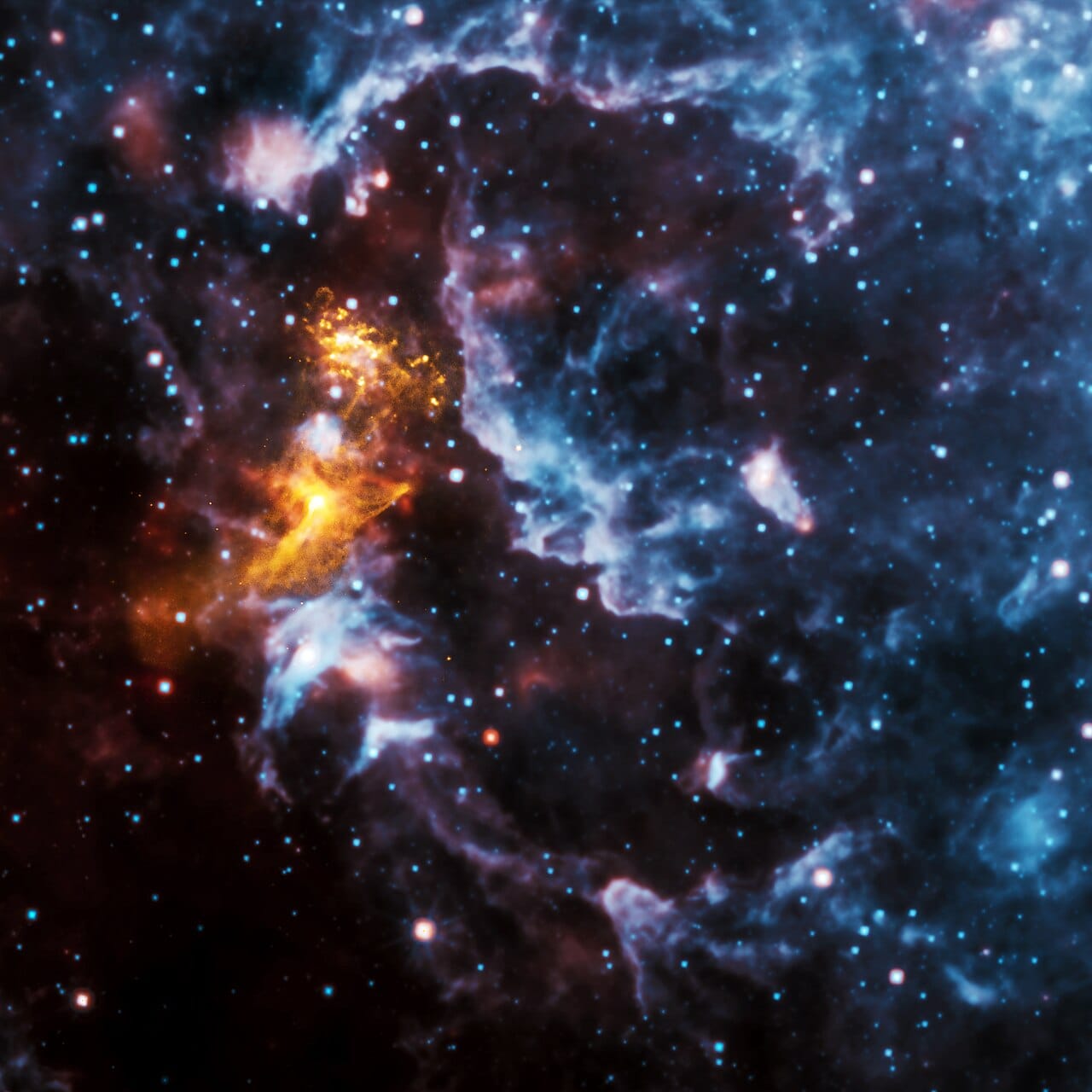
A neutron star with a magnetic axis misaligned from its rotation axis emits beams of radiation from its magnetic poles. If a beam sweeps across the Earth, a pulse is detected once per rotation.
Jocelyn Bell Burnell detected the first in 1967 as a signal of extraordinary regularity, initially labelled LGM-1 in half-serious reference to the possibility of an artificial source. The regularity was quickly explained by rotation.
The stability of the pulses is remarkable. Millisecond pulsars keep time comparably to atomic clocks over long intervals, and this has made them precision instruments.
The Hulse-Taylor binary pulsar provided the first evidence for gravitational waves. Two neutron stars orbiting one another lose energy, and their orbit decays at exactly the rate general relativity predicts for gravitational radiation, a measurement that earned the 1993 Nobel Prize decades before waves were detected directly.
Pulsar timing arrays use many pulsars together as a detector for very low frequency gravitational waves, and evidence for a background of such waves was reported in 2023.
Two neutron stars in a close binary eventually spiral together.
The merger detected in August 2017, designated GW170817, was observed in gravitational waves and then across the electromagnetic spectrum, the first event seen by both means.
Its consequences were substantial. It confirmed that such mergers produce short gamma-ray bursts. It showed that gravitational waves travel at the speed of light to extraordinary precision. And the light curve matched predictions for the rapid neutron capture process, establishing mergers as a major site of heavy element production, which had been argued about for decades.
A significant fraction of the gold and platinum in existence is now attributed to events of this kind.
Neutron stars are the only accessible laboratory for matter at nuclear density, and measurements of their masses and radii constrain the physics of dense matter in ways no accelerator can.
They are also precision instruments. Pulsar timing has tested general relativity in strong fields, detected gravitational waves indirectly and then as a background, and provides a navigation reference independent of any terrestrial system.
And they are a principal source of the heavy elements, which connects the most extreme objects in the universe to the ordinary composition of a planet.