The Standard Model is the theory that describes all the known elementary particles of matter and the forces that act between them, except for gravity. Developed over the second half of the twentieth century, it is one of the most successful and precisely tested theories in the history of science, predicting the outcomes of experiments to an accuracy matched by almost nothing else. Yet it is also known to be incomplete, which makes it both a triumph and a signpost toward deeper physics.
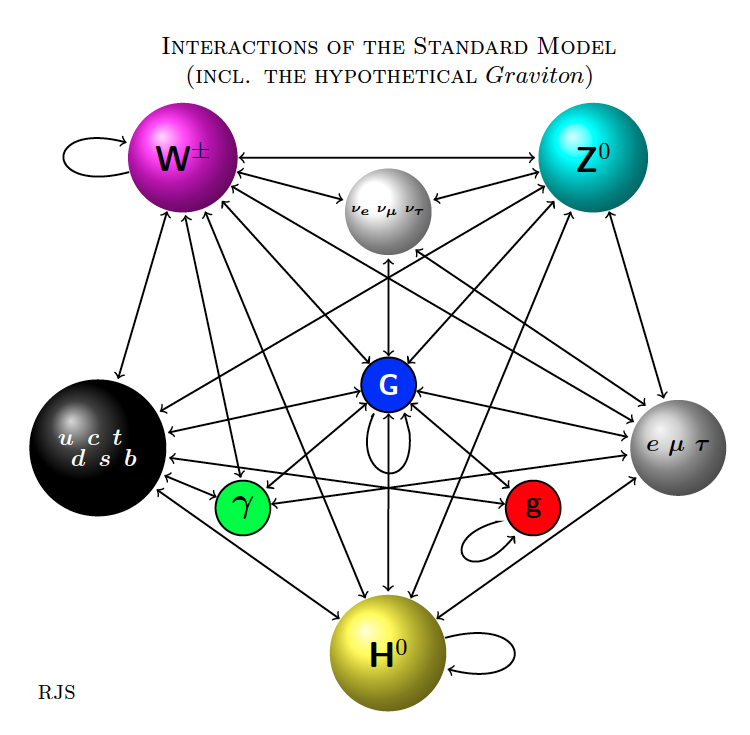
The Standard Model holds that all ordinary matter is built from a small set of fundamental particles: six quarks, which combine to form protons and neutrons, and six lighter particles called leptons, which include the familiar electron. These interact through three of the four known forces, the electromagnetic force and the strong and weak nuclear forces, each carried by its own messenger particles. A further particle, the Higgs boson, is tied to the field that gives many of the others their mass.
The power of the Standard Model lies in its record of successful prediction. Particles were forecast on paper years or decades before they were found, including the heavy carriers of the weak force and, most famously, the Higgs boson, whose discovery at the Large Hadron Collider in 2012 confirmed the last missing piece. Measured quantities such as the magnetic behaviour of the electron agree with the theory to around one part in a trillion, an almost unbelievable level of precision.
For all its success, the Standard Model cannot be the whole story. It does not include gravity, it offers no explanation for the dark matter that appears to fill the universe, and it does not account for why the cosmos contains so much more matter than antimatter. The recent confirmation that particles called neutrinos have a tiny mass is not naturally explained by the original theory. These gaps are among the strongest clues that a deeper theory, of which the Standard Model is only a part, remains to be found.
The Standard Model stands as one of the great intellectual achievements of physics, a single framework that captures the behaviour of the building blocks of matter with extraordinary accuracy. That physicists can point so confidently to what it fails to explain is itself a measure of how well the theory works, and the search for what lies beyond it drives much of modern particle physics.