The family of arguments that political authority is justified by agreement among the governed rather than by divine appointment, natural hierarchy or force. It supplies the reasoning behind constitutional government, and its central device, a hypothetical agreement, is also its most attacked feature.
The question is why anyone should obey a government. Earlier answers appealed to divine right, to natural hierarchy, or to conquest.
Contract theory answers that legitimate authority derives from the consent of those subject to it. To make the argument, it asks what people would agree to if they were choosing, which requires imagining their condition without government at all: the state of nature.
That device is doing justificatory rather than historical work. The claim is not that people once met and signed something, but that authority is legitimate to the extent that it could be justified to those living under it.
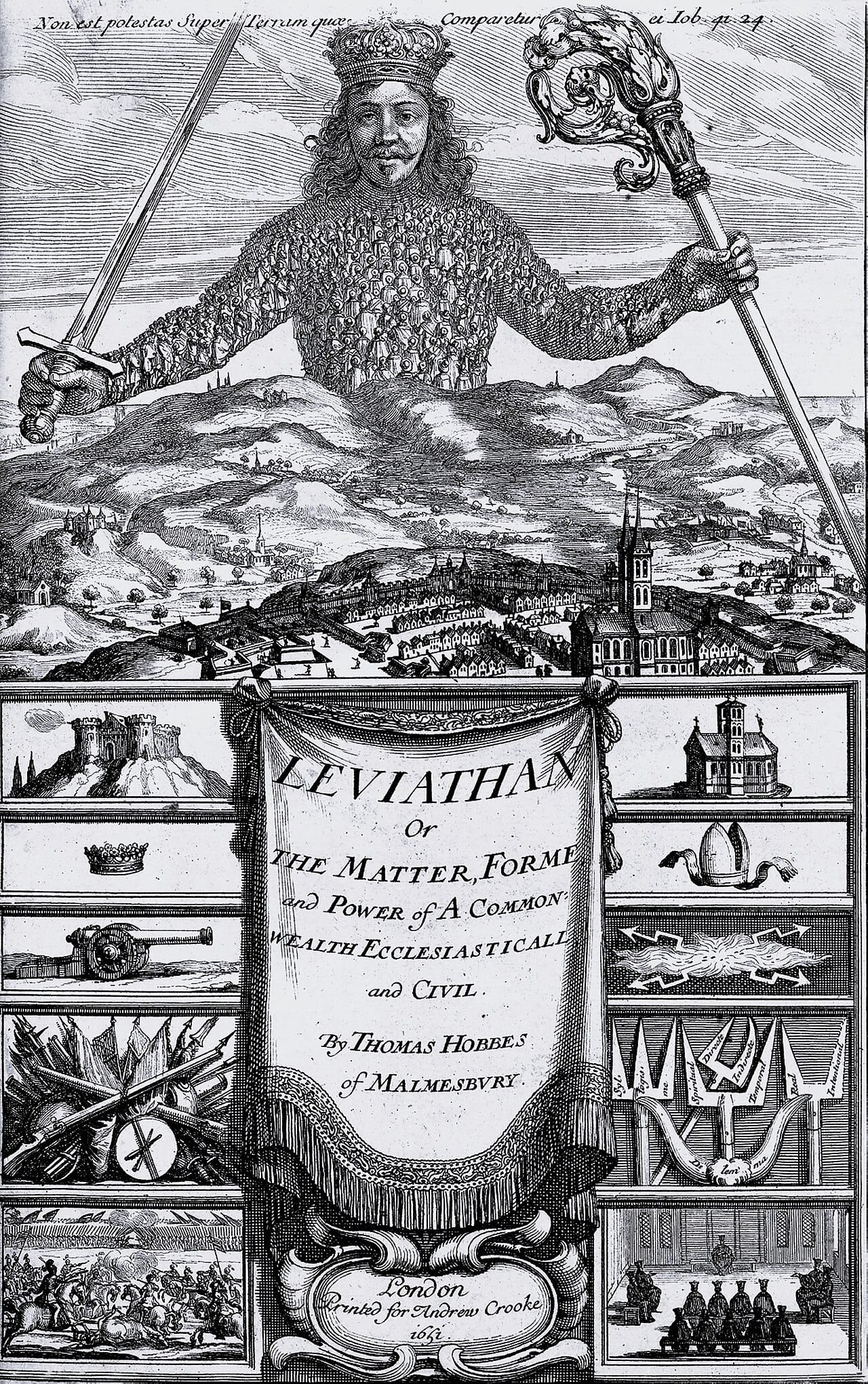
Thomas Hobbes, writing during the English Civil War, described a state of nature in which, absent a common power, people compete, distrust one another and seek reputation, producing a war of every man against every man in which life is solitary, poor, nasty, brutish and short.
His conclusion is that people would rationally covenant with one another to transfer their rights to a sovereign whose power must be absolute and undivided, because a divided or limited sovereign reproduces the problem it was created to solve. There is no right of rebellion, since the alternative is a return to the state of nature, though the covenant lapses if the sovereign cannot provide protection.
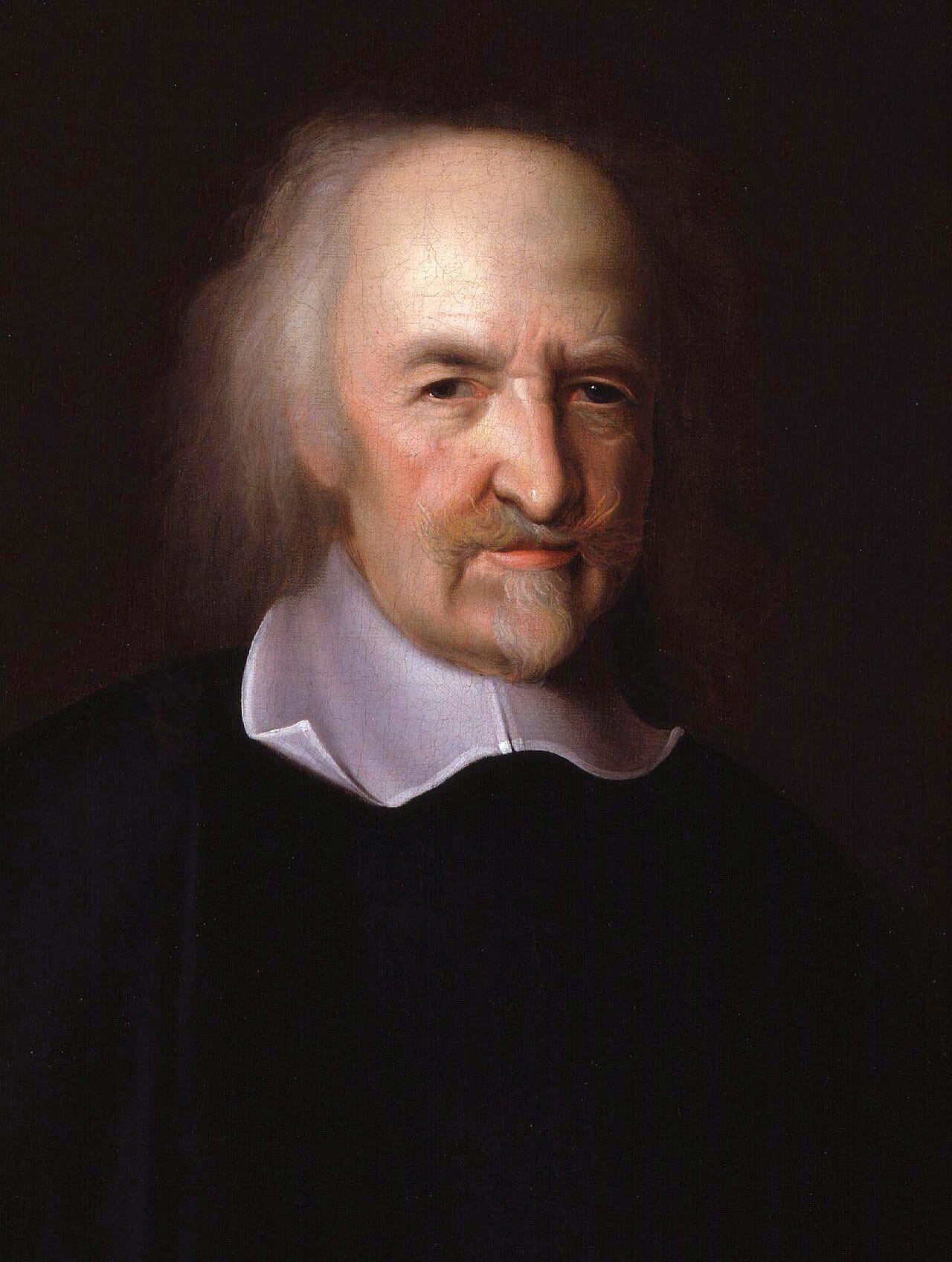
John Locke described a state of nature already governed by natural law, in which people possess rights to life, liberty and property, and which is inconvenient rather than catastrophic, lacking impartial judges and reliable enforcement.
Government on his account is a trust established for limited purposes, principally the protection of those rights. Because it is a trust rather than a transfer, it can be forfeited: a government that acts against the ends for which it was established may be resisted. The language of the American Declaration of Independence follows this argument closely.
Jean-Jacques Rousseau opened with the claim that man is born free and is everywhere in chains, and argued that legitimate authority arises only when people associate in a way that leaves each obeying only himself.
His solution is the general will, the collective interest of the community as distinct from the sum of private interests. Sovereignty rests permanently with the people and cannot be transferred or represented away. The account has been read both as the foundation of democratic legitimacy and as containing an authoritarian danger, since a person can be told that the general will is what he really wants.
The tradition faded through the nineteenth century, displaced by utilitarianism and by historical and sociological approaches, and it was revived decisively by John Rawls in 1971.
Rawls asked what principles of justice people would choose for a society if they were choosing from an original position behind a veil of ignorance, not knowing their own class, talents, sex, religion or conception of the good.
The device makes the contract explicitly hypothetical and removes the objection that real people bargain from unequal positions. He argued that under those conditions people would choose extensive equal basic liberties, and would permit inequalities only where they benefit the least advantaged.
David Gauthier developed a contractarian alternative grounded in rational bargaining among self-interested agents, and Thomas Scanlon a contractualist version in which an act is wrong if it could be reasonably rejected by anyone affected.
No one consented, and this is the oldest objection. David Hume put it directly: most people are born into a state and never agree to anything, and appealing to tacit consent through residence is unconvincing when leaving requires resources most people lack. Hume argued that obedience rests on utility and habit rather than agreement.
The reply is that the contract is a standard of justification rather than a historical event. Critics respond that a hypothetical agreement binds no one, since what someone would agree to under conditions that do not obtain is not an actual obligation.
The state of nature is doing suspicious work. Each theorist's conclusion follows closely from how he characterises the condition without government, and the characterisation is not independently established. Hobbes describes insecurity and derives absolutism; Locke describes inconvenience and derives limited government.
Carole Pateman argued in The Sexual Contract that the classical contract presupposed a prior subordination of women, since the parties were male heads of households and the domestic arrangement was placed outside the scope of the agreement. Charles Mills argued in The Racial Contract that the actual contract underlying modern states was among Europeans and encoded the exclusion of others, so that describing it as universal misdescribes what was agreed. Both criticisms accept the framework's structure and attack its claim to generality.
Communitarian critics, including Michael Sandel and Alasdair MacIntyre, object that the contracting individual is a fiction, since people are constituted by attachments, communities and traditions they never chose, and reasoning from a self stripped of those attachments produces principles no actual person would recognise.
Contract reasoning underlies the architecture of modern constitutional states: government by consent, limits on authority, rights held against the state, and the idea that a regime can lose its legitimacy without losing its power.
Its practical residue is a test rather than a document. Asking whether an arrangement could be justified to everyone bound by it is a demand that survives every objection to the historical contract, and it is the form in which the tradition is still used.