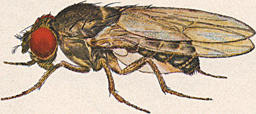
The proposal that organisms must keep evolving simply to maintain their position, because everything they interact with is evolving too. It takes its name from Alice, it was proposed to explain extinction rates, and its most successful application is to a different question entirely.
Leigh Van Valen proposed it in 1973, from a pattern in the fossil record.
He found that the probability of a taxonomic group going extinct is roughly constant over time. A lineage that has survived a hundred million years is no less likely to go extinct in the next million than one that has survived ten.
That is surprising. Lineages should accumulate adaptations and become better fitted to their environment, so extinction risk should fall with age. It does not.
Van Valen's explanation was that the environment that matters most is other species, and they are evolving too. Every improvement by a predator is matched by prey, every improvement by a host is matched by its parasites. Absolute fitness stays roughly constant however much a lineage improves, because the standard is moving.
The name comes from Through the Looking-Glass, in which the Red Queen tells Alice that in her country it takes all the running you can do to stay in the same place.
The extinction claim has not held up well.
Van Valen's law of constant extinction was drawn from data with substantial taxonomic and preservation problems, and later analyses with better data find extinction risk is not constant: it varies with geographic range, with body size, with clade age in some groups, and enormously with mass extinction events, which are driven by physical catastrophes rather than by biotic interaction.
The framework has been substantially displaced in palaeontology by models emphasising physical environmental change, sometimes called the Court Jester hypothesis in deliberate contrast: rather than continuous biotic pressure, evolution is punctuated by external upheavals.
Most current work holds that both operate at different scales, with biotic interaction dominating on short timescales and within communities, and physical change dominating over longer intervals.
The hypothesis found its strongest application in explaining sexual reproduction, which is a different problem.
Sex is costly. An asexual female passes on all her genes to each offspring; a sexual one passes half. Sex requires finding a mate, breaks up favourable gene combinations, and is roughly twice as inefficient. It is nonetheless nearly universal in complex organisms, and explaining that is a long-standing problem.
The Red Queen answer is parasites. Parasites adapt to whatever host genotype is common, because that is where the hosts are. A rare genotype is therefore at an advantage, and sexual reproduction generates rare combinations continuously by shuffling genes. Asexual lineages, producing clones, present a fixed target that parasites eventually match.
The prediction is specific and testable: sexual reproduction should be favoured where parasite pressure is high, and asexual lineages should do better where it is low.
The best evidence comes from a New Zealand freshwater snail, Potamopyrgus antipodarum, which occurs in both sexual and asexual forms in the same lakes.
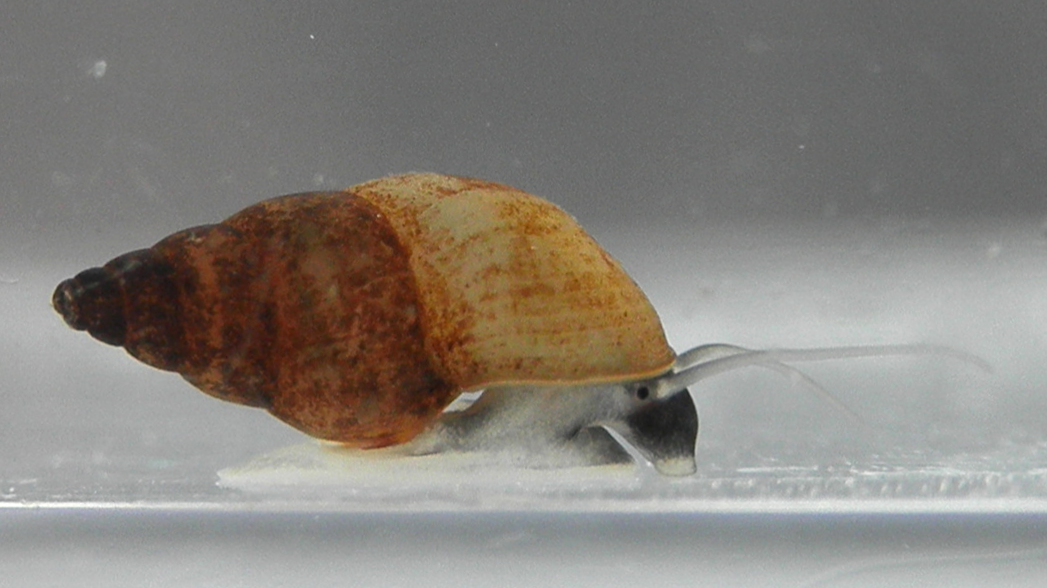
Curtis Lively and colleagues found that the proportion of sexual individuals tracks local trematode parasite pressure: where parasites are common, sexual snails predominate; where rare, asexual clones do.
Further work found that parasites are better at infecting locally common host genotypes than rare ones, which is the mechanism the hypothesis requires. And in populations followed over time, clonal genotypes that became common subsequently became more heavily infected and declined, which is the prediction in action rather than in cross-section.
Experimental work in Caenorhabditis elegans by Levi Morran and colleagues coevolved worms with a bacterial pathogen and found that outcrossing was maintained under coevolution and lost without it, and that obligately selfing populations went extinct under parasite pressure. That is a direct experimental demonstration.
Parasite-driven selection is one explanation for sex among several, and the others have their own support. Recombination allowing beneficial mutations from different individuals to be combined, and allowing deleterious mutations to be purged, are the main alternatives, and they are not exclusive.
Quantitatively, whether parasite pressure alone is sufficient to outweigh the twofold cost of sex is debated, and models require fairly specific conditions of parasite virulence and specificity to work.
The general framing also risks unfalsifiability. Almost any evolutionary change can be described as running to stay in place, and used loosely the hypothesis becomes a slogan rather than a claim.
Its status is therefore split, which is unusual and worth stating. As an account of constant extinction rates it has largely failed. As an account of why sexual reproduction persists it has specific predictions, direct experimental support, and one of the better field demonstrations in evolutionary biology.