Water moves across a membrane from where solutes are dilute to where they are concentrated. It requires no pump and no energy input, it generates pressures greater than a car tyre, and every cell in every organism depends on managing it.
A semipermeable membrane lets water through and blocks dissolved solutes. Put pure water on one side and a solution on the other, and water flows toward the solution.
The common explanation, that water moves to equalise concentration, describes the outcome without giving a mechanism. The mechanism is statistical: water molecules cross in both directions constantly, but on the solution side some water is associated with solute and less is free to cross back. More crosses in than out, and the net flow continues until something stops it.
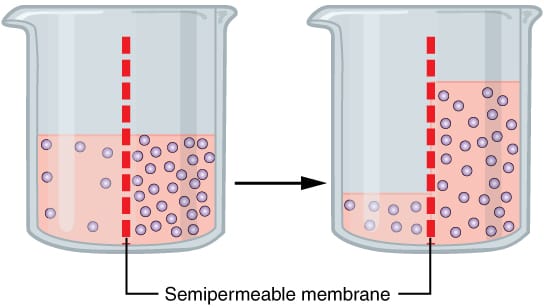
What stops it is pressure. As water accumulates, hydrostatic pressure builds and pushes back. The pressure that exactly halts net flow is the osmotic pressure of the solution, and it depends on the number of dissolved particles rather than what they are. Jacobus van 't Hoff showed in the 1880s that dilute solutions follow a relationship formally identical to the ideal gas law, and received the first Nobel Prize in Chemistry in 1901 in part for this.
The pressures are not small. Seawater has an osmotic pressure of around 27 atmospheres, which is why desalination by reverse osmosis is energy-intensive: the applied pressure must exceed that before any water crosses the wrong way.
An animal cell in pure water takes up water until it bursts. In a concentrated solution it loses water and shrivels. Neither is survivable, so tonicity is regulated continuously.
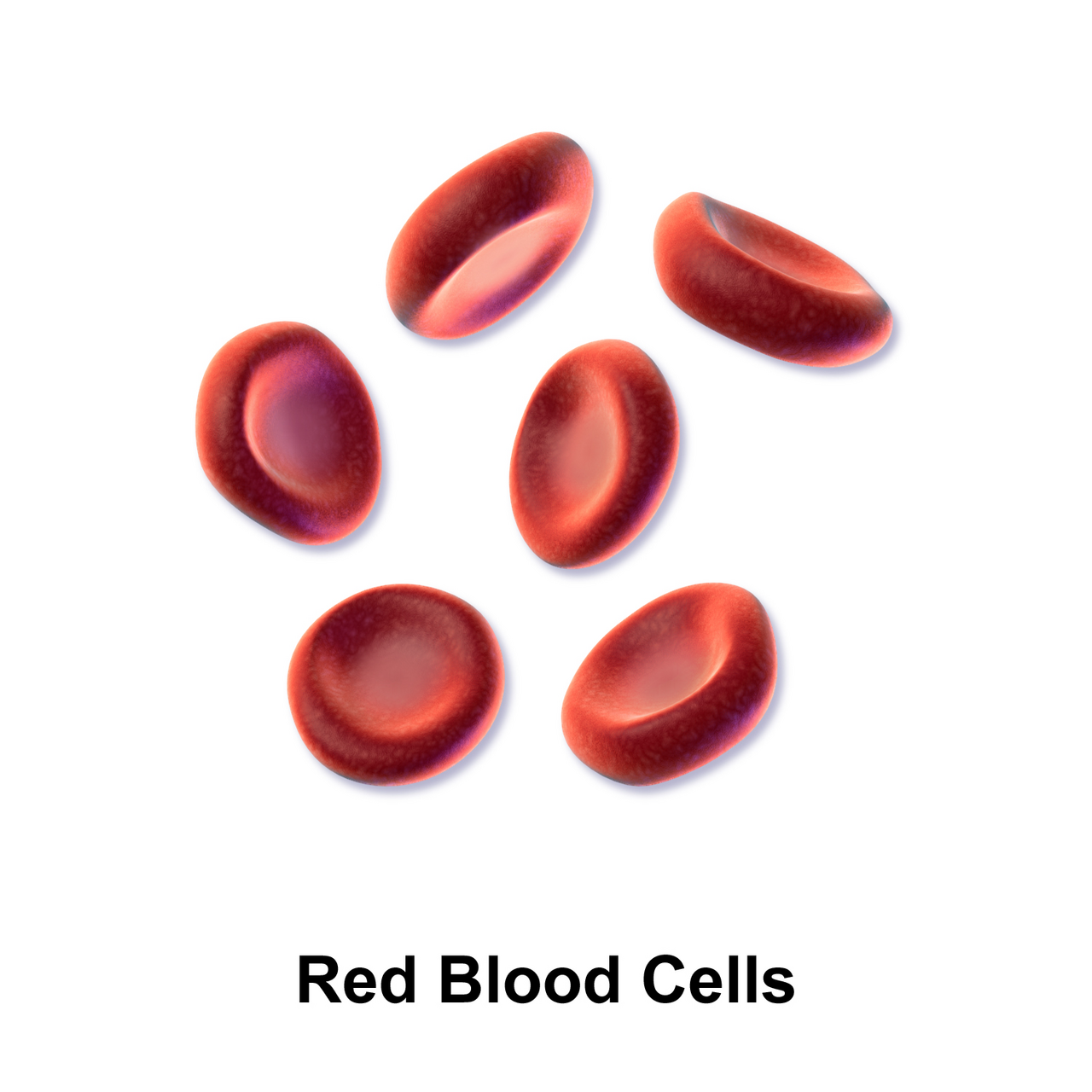
Red blood cells are the standard demonstration and a practical constraint: intravenous fluids must be isotonic with blood, and administering pure water intravenously destroys red cells directly.
Animal cells handle this by pumping ions out, which costs energy, and the sodium-potassium pump consumes a substantial share of the body's resting metabolism partly for this reason.
Plants take the opposite approach. A cell wall lets internal pressure build until it balances the osmotic gradient, and that turgor pressure is what holds a non-woody plant upright. A wilting plant is one whose cells have lost turgor, and watering it restores the pressure rather than supplying any structural material.
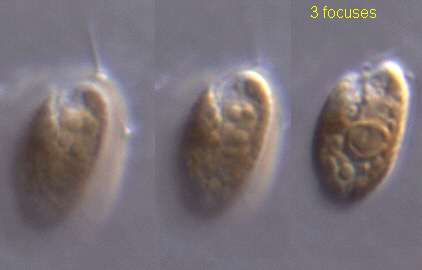
Freshwater protists use contractile vacuoles, collecting incoming water and expelling it, which is bailing rather than sealing.
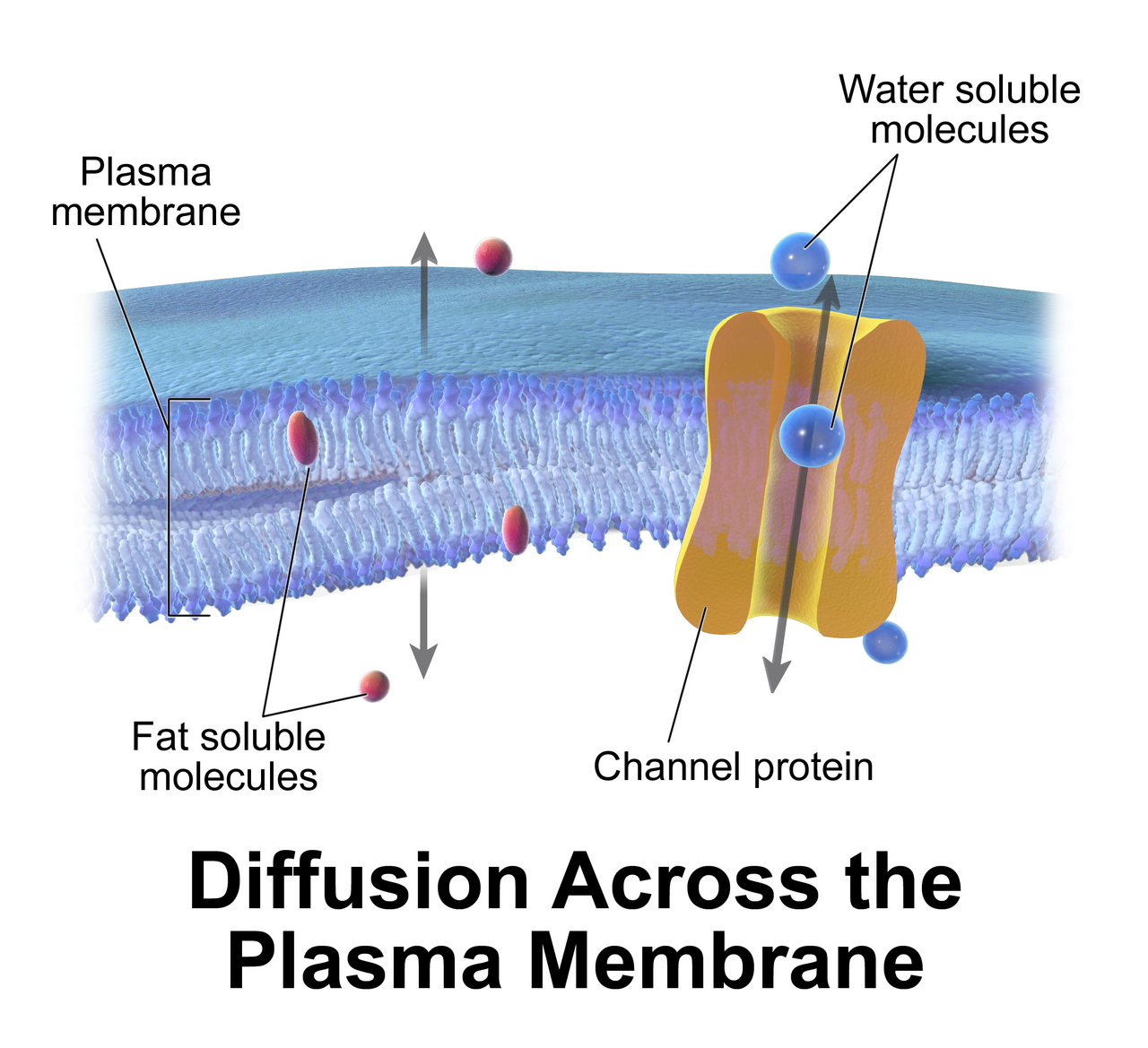
Water passes through lipid membranes slowly on its own. Where rapid movement is needed there are dedicated channels.
Aquaporins, discovered by Peter Agre in 1992 and recognised with the 2003 Nobel Prize in Chemistry, are protein pores that pass water at enormous rates while excluding protons, which is a subtle requirement since protons ordinarily move through water chains very efficiently. The kidney relies on them heavily, and mutations in aquaporin genes cause forms of diabetes insipidus in which the kidney cannot concentrate urine.
Kidneys concentrate urine by establishing an osmotic gradient in the surrounding tissue and drawing water back out of the tubule, which is how a mammal excretes waste without losing the water it is dissolved in.
Food preservation by salting or sugaring works by making the surroundings so concentrated that bacteria lose water and cannot grow. Jam, salted fish and honey keep for the same reason.
Reverse osmosis, applying pressure to drive water backwards through a membrane, supplies drinking water in much of the arid world and is the dominant desalination technology.
Osmosis is passive. It costs nothing and cannot be switched off, which is precisely why organisms spend energy resisting it. The pumping, the walls, the channels and the vacuoles are all responses to a process that will otherwise proceed regardless.