Franz Anton Mesmer's doctrine that an invisible universal fluid flows through all bodies, that illness results from its obstruction, and that a trained practitioner can redirect it to produce a cure. The fluid does not exist. The investigation that established this invented the blinded, placebo-controlled trial.
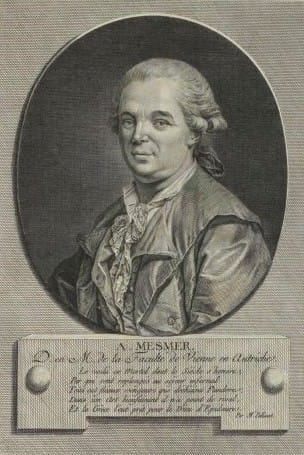
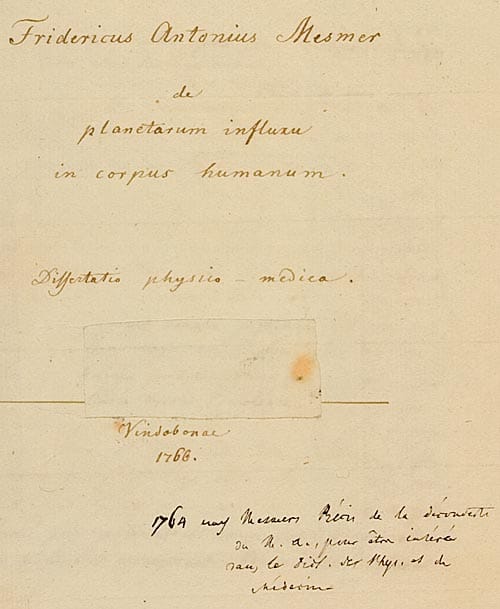
Mesmer qualified in medicine in Vienna in 1766 with a dissertation on the influence of the planets on the human body. He developed from it the theory of animal magnetism: a subtle fluid pervading the universe and connecting all bodies, whose uneven distribution within a person causes disease.
The practitioner, having an abundance of the fluid, could channel it by passing his hands over the patient, by touch, or through magnetised objects. The desired outcome was a crisis, often convulsive, after which the patient was said to be restored.
Moving to Paris in 1778, Mesmer became extremely fashionable. Demand exceeded what individual treatment allowed, so he devised the baquet, a covered tub containing water, iron filings and glass, with protruding iron rods that patients applied to the afflicted part.
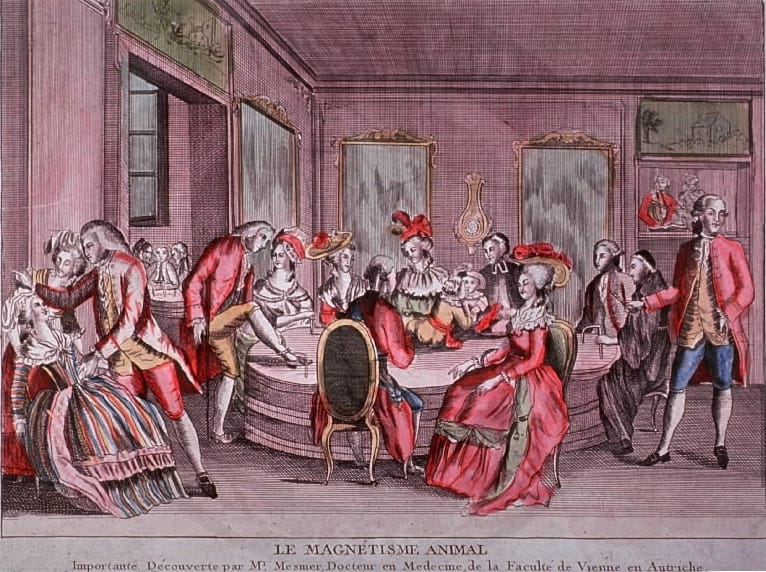
Sessions were staged with dim light, mirrors and music, patients were linked by cords, and crises spread through the group. The reported outcomes were real events: people convulsed, wept, and in some cases reported lasting relief of genuine symptoms.
The controversy was such that Louis XVI appointed a royal commission in 1784, drawn from the Faculty of Medicine and the Académie des Sciences. Its members included Benjamin Franklin, then in France, the chemist Antoine Lavoisier, the astronomer Jean Sylvain Bailly, and the physician Joseph-Ignace Guillotin.
The commission's method is why the episode is remembered. Rather than debating whether a universal fluid could exist, they framed a question that could be settled experimentally: does the claimed agent produce effects when belief is held constant?
They separated the two variables. In one arrangement subjects were told they were being magnetised when no magnetiser was present, or were blindfolded and led to believe a treatment was under way. Crises occurred. In another, subjects were magnetised without their knowledge, through a door or while their attention was elsewhere. Nothing happened.
A woman who reacted strongly to a magnetised tree was blindfolded and led to several untreated trees, and she reacted at each of them, collapsing at one that had not been touched.
The conclusion was precise and is often misreported. The commission did not find that the patients were faking or that nothing occurred. It found that the effects were genuine and that their cause was imagination, meaning the subject's own expectation, and that no evidence supported the existence of the fluid. Where belief was present the effects appeared, and where belief was absent they did not, regardless of the supposed magnetism.
Lavoisier drafted the report. A second, confidential report to the king raised concerns about the crises and about the position of female patients in the practice.
The design contains, in 1784, the essential elements of the modern clinical trial.
There is a control condition, in which the supposed active agent is absent while everything else is preserved. There is blinding, achieved with blindfolds and concealment, so the subject does not know which condition is in force. And there is a clear separation of the specific effect of a treatment from the effect of expectation, which is what the word placebo now denotes.
This is the first well-documented use of a blinded placebo control to settle a medical question, and it was constructed for the purpose rather than inherited.
The fluid was fictitious and the phenomena were not, and that residue became a research programme.
Practitioners continued the work, and the Scottish surgeon James Braid concluded in the 1840s that the effects were produced by focused attention and suggestion in the subject rather than by anything transmitted from the operator. He renamed the phenomenon neuro-hypnotism, later hypnotism, deliberately discarding the magnetic theory.
Hypnosis so understood became a legitimate subject of study, was used for surgical anaesthesia before chemical agents were available, and influenced the development of psychotherapy through Charcot and, by way of him, Freud.
Mesmerism is the origin point of controlled trial methodology, and it arrived there through a commission that took a popular claim seriously enough to test it properly rather than dismissing it.
It is also the clearest early demonstration that a treatment can produce real effects for reasons entirely unrelated to its stated mechanism. That fact is why the placebo control exists, and it is why the observation that patients improved is never on its own evidence that a theory is correct.