One equation relating the pressure, volume, temperature and quantity of a gas. It is an approximation that no real gas obeys exactly, it is accurate enough for most purposes over enormous ranges, and it is the clearest case in science of a deliberately wrong model being more useful than a correct one.
The equation was assembled from separate empirical relationships, each found by holding two quantities fixed and varying the others.
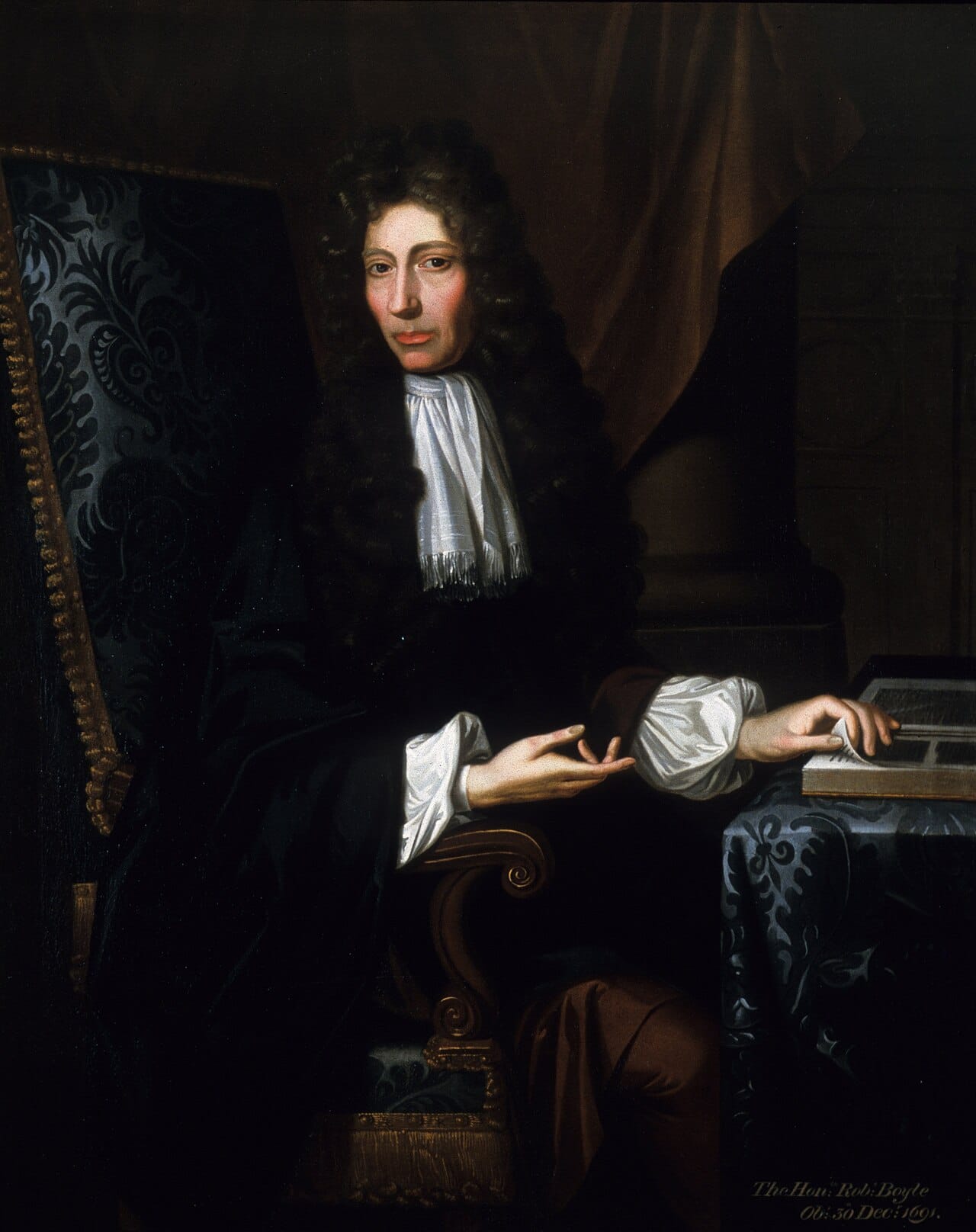
Robert Boyle showed in 1662 that pressure and volume are inversely proportional at fixed temperature: squeeze a gas into half the space and the pressure doubles.
Jacques Charles and Joseph Louis Gay-Lussac established that volume is proportional to temperature at fixed pressure. This has a consequence Boyle's law does not: extrapolating the volume of any gas back to zero gives the same temperature, around minus 273 degrees Celsius, regardless of which gas is used. That convergence is what identifies absolute zero, and it is why the Kelvin scale exists.
Amedeo Avogadro proposed in 1811 that equal volumes of any gas at the same temperature and pressure contain equal numbers of molecules. This was the crucial and long-resisted step, because it made the number of particles rather than the identity of the substance the relevant quantity.
Combining them gives the ideal gas law, first stated in the modern form by Benoit Clapeyron in 1834.
The law can be derived rather than merely fitted, which is what raised it from a rule of thumb to physics.
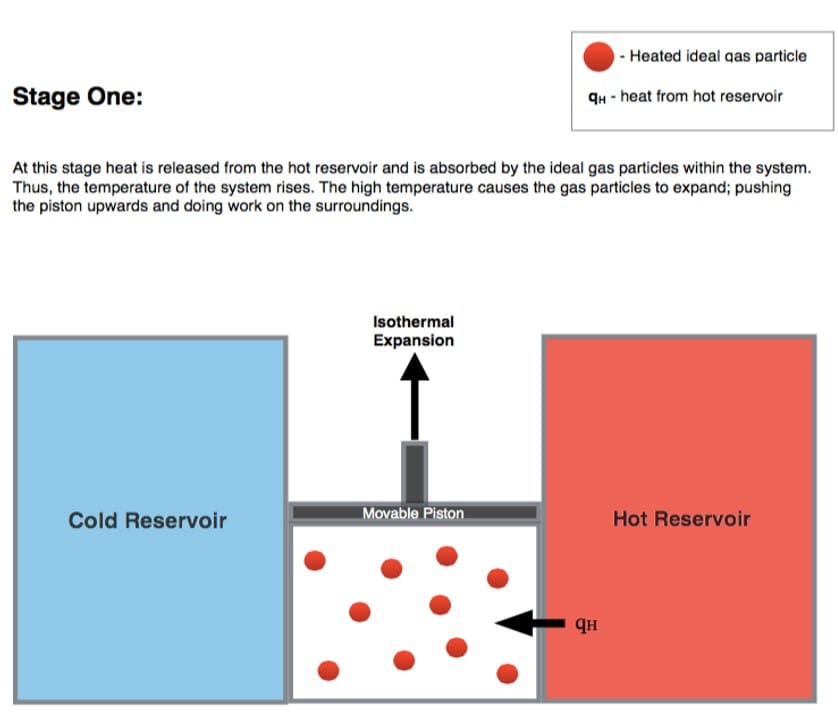
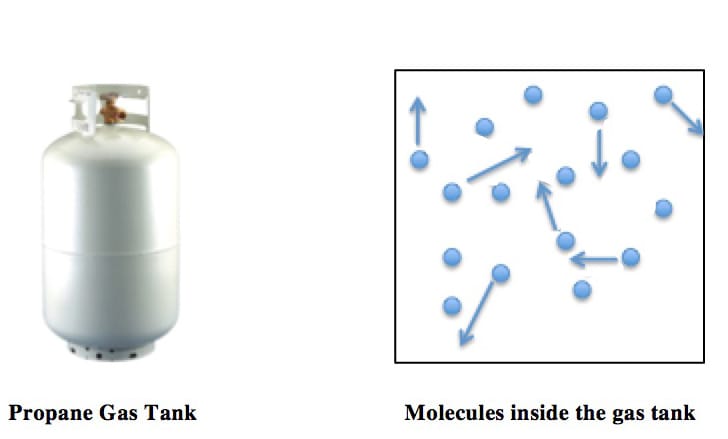
Kinetic theory treats a gas as a very large number of particles in constant random motion, colliding elastically with the walls and with each other. Pressure is the aggregate force of those collisions. Temperature is proportional to the average kinetic energy of the particles.
From those assumptions the ideal gas law follows by mechanics and statistics alone. Two assumptions are required and both are false: that the particles have no volume, and that they exert no forces on one another except during collisions.
That derivation, developed by Maxwell and Boltzmann in the nineteenth century, is one of the strongest arguments that matter is made of particles. It was made before atoms were universally accepted as real, and the fact that a model of invisible colliding particles reproduced measured gas behaviour precisely was among the reasons they became so.
Real gases deviate from the law where the two false assumptions matter: at high pressure, where the particles' own volume becomes a significant fraction of the container, and at low temperature, where attraction between molecules becomes significant relative to their kinetic energy.
The van der Waals equation, from 1873, corrects both with two parameters fitted per substance. It is more accurate and much less convenient, and it earned a Nobel Prize in 1910.
For most everyday conditions the error is small. Air at room temperature and atmospheric pressure follows the ideal law to within a fraction of a percent, which is why engineering calculations for ventilation, weather and combustion use it directly.
The failure is worst near condensation, which is precisely where the assumption that molecules do not attract each other becomes untenable, since condensation is that attraction winning.
Weather prediction rests on it. The behaviour of rising and falling air masses, cloud formation and the temperature structure of the atmosphere are all worked out from gas laws, with corrections.
Engine design uses it for combustion cycles. Diving depends on it directly, since the volume of gas in the lungs and in equipment changes with depth, and decompression tables come from gas behaviour under pressure. Airbags are sized by it. Balloons and aircraft pressurisation are governed by it.
Chemistry uses it constantly, since measuring the volume, pressure and temperature of a gas gives the number of moles, which is how gaseous reactions are quantified.
The law's status is worth stating plainly because it is often taught as if it were true.
It describes a substance that does not exist. Every real gas violates it. It is used anyway, everywhere, because the error is small in the conditions that usually matter and because the correction terms can be added when they are not.
That is the ordinary situation in physical science rather than an embarrassment. A model is judged by whether its error is smaller than what the problem tolerates, and a simple model with known failure modes is generally more useful than a complicated one whose failures are unmapped.