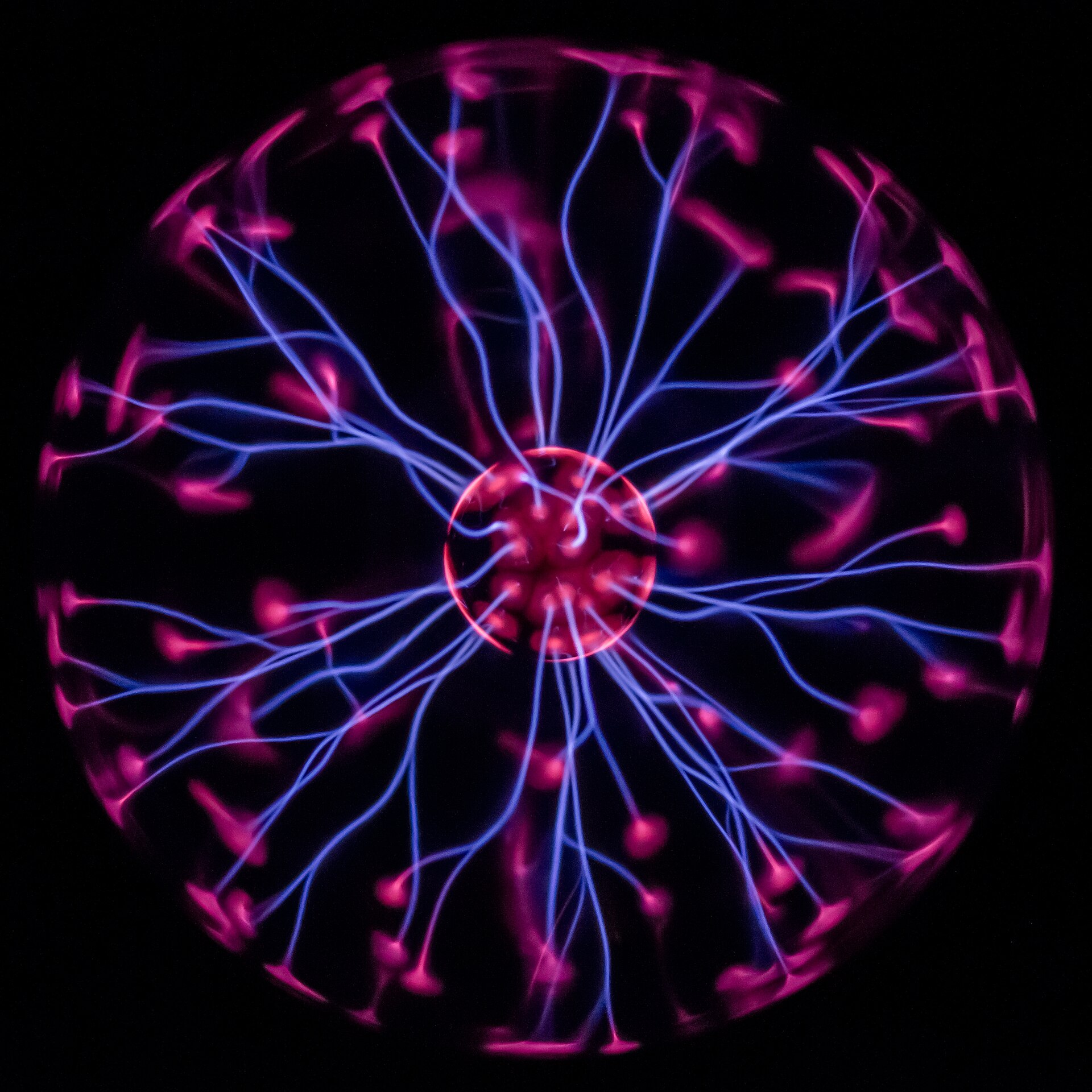
Electromagnetism is the branch of physics that describes the forces between electric charges and the deep connection between electricity and magnetism. It is one of the four fundamental forces of nature and underlies a vast range of everyday phenomena and modern technology.
At the heart of electromagnetism is electric charge, a basic property of matter that comes in two kinds, positive and negative. Like charges repel and opposite charges attract. The electrons in atoms carry negative charge, and the flow or buildup of charge produces the electric effects we see, from a spark to a lightning bolt.

A charge creates an electric field around it, a region in which other charges feel a force. When charges flow through a material, we call it an electric current, the basis of all our electrical technology. Static electricity, by contrast, is charge that has built up and stays put until it suddenly discharges.
Magnetism was long thought to be a separate phenomenon, the strange power of lodestones and compass needles. In fact it is intimately tied to electricity: magnetism arises from moving charges. A magnet has two poles, north and south, and like electric charges, like poles repel and opposite poles attract.
Electricity and magnetism are two aspects of a single force. Moving charges, that is electric currents, create magnetic fields, and a changing magnetic field, in turn, drives an electric current. This intimate two way relationship is the heart of electromagnetism and the reason the two phenomena cannot be cleanly separated.
Through the nineteenth century, scientists uncovered these links through careful experiment. Hans Christian Ørsted found that an electric current deflects a compass needle, André-Marie Ampère worked out the forces between currents, and Michael Faraday showed that a moving magnet could generate electricity, the principle behind every generator.
In the 1860s the Scottish physicist James Clerk Maxwell united these findings into a set of elegant equations. Maxwell's equations not only described all known electric and magnetic effects but also predicted that light itself is an electromagnetic wave, a stunning and unexpected unification of light, electricity, and magnetism.
Maxwell's insight revealed that visible light is just one small band of a vast electromagnetic spectrum. Radio waves, microwaves, infrared, ultraviolet, X-rays, and gamma rays are all electromagnetic waves, differing only in their wavelength. The same physics governs a radio broadcast, a sunbeam, and a medical X-ray.
Electromagnetism holds atoms and molecules together, so it governs essentially all of chemistry and the properties of materials. Almost every force we feel in daily life, from the solidity of a table to the friction under our feet, is electromagnetic in origin, arising from the interactions of charged particles.
Electromagnetism makes modern civilization possible. Electric power, motors and generators, radio, television, mobile phones, computers, and medical imaging all rely on it. Of the four fundamental forces, it is the one we understand most completely and harness most directly, shaping nearly every machine and device we use.