Determining the order of bases in a DNA molecule. The cost has fallen faster than almost any technology in history, and that fall converted sequencing from a research project into a routine measurement.
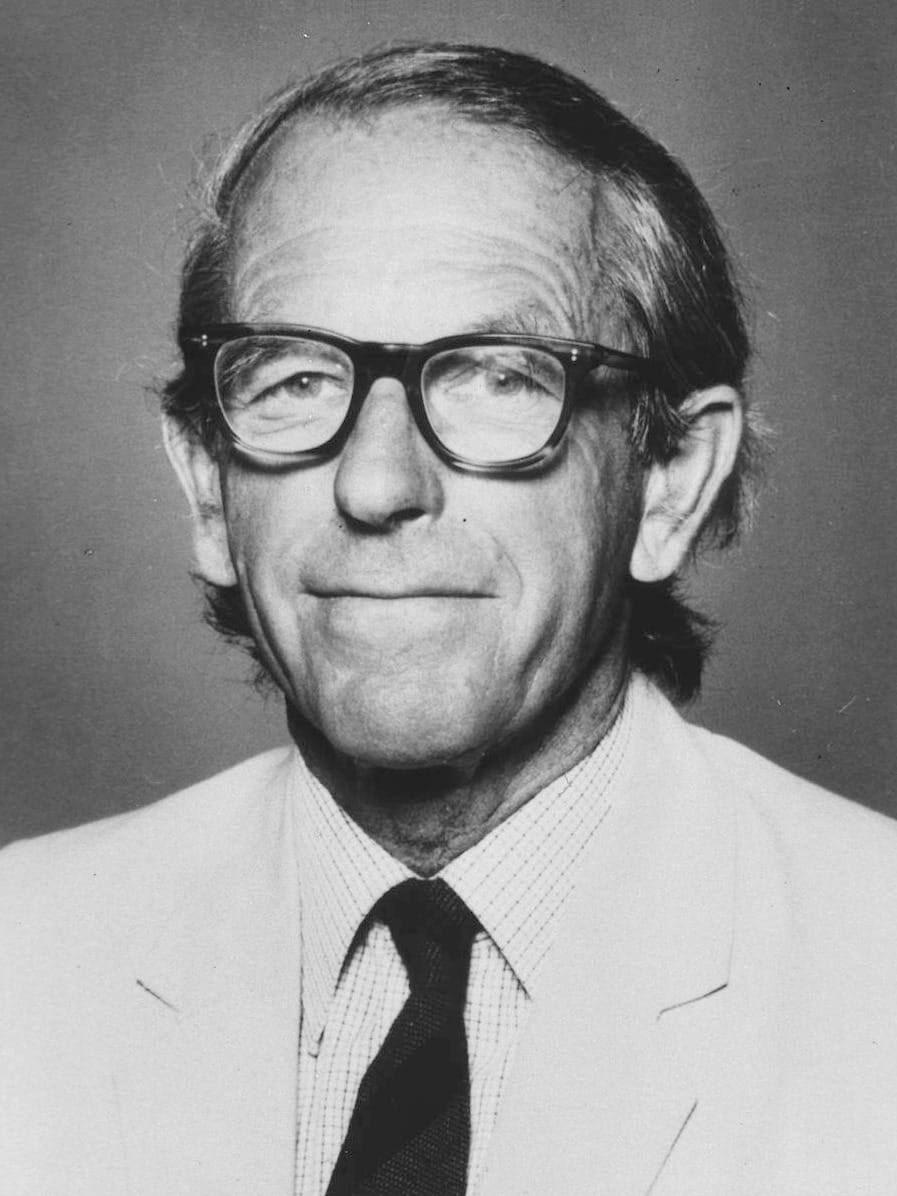
Frederick Sanger developed chain-termination sequencing in 1977, the work for which he received his second Nobel Prize.
The method copies the DNA while including a small proportion of modified bases that stop the copy when incorporated. The result is a collection of fragments of every possible length, each ending at a known base type.
Separating those fragments by size, originally on a gel, produces a ladder from which the sequence can be read directly.
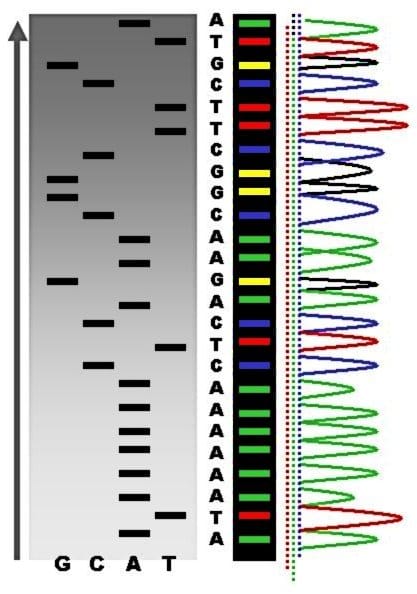
Automation replaced radioactive labels with four fluorescent dyes, one per base, allowing all four reactions in one lane and machine reading. This is what made the Human Genome Project feasible.
Sanger sequencing produces long accurate reads of around eight hundred bases and remains the reference method for verifying individual sequences.
Next-generation sequencing, from the mid 2000s, replaced sequential reading with massive parallelism.
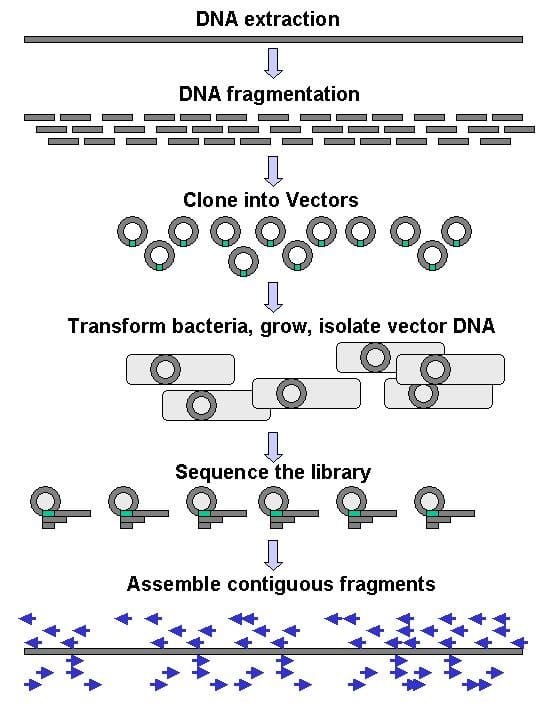
The DNA is fragmented, the fragments are attached to a surface and amplified into clusters, and all clusters are sequenced simultaneously with imaging after each base is added. Hundreds of millions of short reads are produced in a single run.
Reads are short, typically one to three hundred bases, and are assembled computationally by finding overlaps or by aligning to a reference. This shifted a substantial part of the problem from chemistry to computing.
Third-generation methods read single molecules in real time and produce very long reads, tens of thousands of bases or more. Nanopore sequencing threads a DNA strand through a protein pore and reads the change in electrical current as bases pass, which requires no amplification and can be done on a device the size of a phone.
Long reads solve problems short reads cannot: repetitive regions, structural variants and complete assembly of chromosomes. The first genuinely complete human genome sequence, published in 2022, filled gaps that had remained since 2003 and depended on long-read methods.
The Human Genome Project ran from 1990 to 2003 and cost on the order of billions of dollars for one composite genome.
The cost per genome fell to around ten thousand dollars by 2011 and to roughly a thousand within a few years, and has continued to fall since.
The rate of decline outpaced Moore's law for an extended period, which is unusual and is why the comparison is made so often.
The consequence is that sequencing changed category. A measurement that justified an international programme became something a hospital laboratory or a field team performs routinely.
Medical diagnosis of genetic conditions, where sequencing an individual's genome or the coding portion of it can identify a causative variant, and has ended long diagnostic searches for many rare diseases.
Cancer genomics, sequencing tumour DNA to identify mutations that indicate which targeted treatments may work.
Non-invasive prenatal testing, which sequences fragments of fetal DNA circulating in maternal blood.
Infectious disease. Sequencing identifies pathogens without culturing them, tracks transmission chains, and monitors variants, which became visible at scale during the COVID-19 pandemic and is described in the disease surveillance capsule.
Ancient DNA, which has transformed archaeology and human history by recovering sequence from remains tens of thousands of years old.
Environmental sequencing, which identifies organisms present in a sample of soil or water without isolating them, and has revealed large numbers of undescribed microorganisms as the archaea capsule notes.
Forensics, agriculture and evolutionary biology all use it routinely.
Interpretation is now the limiting step rather than measurement. A genome yields millions of variants, most of unknown significance, and distinguishing a causative variant from harmless variation is the difficult part.
Predictive power for common conditions remains modest. Polygenic scores aggregate many small-effect variants and explain a limited share of variation in most traits, and their use for individual prediction is disputed.
Privacy is a genuine problem, since a genome identifies not only the individual but their relatives, and consumer genetic databases have been used to identify people who never submitted a sample.
Storage and analysis of the resulting data are substantial computational problems in their own right.
DNA sequencing converted the genome from something inferred to something read, and nearly every area of biology now depends on it as a basic measurement.
The cost trajectory is also the clearest recent example of a technology changing what questions are worth asking. Experiments that were unthinkable when a genome cost millions became routine when it cost hundreds, and the limiting factor moved from generating data to understanding it.