The proposal that organisms age because it is not worth the energy to maintain a body indefinitely when something will kill it anyway. It explains why lifespans differ so enormously between species, and it explains the mechanism of ageing less well than it explains its distribution.
Ageing is puzzling from an evolutionary standpoint. A body that repaired itself indefinitely would leave more offspring, so why does anything decay?
The answer cannot be that ageing is programmed for the good of the species, by clearing space for the young. That reasoning requires group selection of a kind that does not generally work, and it is circular: a gene causing its bearer to die would be outcompeted by one that did not.

Thomas Kirkwood set it out in 1977, and the argument is economic.
An organism has finite energy and must divide it between reproduction and somatic maintenance: DNA repair, protein turnover, antioxidant defence, immune function. Every unit spent on one is unavailable to the other.
In the wild, almost nothing dies of old age. Predation, disease, starvation, cold and accident kill first. A wild mouse has a life expectancy of well under a year despite being capable of living three in a laboratory.
Given that, maintaining a body to last twenty years is wasted investment, because the body will be eaten long before. Selection favours spending on reproduction now rather than on repair for a future that will not arrive.
The soma is therefore disposable: maintained well enough to reproduce, and no better. The germ line is different, because it must persist indefinitely, and it receives correspondingly greater protection.
The theory predicts that lifespan should track extrinsic mortality risk. Species with low risk of being killed should evolve longer lifespans and greater investment in maintenance.
This prediction is well supported and is the strongest part of the case.
Flying animals live far longer than ground-dwelling ones of similar size. Bats commonly reach twenty to thirty years and some exceed forty, against two or three for a mouse. Birds are similarly long-lived for their mass. Flight is an escape from most predation.
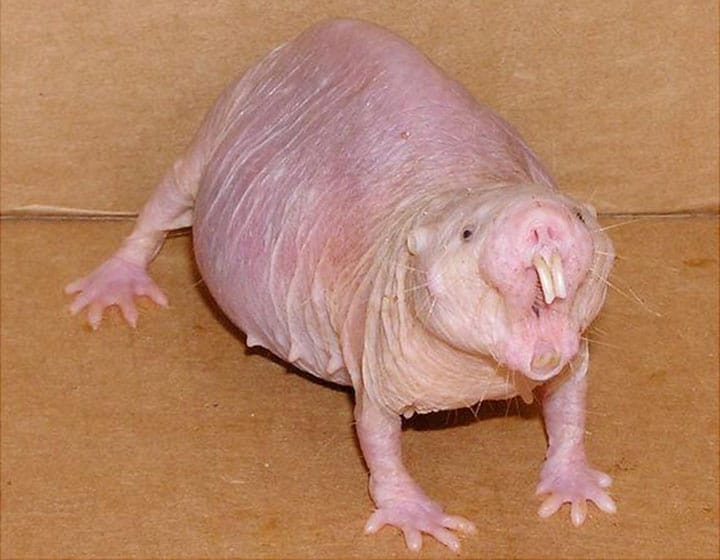
Tree-dwelling and burrowing animals show the same pattern. Naked mole-rats live underground in defended colonies with very low predation, and live roughly ten times longer than similar-sized rodents.
Animals with hard shells or effective toxins live long. Island populations, released from mainland predators, evolve longer lifespans and slower reproduction, which has been documented repeatedly.
The relationship holds across a wide range of taxa and is difficult to explain any other way.
The trade-off it depends on is harder to demonstrate directly than the correlation is.
Caloric restriction is the awkward case. Reducing food intake extends lifespan in many species while reducing reproduction, which fits. But it does so while reducing total energy available, which on a simple reading of the theory should reduce maintenance too. Explaining it requires the organism to reallocate rather than simply spend less, which is plausible and is an addition to the theory rather than a prediction of it.
Direct measurement of a reproduction-maintenance trade-off in individuals has produced mixed results. Some studies find that reproduction shortens life; others find the longest-lived individuals also reproduce most, which suggests differences in overall quality can mask the trade-off.
The theory also does not specify a mechanism. It explains why maintenance is limited without saying which maintenance failure produces ageing, and it is compatible with almost any proximate mechanism, which limits how sharply it can be tested.
Three evolutionary theories of ageing exist and they are complementary rather than competing.
Mutation accumulation, from Peter Medawar, holds that late-acting deleterious mutations face weak selection because most individuals are dead before they act, so they accumulate.
Antagonistic pleiotropy, from George Williams and treated in its own capsule, holds that genes benefiting early life at the cost of later life are favoured.
Disposable soma is the resource-allocation version, and can be seen as a physiological account of why antagonistic pleiotropy arises: the trade-off is energetic.
All three predict that ageing should be shaped by the strength of selection declining with age, which is the common core and is well supported.
The comparative evidence is strong and the mechanism is not demonstrated.
What would strengthen it is direct measurement of energetic allocation between reproduction and repair in individuals, showing the trade-off rather than inferring it from the correlation between mortality risk and lifespan. That measurement is difficult and the attempts have been inconclusive.
It remains the most economical explanation for why lifespan varies as it does across species, and that is a substantial achievement for an argument that contains no biology at all.