Colour is not a property of light. It is what the visual system computes from the responses of three receptor types, and the computation is what makes the same physical wavelength look different depending on what surrounds it.
Light arriving at the retina has a continuous distribution across wavelengths. The eye does not measure that distribution. It measures three numbers.
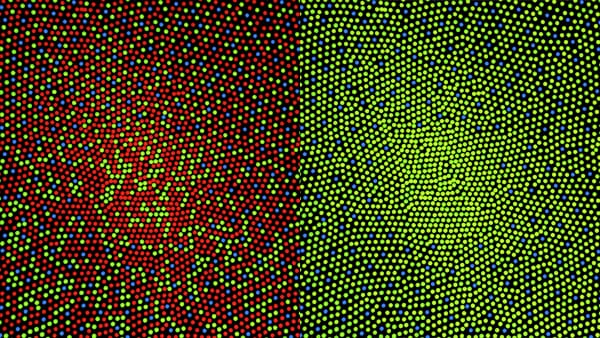
Three cone types have peak sensitivities in roughly the long, medium and short wavelength regions, with broad and heavily overlapping response curves. Each cone reports only how strongly it was stimulated, not which wavelengths did the stimulating.
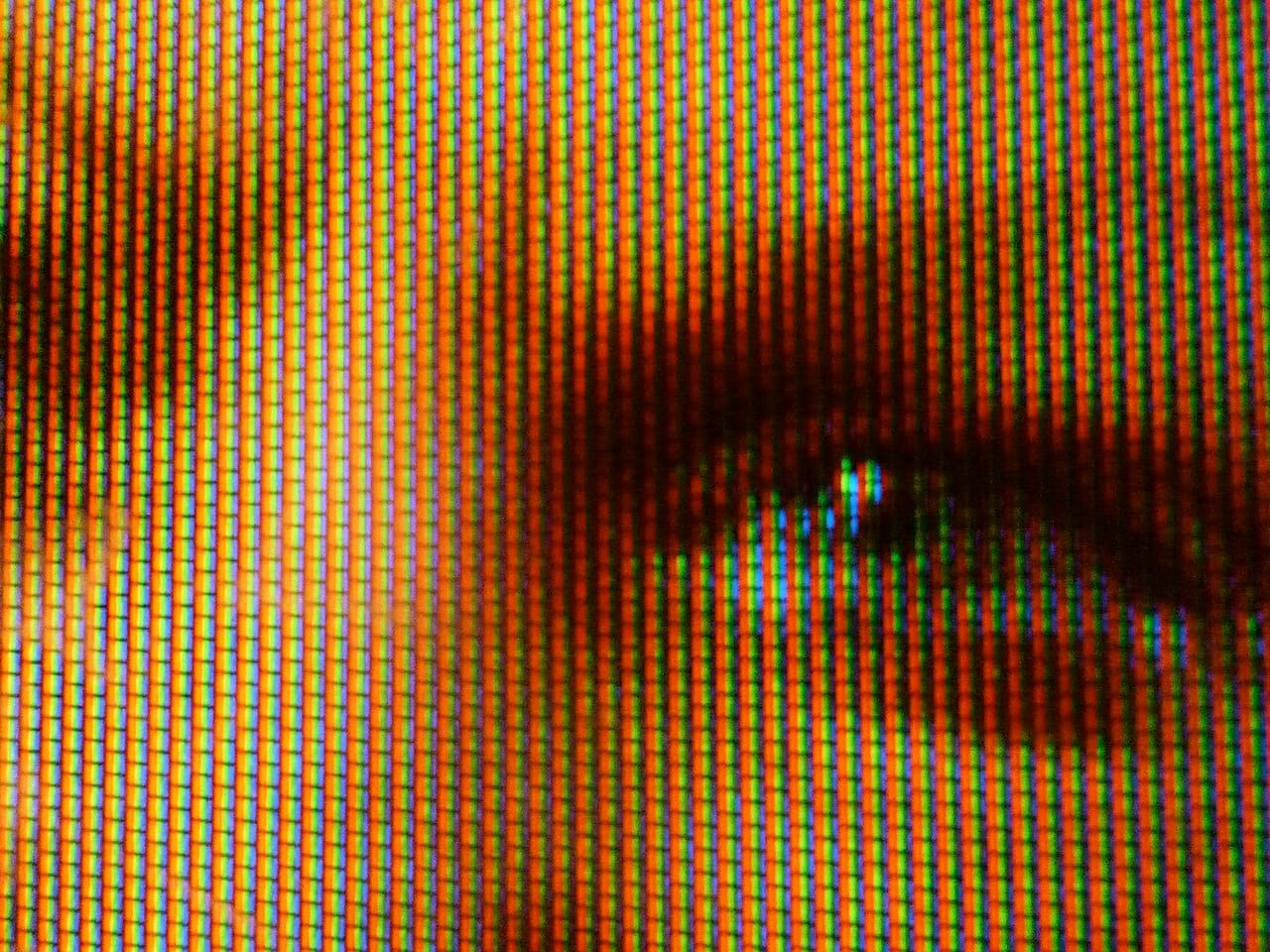
The consequence is that enormous amounts of information are discarded, and it is what makes colour reproduction possible. Two lights with completely different spectral compositions can produce identical cone responses and therefore look identical. These are metamers, and every screen exploits them: a display emits three narrow bands and reproduces the appearance of a rainbow it cannot physically produce.
Nineteenth-century colour science had two competing accounts and a long argument.
Trichromatic theory, from Thomas Young and Hermann von Helmholtz, held that three receptor types account for colour vision. It explains colour mixing and metamerism directly.
Opponent process theory, from Ewald Hering, held that colours are encoded in opposing pairs: red against green, blue against yellow, black against white. Its evidence was perceptual. There is no such thing as a reddish green or a yellowish blue, which trichromacy does not explain. Afterimages appear in the opponent colour: stare at red and look away and you see green.
Both are correct and they describe successive stages. The cones are trichromatic. The signals are then recombined by retinal ganglion cells into opponent channels: one carrying long minus medium, one carrying short minus the sum of the others, and one carrying overall brightness.
The recombination is not decoration. It removes redundancy, since the three cone signals are highly correlated, and it produces a more efficient code for transmission down the optic nerve.
A white sheet of paper looks white under midday sun, under an overcast sky, and under a tungsten lamp, though the light reaching the eye from it differs enormously in composition.
This is colour constancy, and it means the visual system is not reporting the light arriving but estimating the reflectance of the surface, which requires discounting the illumination. It is an inference from an underdetermined problem: the same signal could be a white surface under yellow light or a yellow surface under white light, and the system must choose.
Edwin Land demonstrated this dramatically with displays in which a patch's apparent colour depended on the surrounding patches rather than on its own reflected light, and developed retinex theory to account for it.
The dress photograph that circulated in 2015 is the same phenomenon on an ambiguous image. Viewers disagreed about its colours because the picture gives too little information about the illumination, and different assumptions about whether it was in shadow or direct light produce different answers. The disagreement was not about the image but about what each visual system assumed.
Red-green colour deficiency affects roughly eight percent of men of northern European descent and under one percent of women, because the relevant genes are on the X chromosome. It usually involves a shifted or missing cone type rather than an absence of colour.
Complete colour blindness is rare and generally involves other visual problems, since it means non-functioning cones.
Some women carry a fourth cone type as a consequence of the same genetics, and a small number have been shown behaviourally to make colour discriminations that trichromats cannot. Genuine functional tetrachromacy appears to be rare even among those with the genetic potential.
Other species differ substantially. Many birds and insects see ultraviolet, so flowers carry patterns invisible to us. Mantis shrimp have twelve or more receptor types and, when tested, discriminate colours worse than humans, which suggests their system works by a different principle than fine comparison.
The frequently repeated claim that colour is an illusion is misleading. Colour is a real and reliable computation performed on real physical differences.
What is true is that colour is not in the light. Wavelength is a physical property; colour is what a particular nervous system makes of it, and a different arrangement of receptors produces a different and equally valid partition of the same spectrum.