The proposal that ageing is caused by genes which help early in life and harm later, and which selection favours anyway because early effects matter more. It is the most elegant evolutionary account of ageing and the hardest to demonstrate in any specific gene.
Selection weakens with age, and the reason is arithmetic rather than biological.
An organism's contribution to future generations comes from the offspring it has. Individuals die from accident, predation and disease at some rate regardless of ageing, so the proportion of a cohort still alive declines with time. A gene acting at twenty is expressed in most of the cohort; a gene acting at eighty is expressed in whatever fraction survived to eighty.
A deleterious effect appearing late therefore faces much weaker selection than the same effect appearing early. Peter Medawar made this point in 1952, and it is the foundation all evolutionary theories of ageing rest on.
George Williams took the next step in 1957.
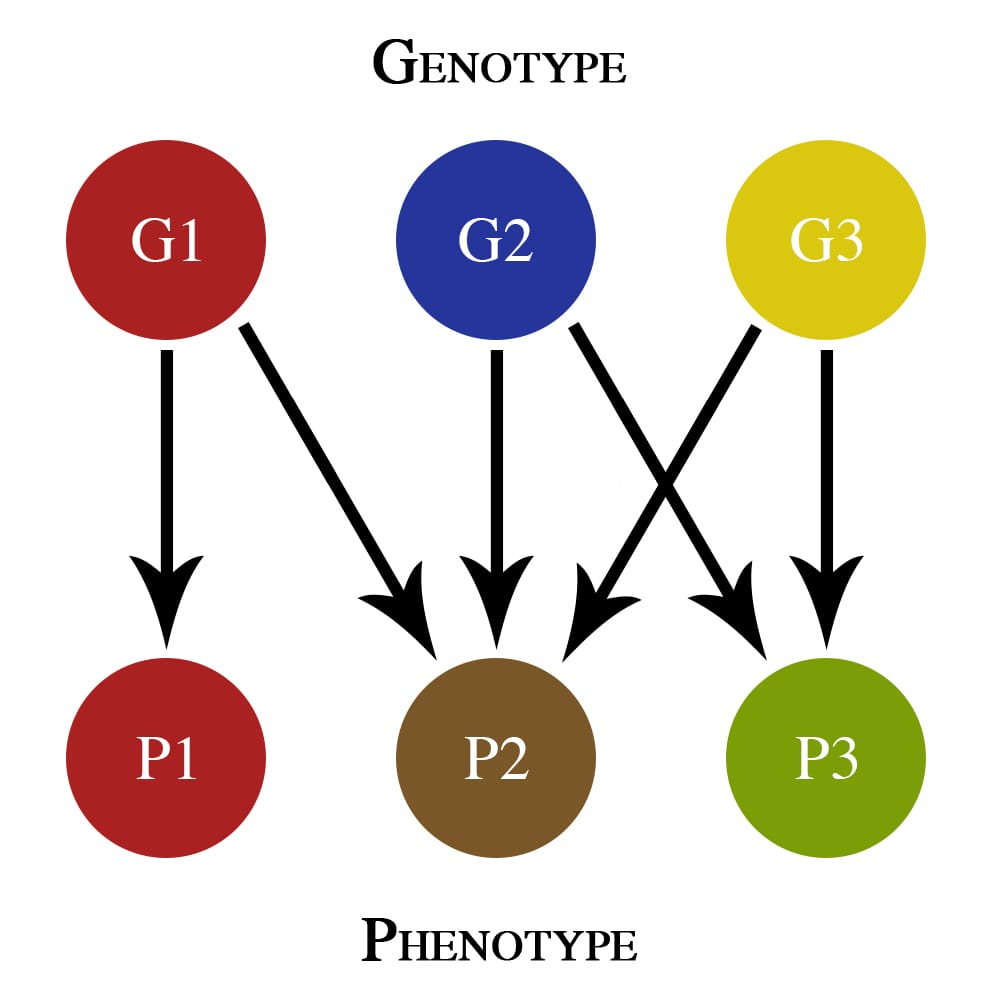
Pleiotropy is one gene affecting several traits, which is ordinary. Antagonistic pleiotropy is the case where the effects point in opposite directions: beneficial early, harmful late.
Such a gene is favoured. The early benefit is expressed in a large fraction of the population and increases reproduction; the late cost is expressed in a small surviving fraction and reduces little. Selection accepts the trade.
Ageing on this account is not a failure of selection and not an accumulation of unremoved mutations. It is the direct consequence of selection actively favouring genes whose late effects are harmful.
That is a stronger and more interesting claim than mutation accumulation, because it makes senescence something selection produces rather than something it merely tolerates.
Several lines support the framework, though direct examples are fewer than the theory's prominence suggests.
Selection experiments are the strongest. Fruit flies bred for late reproduction, by only allowing old flies to breed, evolve longer lifespans within a few dozen generations, and they reproduce less early in life. That trade-off is exactly what the theory predicts and it appears reliably.
The p53 gene is the most cited candidate. It suppresses tumours by triggering cell cycle arrest or apoptosis in damaged cells. Mouse work with hyperactive p53 variants found reduced cancer and accelerated ageing phenotypes, which is the predicted shape: better protection early, faster depletion of stem cells later.
Genes involved in insulin and IGF-1 signalling promote growth and reproduction and, when reduced, extend lifespan in worms, flies and mice, which fits.
Testosterone in males is often given as an example, supporting reproduction early and contributing to prostate disease later. Studies of historical castration records have reported longer lifespans, though the samples are small and confounded.
Sickle cell trait is the classic pleiotropy example and is not antagonistic in the age sense: it trades malaria resistance against anaemia risk within the same period, which is a different structure.
Demonstrating antagonistic pleiotropy for a specific gene requires showing that the same allele improves early fitness and reduces late fitness in the same organism, and that is demanding.
Most candidates rest on plausibility rather than measurement. Showing that a gene does something useful early and something harmful late is not the same as showing the two effects are inseparable, which the theory requires: if they could be uncoupled, selection would uncouple them.
Genome-wide studies of human longevity have found relatively few variants showing the predicted pattern of opposite effects at different ages, and the signal is weaker than the theory would predict if it were the dominant mechanism.
Effects also depend on environment. A gene favouring rapid growth may be beneficial where food is scarce and harmful where it is abundant, which makes the sign of the trade-off conditional and complicates any general claim.
The implication is uncomfortable for the prospect of treating ageing.
If ageing results from damage accumulating, then repairing damage should help. If it results from genes selection actively favoured, then the harmful late effects are inseparable from the early benefits, and removing them may cost something that mattered.
The p53 case illustrates it. Reducing p53 activity might slow some aspects of ageing at the cost of higher cancer rates, which is not a trade most people would take.
Whether the constraint is absolute is the open question. Antagonistic pleiotropy says the effects were linked over evolutionary time under the conditions that prevailed; it does not prove they cannot be separated by intervention. Several longevity interventions in model organisms do extend healthy lifespan without an obvious offsetting cost, which suggests the constraints are looser than the strong reading implies.
The logic is sound and the general prediction, that selection strength declining with age shapes senescence, is well supported.
What is missing is a body of demonstrated cases. A theory about genes needs genes, and after nearly seventy years the confirmed examples remain few and contested. It sits alongside the disposable soma theory as a framework that explains the pattern of ageing convincingly and its molecular substance much less so.