The electrical pulse a nerve cell uses to signal. It is the unit of communication in every nervous system, its mechanism is understood in quantitative detail, and it was worked out largely by experimenting on the squid.
A neuron at rest holds a voltage difference across its membrane, the inside roughly seventy millivolts negative relative to the outside. This is maintained by pumps that move sodium out and potassium in against their concentration gradients, consuming a substantial fraction of the body's energy budget to do so.
The membrane is selectively permeable, and the permeability is controlled by protein channels that open and close. The resting state is not equilibrium; it is a maintained disequilibrium, held ready.
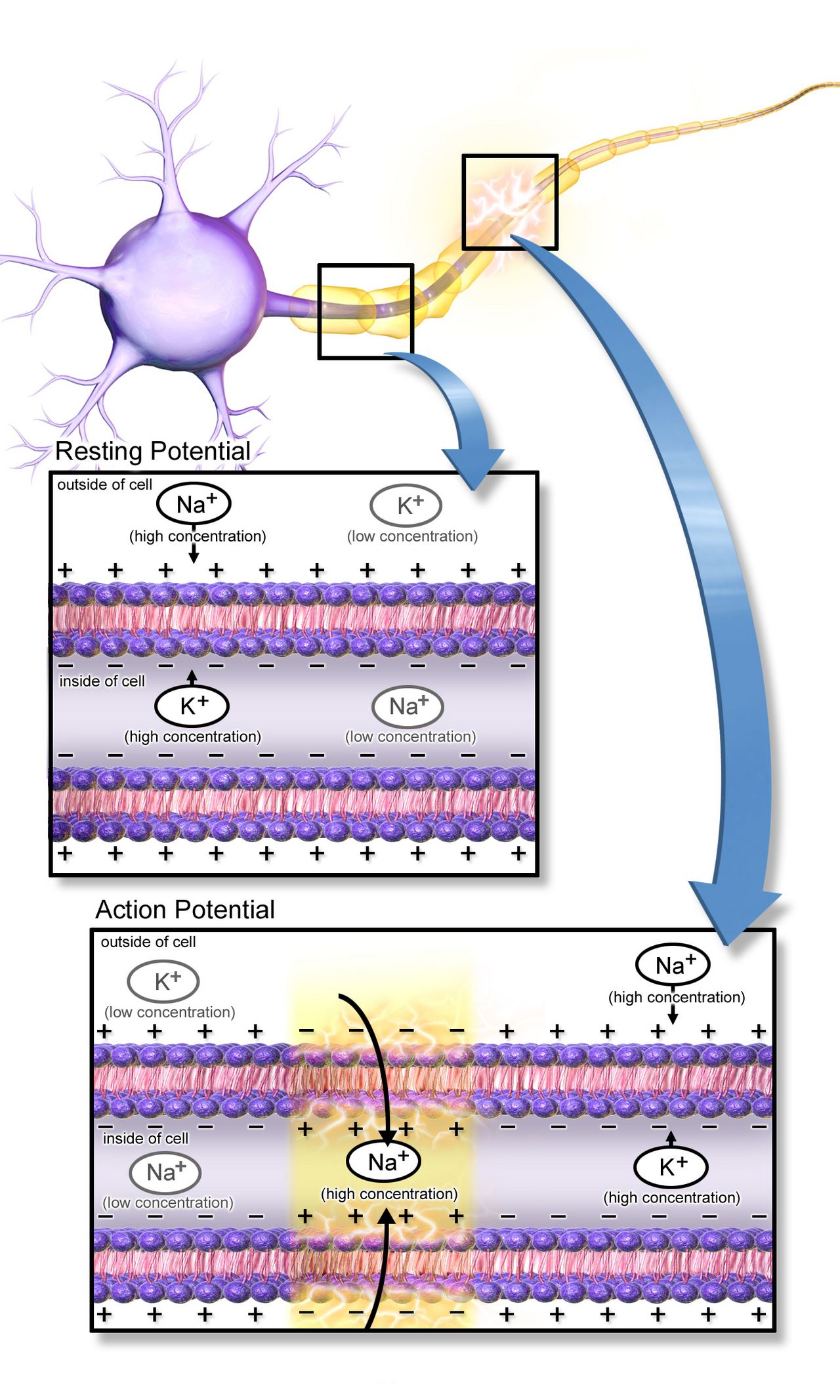
If the membrane depolarises past a threshold of about fifteen millivolts, voltage-gated sodium channels open. Sodium rushes in, depolarising the membrane further, opening more channels. This positive feedback is what makes the response all or nothing: once threshold is crossed the pulse proceeds to completion, and its size carries no information about the strength of the stimulus.
Within about a millisecond the sodium channels inactivate automatically, and potassium channels, slower to open, allow potassium out. The membrane returns to rest and briefly overshoots.
The inactivation produces a refractory period during which no second pulse can be triggered. This has two consequences: it caps the firing rate, and it forces the pulse to travel in one direction only, since the region just behind it cannot fire again.
Information is carried by the rate and pattern of pulses, not their size.
The mechanism was established by Alan Hodgkin and Andrew Huxley at Plymouth and Cambridge, using the giant axon of the squid, which is up to a millimetre across and large enough to insert an electrode into.
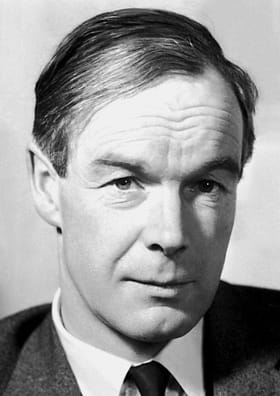
Using the voltage clamp, a feedback circuit holding membrane voltage at a chosen value while measuring the current required to hold it there, they separated the sodium and potassium currents and characterised how each depended on voltage and time.
They then wrote equations describing the channels and integrated them by hand, a calculation taking weeks. The equations predicted an action potential of the correct shape, amplitude, threshold and conduction velocity, none of which had been fitted. Publication in 1952 was followed by the 1963 Nobel Prize in Physiology or Medicine, shared with John Eccles.
The Hodgkin-Huxley model remains in use. It is among the most successful quantitative models in biology, and it was written before anyone knew that ion channels were proteins.
Conduction velocity ranges from about half a metre per second to over a hundred, and the difference is structural.
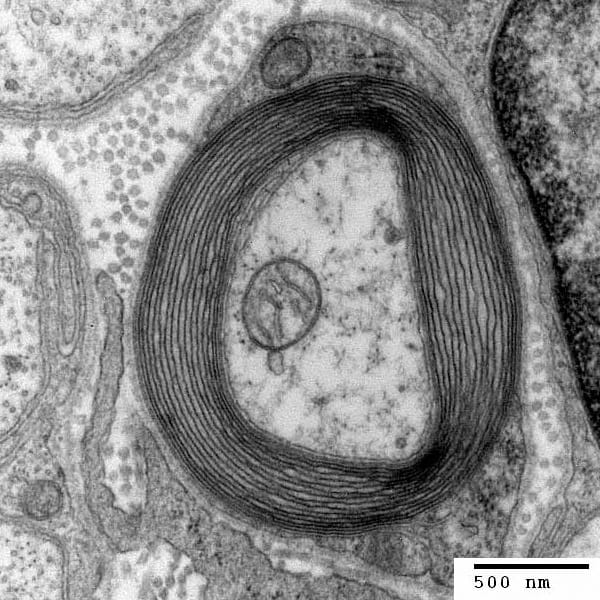
Increasing axon diameter raises speed, which is why the squid's escape axon is so large, but the gain scales poorly and the space cost is prohibitive for a nervous system needing many fibres.
Vertebrates use insulation instead. Glial cells wrap the axon in myelin, leaving small gaps. The pulse regenerates only at the gaps and jumps between them, which raises speed by up to fifty times at a fraction of the volume. The importance of this is visible in multiple sclerosis, where myelin is destroyed and conduction fails.
Local anaesthetics block voltage-gated sodium channels, preventing the pulse from being generated. Several potent natural toxins, including tetrodotoxin from pufferfish, act on the same channels, which is why they are lethal at minute doses.
Epilepsy involves populations of neurons firing in pathological synchrony, and several anticonvulsants act on sodium channel kinetics. Cardiac arrhythmias involve related channels in heart muscle.
The 2003 Nobel Prize in Chemistry went to Roderick MacKinnon for the atomic structure of a potassium channel, showing exactly how a pore distinguishes potassium from the smaller sodium ion. That structure explained, half a century later, the selectivity Hodgkin and Huxley had inferred from currents alone.