Two complementary classes of substance, defined by what they do with protons or with electron pairs. The distinction organises a large part of chemistry, and it has been defined three times, each definition wider than the last.
Acids taste sour, dissolve many metals, turn litmus red and conduct electricity in solution. Bases feel slippery, turn litmus blue and also conduct. Mixed in the right proportion they cancel one another, producing a salt and water, which is called neutralisation.
These properties were catalogued long before anyone could explain them. The word acid comes from the Latin for sour, and alkali from the Arabic for the plant ash from which the first ones were obtained.
The Arrhenius definition, from 1884, is the narrowest. An acid releases hydrogen ions in water and a base releases hydroxide ions. Neutralisation is then simply those two combining to form water. It works well and it only works in water.
The Brønsted and Lowry definition, proposed independently by Johannes Brønsted and Thomas Lowry in 1923, is the one most used. An acid is a proton donor and a base is a proton acceptor.
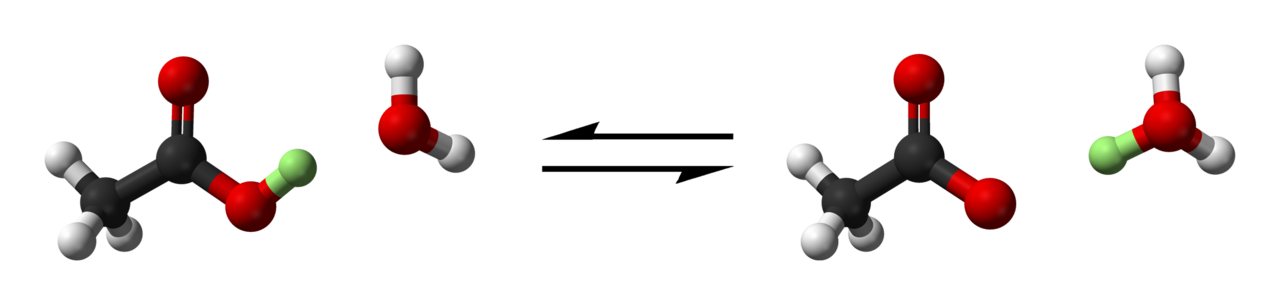
This is wider in two useful ways. It requires no solvent, so it applies to reactions in ammonia or in the gas phase. And it makes acid and base a relationship rather than a fixed property: every acid has a conjugate base, the species left after it loses its proton, and water can act as either depending on what it meets.
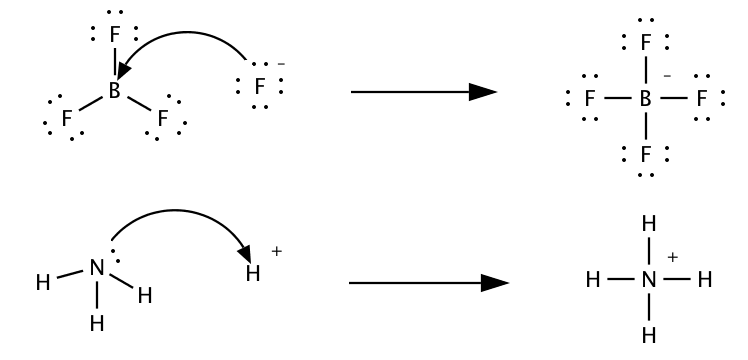
The Lewis definition, from Gilbert Lewis in 1923, is the widest. An acid accepts a pair of electrons and a base donates one. This covers species with no hydrogen to give, such as boron trifluoride and many metal ions, and it is the definition that matters in catalysis and in the chemistry of metal complexes.
The three are not rivals. Each contains the one before it, and chemists use whichever is appropriate to the problem.
Strength is not the same as concentration. A strong acid dissociates essentially completely in water; a weak acid establishes an equilibrium in which most molecules remain intact. Hydrochloric acid is strong, acetic acid is weak, and a dilute solution of a strong acid can be less acidic than a concentrated solution of a weak one.
The pH scale expresses hydrogen ion concentration logarithmically, so each unit is a factor of ten. Seven is neutral at room temperature, lower is acidic, higher is basic. Because the scale is logarithmic, a change from pH 5 to pH 3 is a hundredfold increase in acidity, which is why small-sounding pH shifts in ocean chemistry or in blood are consequential.
A buffer is a mixture of a weak acid and its conjugate base, and it resists change in pH because whichever is added is consumed by one of the pair. Blood is buffered by the carbonic acid and bicarbonate system, and human arterial pH is held between about 7.35 and 7.45. Departure of a few tenths in either direction is a medical emergency.
Digestion. Stomach acid is roughly pH 1 to 2, strong enough to denature proteins and to kill most swallowed microorganisms, and the stomach lining is protected by a mucus layer rather than by any resistance of the tissue itself.
Industry. Sulfuric acid is produced in greater quantity than any other manufactured chemical, and its consumption has been used as a rough index of a country's industrial activity. Ammonia, a base, is the basis of nitrogen fertiliser.
The environment. Acid rain, produced when sulfur and nitrogen oxides dissolve in atmospheric water, damaged forests and lakes across industrialised regions until emissions controls reduced it, and the recovery of affected lakes is one of the clearer environmental policy successes. Ocean acidification, treated in its own capsule, is the same chemistry applied to dissolved carbon dioxide.
Everyday life. Soap is made by treating fats with a strong base, baking powder works by an acid and a carbonate reacting to release carbon dioxide, and descaling agents are weak acids that dissolve carbonate deposits.
Acid and base behaviour is the most widely applicable organising idea in chemistry after bonding itself, because proton transfer is the commonest reaction there is. It also demonstrates something about scientific definitions: the three accounts here were not corrections of error but successive widenings, each keeping everything the previous one explained and adding cases it could not reach.