The account of chemical reaction rates that treats a reaction as passing through a specific high-energy configuration, the transition state, and calculates the rate from the population of molecules in that configuration. It converts reaction kinetics from an empirical fitting exercise into thermodynamics.
Reactions have rates that vary over an enormous range and depend steeply on temperature. Svante Arrhenius established in 1889 that rate constants generally follow an exponential dependence on the reciprocal of temperature, with an activation energy in the exponent and a pre-exponential factor in front.
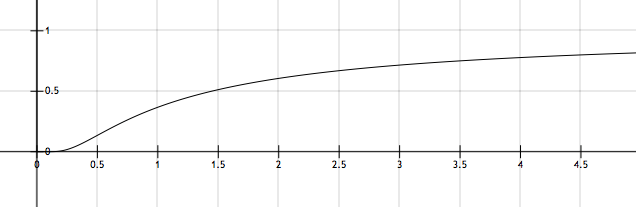
The Arrhenius relation is descriptive. It says nothing about what the activation energy corresponds to physically, and nothing about what determines the pre-exponential factor, which varies by many orders of magnitude between reactions.
Henry Eyring, and independently Meredith Evans with Michael Polanyi, proposed in 1935 that the rate could be obtained from the properties of a particular molecular configuration.
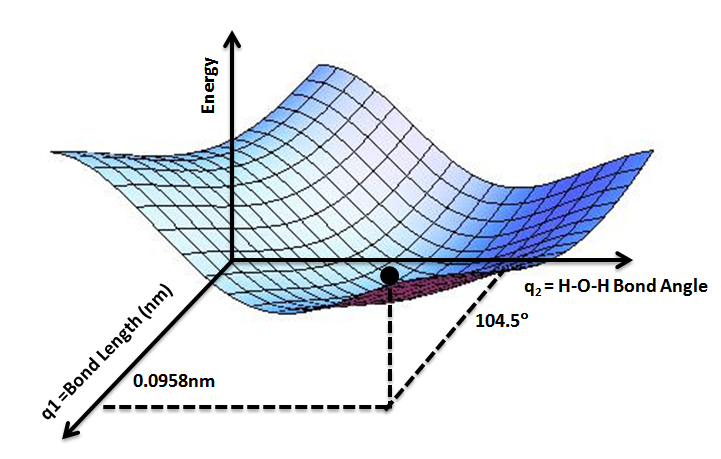
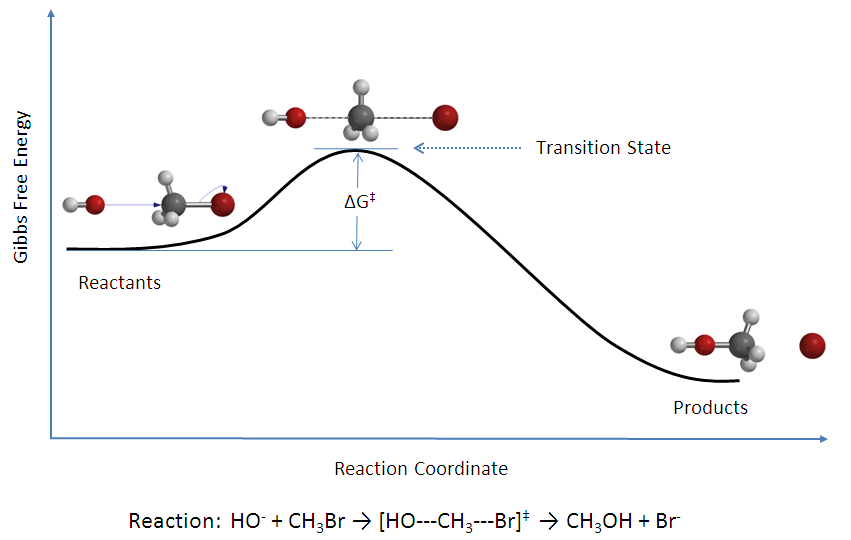
The energy of a molecular system is a function of all its internal coordinates, defining a potential energy surface. Reactants sit in one valley and products in another, and the lowest-energy route between them passes over a saddle point. The configuration at the saddle is the transition state, sometimes called the activated complex.
The theory makes three assumptions and derives the rate from them. The transition state is in quasi-equilibrium with the reactants, so its concentration can be calculated by statistical mechanics. Motion through the transition state along the reaction coordinate is treated as a simple translation. And any system reaching the transition state proceeds to products without turning back.
The result is the Eyring equation, in which the rate constant is a universal frequency factor, equal to the thermal energy divided by Planck's constant, multiplied by an equilibrium constant for forming the transition state.
The payoff is that the equilibrium constant can be split into an enthalpy and an entropy of activation. The activation enthalpy corresponds roughly to the Arrhenius activation energy, and the activation entropy explains the pre-exponential factor that Arrhenius could only fit. A reaction requiring two molecules to meet in a specific relative orientation has a large negative activation entropy and is slow for that reason alone, independently of its barrier height. This is why an intramolecular reaction commonly runs far faster than the equivalent reaction between two separate molecules.
Activation parameters extracted from rate measurements distinguish mechanisms. A strongly negative activation entropy indicates an ordered transition state with molecules combining, and a positive one indicates a transition state looser than the reactants, as when a bond breaks with nothing else required. This is routine mechanistic evidence.
Kinetic isotope effects are the sharpest test. Replacing hydrogen with deuterium changes the zero point vibrational energy of the bond to it, and if that bond is being broken at the transition state the rate changes by a predictable factor of about six to eight at room temperature. Observing the effect localises bond breaking in the mechanism, and the size predicted by the theory is the size observed for many reactions.
The theory also gives enzyme catalysis its modern explanation. Linus Pauling argued in 1948 that an enzyme works by binding the transition state more tightly than the substrate, which lowers the barrier without changing the equilibrium. The prediction that follows is that stable molecules resembling the transition state should be powerful inhibitors, and transition state analogues are indeed among the tightest binding inhibitors known, several of which are drugs.
The no-recrossing assumption is the weakest. Trajectories can cross the saddle and return, particularly in solution where solvent molecules exert forces throughout, so the theory gives an upper bound on the rate and a transmission coefficient below one is introduced to account for the difference.
Quantum tunnelling is a real and substantial correction. The theory treats the system as passing over the barrier, and light particles can pass through it. Hydrogen transfer reactions at low temperature can run orders of magnitude faster than the theory allows, and can show kinetic isotope effects far larger than the classical prediction, which is the standard evidence that tunnelling is occurring. Enzymatic hydrogen transfers frequently show this.
Not every reaction has a barrier at all. Radical recombination and many ion reactions in the gas phase are barrierless, and their rates are set by how fast the reactants can approach each other, so the theory does not apply and capture models are used instead.
Variational transition state theory addresses the recrossing problem by locating the dividing surface where the calculated rate is minimised rather than at the saddle point, and it substantially improves accuracy. Modern practice combines this with tunnelling corrections.
Transition state theory made reaction rates calculable from molecular structure, which is why computational chemistry can predict whether a proposed synthetic step will work. It also supplied the conceptual object that most of chemistry now reasons with: the transition state is not observable directly, since it exists for the duration of a bond vibration, yet it is what synthetic design, enzyme mechanism and catalyst development are all organised around.