The outer layer of the cerebrum, a sheet of neurons a few millimetres thick folded to fit inside the skull. It performs the processing associated with perception, movement, language and thought, and its expansion is the most conspicuous feature of the human brain.
The cortex is a sheet roughly two to four millimetres thick. Unfolded, a human cortex would cover an area of around two thousand square centimetres.
Folding is what allows that area inside a skull. The ridges are gyri and the grooves sulci, and the pattern is broadly consistent between individuals, which allows regions to be named and compared.
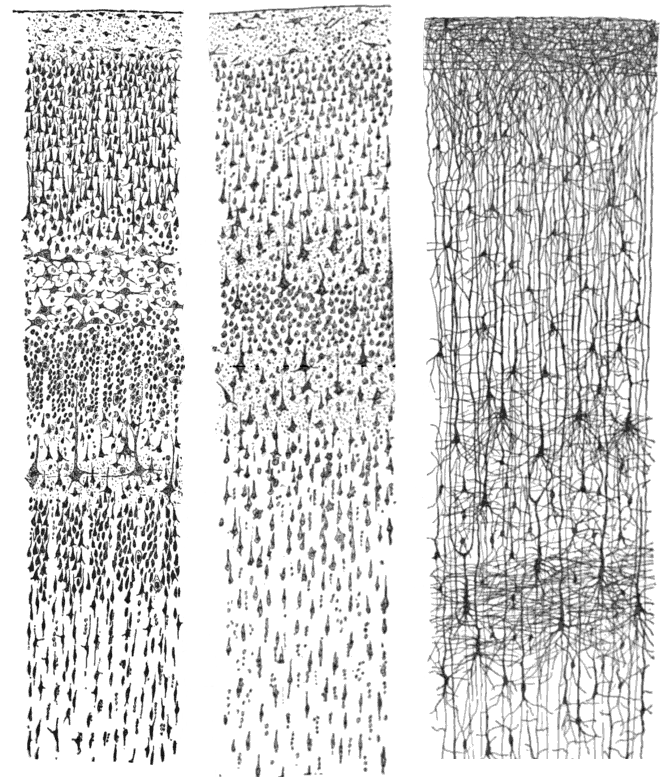
It is organised in six layers, distinguishable by cell type and density. Different layers have characteristic connections: some receive input from elsewhere, some send output to distant structures, and some connect locally.
The cortex is also organised into columns running through the layers, in which neurons respond to similar features, and this columnar organisation was described in the visual cortex by David Hubel and Torsten Wiesel, work that earned the 1981 Nobel Prize.
Korbinian Brodmann divided the cortex into numbered areas in 1909 on the basis of cellular structure alone, and the numbering remains in use because his structural divisions turned out to correspond closely to functional ones.
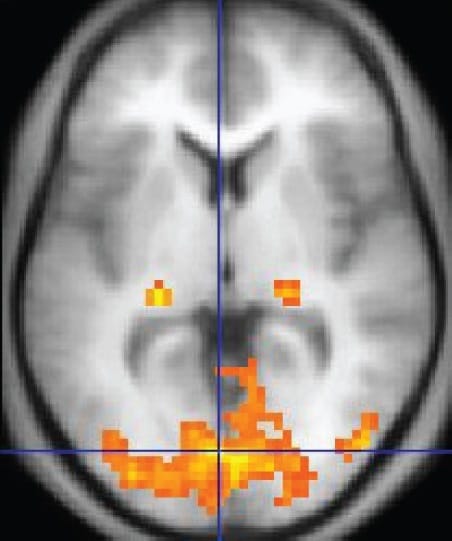
The occipital lobe at the back handles vision. Processing proceeds through stages, with early areas responding to edges and orientation and later areas to complex forms.
The temporal lobes handle hearing, object recognition and, in the left hemisphere in most people, aspects of language. They also contain the hippocampus beneath, which is not cortex in the same sense and is essential to memory as the human memory capsule describes.
The parietal lobes handle touch, spatial awareness and the integration of senses. Damage on the right frequently produces neglect of the opposite side of space.
The frontal lobes handle movement, planning, inhibition and aspects of personality and social behaviour. The prefrontal region is proportionally larger in humans than in other primates, though by how much is disputed.
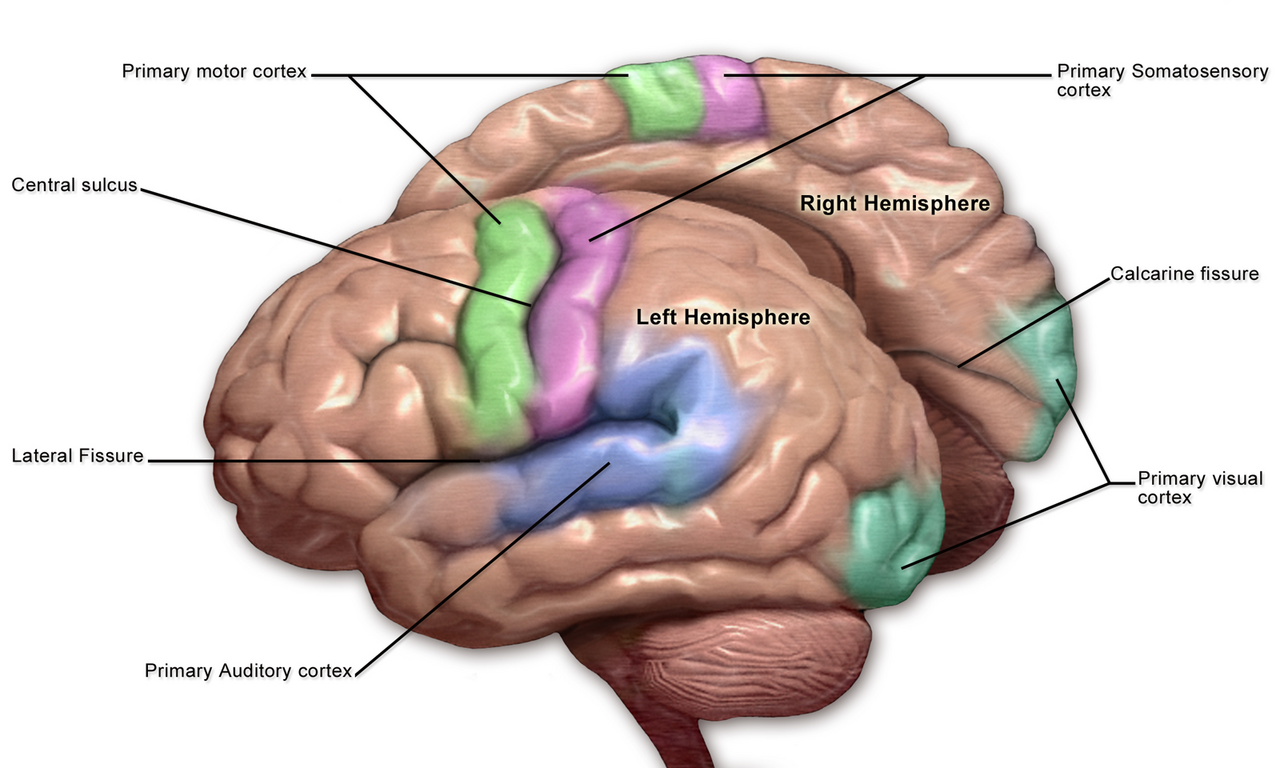
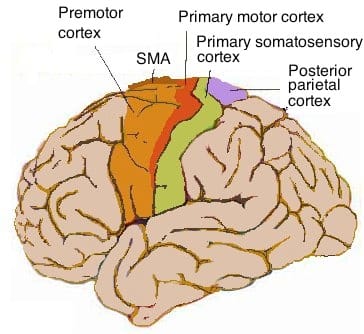
Primary sensory and motor areas occupy a minority of the total. The remainder is association cortex, which integrates across modalities and performs the processing that has no single sensory or motor description.
The body is mapped onto the cortex in an orderly way, with adjacent body parts represented in adjacent cortical territory, in both the motor and somatosensory strips.
The map is proportioned by innervation density rather than by size. The hands, lips and tongue occupy far more cortical area than the trunk or legs, which is why they are more sensitive and more finely controlled.
Wilder Penfield produced these maps in the 1930s and 1940s by stimulating the cortex of conscious patients during surgery for epilepsy, and asking what they felt. The resulting distorted figure is the homunculus.
Similar orderly maps exist for vision, where adjacent points in the visual field are represented in adjacent cortex, and for hearing, where the map is by frequency.
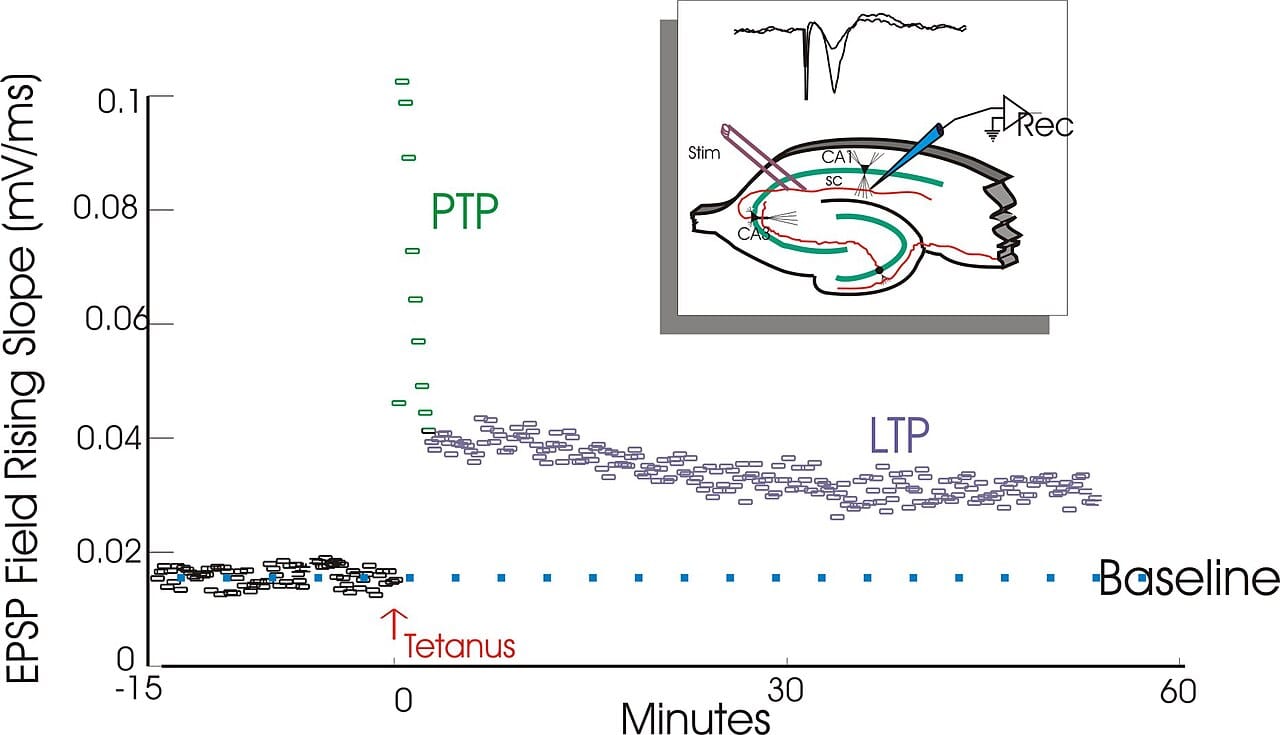
Cortical maps are not fixed. They reorganise with experience, injury and training.
Musicians show enlarged cortical representation of the fingers used in playing. People who lose a limb show reorganisation of the corresponding territory, which is associated with phantom limb sensations. Blindness leads to visual cortex being recruited for other functions including tactile reading.
Plasticity is greater in development and continues throughout life, and it is the mechanism underlying recovery after stroke. The neuroplasticity capsule treats the evidence and the frequent overstatement of it.
Whether the human cortex differs from other primates qualitatively or only in scale is argued. It is larger relative to body size and has more neurons, and claims about uniquely human cortical features have generally weakened as comparative data has improved.
How strictly regions are specialised is also disputed. Strong localisation, in which a region performs one function, is contradicted by evidence that most regions participate in many tasks, and network accounts have largely displaced strict modularity. The brain imaging capsule describes why the imaging evidence is frequently over-read on this point.
The cortex is where the processing underlying perception, language, planning and deliberate action occurs, and damage to specific parts of it produces the specific deficits from which its organisation was originally inferred.
Its layered and columnar architecture is also remarkably uniform across regions performing very different functions, which has prompted the influential suggestion that the cortex runs something like a single general algorithm on different inputs. That idea remains a hypothesis and has been productive well beyond neuroscience.