The proposal that awareness of a negative stereotype about one's group can impair performance on a task the stereotype concerns. The original demonstration is among the most cited findings in social psychology, and its size and robustness have been seriously questioned.

Claude Steele and Joshua Aronson reported in 1995 that Black university students performed worse on a difficult verbal test when it was described as diagnostic of intellectual ability than when the same test was described as a laboratory problem-solving exercise. White students were unaffected by the description.
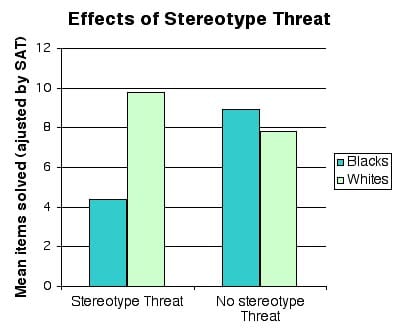
One detail is important and is frequently dropped in retellings. The analysis adjusted for participants' prior standardised test scores, so the finding concerns performance relative to what each student's earlier scores predicted, not raw group differences.
The proposed mechanism was that the fear of confirming a stereotype consumes working memory and increases monitoring, both of which impair performance on demanding tasks.
The idea was quickly extended, most prominently to women and mathematics, and to a wide range of other groups and domains.
The appeal was that it located an important effect in the situation rather than in the person, which meant it could be removed by changing the situation.
That generated a large applied literature on interventions, including changing how tests are described, values affirmation exercises, and altering the demographic composition of testing environments.
It also offered an account of achievement gaps that did not require appeal to either fixed group differences or purely structural explanation, and that position made it attractive across a wide audience.
The literature has not held up as well as its citation count suggests.
Meta-analyses have found strong evidence of publication bias. A 2015 analysis of the effect in girls and mathematics found that once small-study effects were accounted for, the adjusted estimate was close to zero, and that the published record was heavily skewed toward positive results.
Several large pre-registered replications have failed to find the effect or have found it much smaller than the original. Attempts that fixed the analysis plan in advance, used larger samples, and did not select for significant outcomes have repeatedly produced null or negligible results.
The applied interventions have had a mixed record. Some values affirmation studies have replicated and some large-scale attempts have found little effect, and effect sizes in real classrooms are generally far smaller than early studies implied.
Two qualifications should be stated fairly. Null results in this area are not uniform, and some laboratory conditions do reproduce the effect. And the failure of a specific manipulation to shift test scores is not evidence that stereotypes have no effect on people, which is a much broader claim resting on a much wider body of evidence.
The disagreement is best stated as a set of narrower questions rather than a single yes or no.
Whether the effect exists under some conditions is not seriously disputed by most researchers. Whether it is large enough to matter outside a laboratory is disputed.
Whether it explains any appreciable share of real achievement gaps is disputed, and the estimates that have been offered are much smaller than the framing of the early literature suggested.
Whether the interventions built on it work reliably at scale is disputed, and this is where the practical stakes are, since these programmes have been widely adopted.
Stereotype threat is one of the clearest cases of a finding whose social importance outran its evidence base. It was adopted into policy, teacher training and public argument on the strength of a literature that later analysis showed to be distorted by selective publication.
It is also a case where the correction is easily misused in both directions. The honest position is that a specific laboratory effect is much weaker and less general than was claimed, and that this says nothing about whether stereotypes affect people's lives through other routes, which is a different question studied by different methods.